






































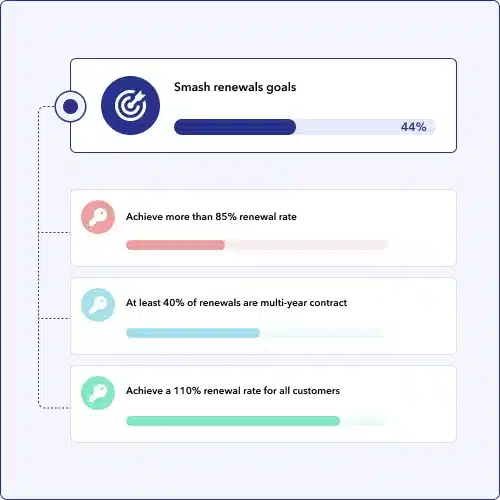
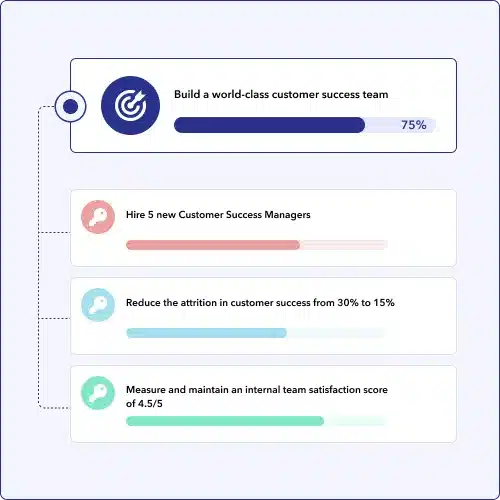
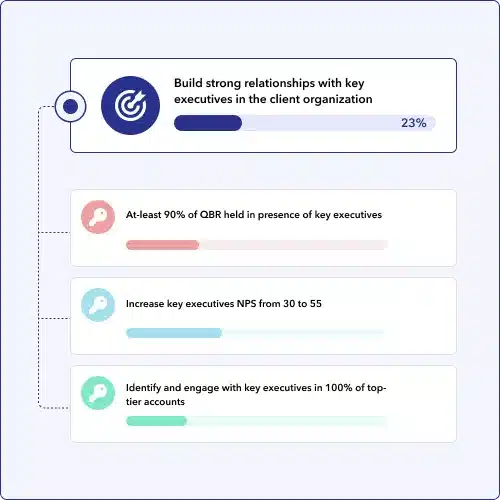
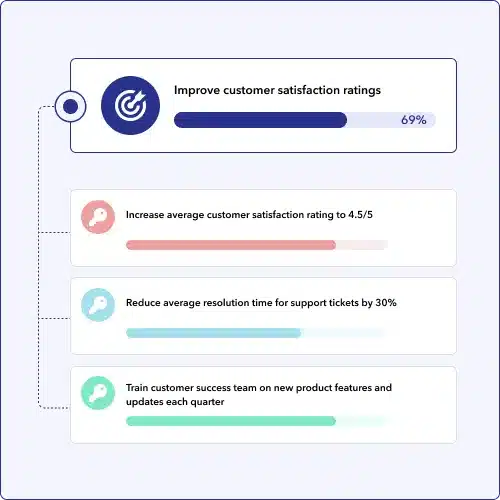
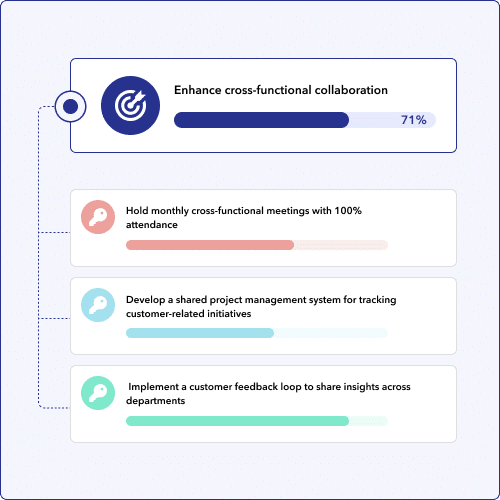

OKRs have emerged as an effective process management methodology. OKR framework provides agility, focus, and team engagement. It has been successful enough for companies like Google and LinkedIn to adopt it. Most of the companies are still debating on the fact “Why use OKRs”?
Is it a viable option for startups and remote teams? Can organizations use the OKR methodology to achieve Hyper-growth?
Depending on the size of the company, the OKR framework could be applied. Organizations have faced challenges with getting the same output from remote employees, startups often fail because they get distracted, and achieving hyper-growth is never a mean task. OKRs can help overcome these challenges.
Intel had introduced the OKR framework in 1970 when they were moving into developing microprocessors as they needed extra focus on the set of priorities in order to succeed.
[elementor-template id=”12933″]
Why use OKRs for Remote Teams?
The pandemic had forced companies to design an alternative methodology to work. As the employees couldn’t come to the office, the offices were taken to people’s homes. But this wasn’t easy.
Processes, targets, and workflows were disrupted. Management frameworks needed to be redesigned. OKR has emerged as a bridge aligning employees to company objectives, enabling communication, and building a clear vision.
1 OKRs Eliminate Guesswork
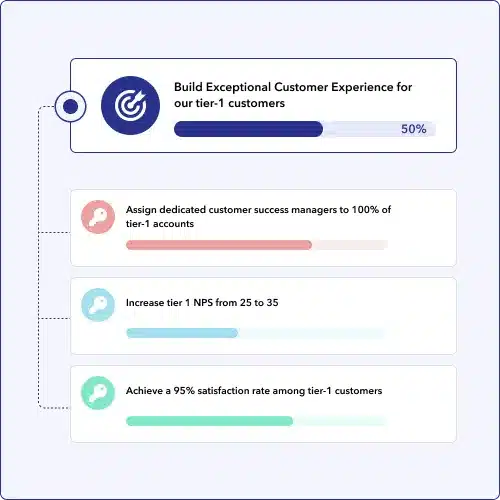
OKR methodology works on defining clear and measurable objectives along with 3 to 4 key results. These key results are also measurable. So the entire framework gives clarity on what the company wants to achieve.
“If you tell everybody to go to the center of Europe, and some start marching off to France, and some to Germany, and some to Italy, that’s no good—not if you want them all going to Switzerland,” former Intel-alum Jim Lally once explained to John Doerr. “If the vectors point in different directions, they add up to zero.”
[elementor-template id=”12871″]
An example of OKR could be:
Objective: Increase subscriptions by 1000 per month
Key Result 1: Reach 100,000 visitors a month through technical and non-technical SEO
Key Result 2: Based on Site Traffic, improve funnel to achieve 1000 per month subscriptions
Key Result 3: Build infrastructure to accommodate 1000 subscriptions per month
The framework is done to design objectives and build measurable key results that would build up to achieve the desired objective. In the example stated above, the SEO team, marketing funnel team, and production team are all aligned.

OKR framework also allows for the same OKRs to be shared with a different team, as is evident from the example. Different teams can work towards the same objective, each with a clear understanding of the result they need to achieve.
Good OKR software would also allow team members to communicate easily to get inputs from members of the other team.
This allows remote workers to stay connected as a team and work towards a common objective. Even though employees are not working in an office, they don’t have any ambiguity about their role in achieving the key result.
2 Result Oriented
As seen in the example above, Key Results are clearly defined, so the teams are more result-oriented. Now teams can define their own set of OKRs based on the key result they have to achieve.
From the example above, the SEO team knows that they have to reach 100,000 visitors a month. So setting that as their objective, they could define their key results.
This can further be divided between different individuals. So each member is clear about what they have to do to achieve a common goal. This is the cascading effect that the OKRs framework facilitates.
“The remote teams to “replace the flawed ‘hours at work’ model of productivity measurement with result-oriented performance analytics based goals.”
–The Public Productivity and Performance Handbook , Andrew Ballard
With key results being clear and measurable, from top-to-bottom, it becomes easier to measure progress. Individuals and team managers can easily check where they are in achieving the objective.
Even if there is a deviation or if a key result seems to be unachievable, then instead of waiting for months or weeks, in the OKR framework team members can discuss it frequently. OKR methodology is built to have regular check-ins.
They can be set weekly, monthly or quarterly, or they can be set in a cascading manner with weekly OKRs building to monthly OKRs and monthly OKRs building to quarterly OKRs.
Cascading OKRs also help employees to prioritize. Working in isolation, in remote locations it gets difficult for an employee to maintain focus. It has been found that working from home can have more distractions than working from the office.
[elementor-template id=”12880″]
Also, at the office, with everyone working towards the same objective, it is easier to stay motivated. OKRs help employees prioritize the tasks, depending on the objective they have to achieve.
As they can track their progress on a particular objective and with other team members updating on the same platform, it is easier to get the focus back.
Atlassian’s Engineering Manager Brett Huff says the best way to motivate remote employees is to give them all the information they need for them to reach their own decisions about how to best spend their time. Huff says, “If you can get people intrinsically motivated, you don’t have to worry much about accountability.”
3 Frequent Reviews & Ease of Communication
OKR framework is designed for frequent check-ins. That is, the methodology would work properly only when teams discuss regularly. This makes OKRs agile. Even remote workers can benefit from regular check-ins. With measurable key results, employees would be able to realize problems faster. Easy modes of communication facilitated by OKR software allow discussing problems that are keeping from reaching the objective.
On a recent episode of the Recode Decode podcast, investor and author Tim Ferriss said, “I’ve made a lot of good fast decisions, but no good rush decisions.”
Frequent meetings and clear communication would also remove any room for rushed decisions. Clarity of goal and a clear understanding of what it would take to achieve those goals would allow for fast decisions.
Even though employees are working remotely, they can be part of the company’s momentum. Each person is aware of the progress the team is collectively making. With their OKRs defined and tied towards team OKRs, they are also able to see how their contribution is helping the team achieve their goal.
For example, if Slack is integrated with OKR software, then as the team updates Slack with the progress they make in their tasks, Slack would update OKR. This would allow managers and team members to know where they stand on achieving key results building momentum.
Can Startups benefit from OKRs?
In a report by SmallBizTrends.com, only 56% of the startups can continue business in their fourth year. The startups fail when they focus too much on viable products, fail to validate the idea, lack team alignment, and no scaling up.
Jim Rohn has said, “Discipline is the bridge between goals and accomplishments.”
The OKR framework helps the founders stay focused and prioritize ideas. Even if the team is getting distracted, the key results will highlight it. OKRs are set for regular check-ins and for a shorter period. So if the team is getting distracted or if they are stretching the deadline, the OKR methodology would allow startups to correct it in time.
In a nutshell, the OKRs framework helps the startups to transition to agile defined output encompassing features like roadmaps that can yield noticeable business outcomes. It can also be a learning experience for the team to understand their key customer and their preferences and comply with the decision-making of the top management.
[elementor-template id=”12868″]
1 OKR Framework Help Validate Idea
Objective: Validate Idea
Key Result 1: Build landing page.
Key Result 2: Generate 1000 followers on social media channels.
Key Result 3: Publish video explaining ideas with the problem it solves.
Idea validation is important before the founders devote resources towards building a business.
The OKR example clearly states what key results should the founders reach to make sure the idea would be profitable. This is just an example, depending on the product or service that the startup is planning to launch; they can set their own ‘Key Results’.
OKRs help the founders to envision a clear and measurable goal. The key results also help in tracking progress. An OKR framework would also allow setting deadlines by when these results should be achieved to consider the objective completed.

2 How OKRs Help with Minimum Viable Product (MVP)?
Startups are always flowing with high energy and ideas. That is good, it helps be innovative and driven. But it often leads to too much ideation. An MVP is just the basic version of the product. But as ideas keep pouring in, that product keeps getting modified, which leads to delay in release. OKRs help avoid that!
In Lean Analytics, Croll and Yoskovitz explain that some metrics must be addressed before others, and suggest focusing on one metric, depending on the stage of your startup.
The OKR framework can help prioritize. As stated earlier, OKRs can help in setting a clear objective and then setting up key results that should be completed within a time frame to achieve that objective. The key result would allow the developers to focus on the most impeding features of the products.
As ideas pour in, those could be added as a secondary objective, so that the team doesn’t lose focus in releasing the beta version.
3 OKRs Should be Customer & Team Focused
All individual efforts should be focused on achieving the team goal. As stated earlier, that helps every person in the startup stay focused. Every effort that the team makes should be customer-oriented.
Cascading OKRs help individuals stay focused on team objectives. And the clarity and progress that OKRs provide allow teams to focus on customers.
Setting up OKRs handbook allows visualizing what the result would look like. This assures whether the objective that the team is planning is customer-oriented or not.
Similarly, when individuals set OKRs, they have a clear picture of whether they would be aligned to the team’s objective.
How does OKR Build Hyper-Growth?
Hypergrowth is when companies grow steadily but steeply. Hypergrowth is a process in which the company’s compound annual growth rate is 40% or higher.
“[Hypergrowth] prioritizes speed over efficiency in an environment of uncertainty and allows a company to go from ‘startup’ to ‘scaleup’ at a furious pace that captures the market.” – Reid Hoffman & Chris Yeh, Blitzscaling: The Lightning-Fast Path to Building Massively Valuable Companies
Hypergrowth has three stages –
- The first stage is when the company finds the product fit that would solve the problem that their customers have;
- The second stage is about building processes to efficiently deliver the product and to increase as and when required;
- The third stage is hyper-growth, that is, where to match growth, innovations, and team capabilities are stretched to maintain growth.
And if your teams can repeat the process, then there is no looking back.
This won’t happen if there isn’t a management process that has proven successful and can be scaled as and when needed. That’s where OKRs come in!
1 Focused Teams
Cascading OKRs allows individuals to align their tasks to achieve the company goal. This gives individuals the base to build a process that would lead to success.
When individuals can build personal processes that are aligned to achieve the team goal, then the teams are better prepared to scale those processes to achieve growth. This helps the organization to scale as per requirement.

The OKR methodology emphasizes setting up ‘Stretch’ goals. It’s not just to organize the day-to-day business. Stretch objectives might not always be achievable.
OKRs are set in a way that the objectives are 70% to 80% achievable. This helps teams and individuals in testing their potential and being innovative. Being able to stay on the toes and innovative prepares the team to scale up when needed.
2 Increased Productivity
The OKR framework is designed to be measurable. Key results are always defined clearly so that the teams can measure progress.
Cascading and measurable objectives and key results help individuals and teams to mark progress. When individuals have a clear idea about their progress, then they can define the best possible to achieve the key result. This increases efficiency leading to increased productivity.
As stated by Reid Hoffman and Chris Yeh, hyper-growth prioritizes speed, with increased productivity, speed would increase. And with the cascading effect, the bottom-to-top efficiency would build into a faster organization.
As objectives are aligned from top-to-bottom, efficiency and productivity would align from bottom to top.
3 Maintain Growth Rate
OKRs help analyzes what works and what does not. With frequent check-ins, problems are identified earlier and solutions designed. Not just stretch goals, but when problems are identified and discussed, innovative solutions are designed.
This helps in locking a successful process. The OKR framework does not limit the size of the team. It can be applied to a small team or a big team. The process design would be the same, the levels would increase.
When the management process is scalable, productivity can also be scaled without compromising on time
[elementor-template id=”12864″]
A good OKR implementation strategy includes testing the process on an individual, then a team, and then the entire organization. This mimics the implementation of the organization as it grows from a group of 50 people to a team of 100 or 1000s.
“We had grown to the low eight digits in revenue, and we’ve got a lot of teams dependent on one another to succeed — no one person knows everything going on inside the organization anymore,” Angus Davis, CEO Swipely says. “The right way to look at OKRs is a way to communicate so there’s clarity of purpose.”
Conclusion
OKRs methodology is not for setting up tasks or employee assessment. OKRs help in breaking down company objectives into smaller chunks, objectives that can be set for teams and individuals.
The key results help in tracking whether the team and individuals are progressing to achieve the objective. Remote teams can use OKR to align team members working from different locations and maintain the momentum of working in the office
Apart from other benefits of OKR, startups can utilize the framework from inception. OKR methodology helps in keeping the team focused and prioritizing ideas and tasks. Achieving hyper-growth is not just a state, it is a continuous process, and without a proper management process that can be scalable, it is not possible to maintain it, and the OKR framework can be used to achieve it.