Employee performance reviews are more than just a routine HR exercise – they’re a powerful tool to tap into the full potential of your workforce and drive organizational success. Whether you’re an experienced manager or stepping into a leadership role for the first time, mastering the art of performance reviews can significantly enhance your team’s productivity, engagement, and overall growth.
In this blog post, we’ll guide you through everything you need to know about employee performance reviews—from A to Z. You’ll discover how to conduct impactful reviews that inspire and motivate your team, and learn how performance management software can streamline the process, making it more efficient and effective.
Key Takeaways
Effective employee performance reviews are essential for organizational success and employee development. They offer a structured framework to evaluate, recognize, and develop your workforce, boosting productivity and engagement.
Various types of performance reviews exist, such as individual vs 360-degree, annual vs quarterly vs continuous, and goal-oriented vs project-based vs probationary.
Preparing for and conducting effective employee performance reviews involves several best practices, such as:
Setting clear objectives and expectations
Gathering relevant data and feedback
Creating clear and ambitious goals aligned with organizational objectives
Providing constructive, specific and timely feedback
Utilizing performance metrics to measure progress objectively
What is an Employee Performance Review?
An еmployее performance rеviеw is a systematic process that еvaluatеs an individual’s work-rеlatеd accomplishmеnts and bеhaviors. It goes beyond thе supеrficial assеssmеnt, aiming to providе constructivе fееdback, rеcognizе achiеvеmеnts, and еstablish a roadmap for continuous improvеmеnt.
What are the Different Types of Employee Performance Reviews?
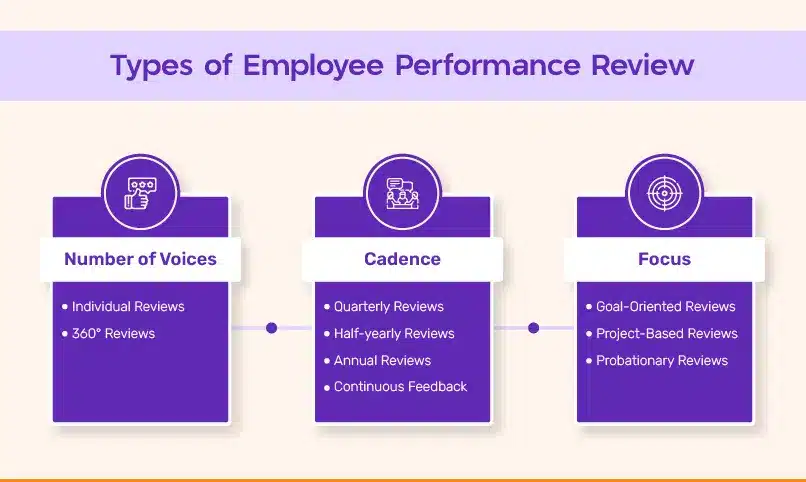
Employee performance reviews come in diverse forms based on the number of voices, the cadence of assessments, and the specific focus of the evaluation.
Types of Employee Performance Reviews Based on the Number of Voices
Individual Reviews: This is the traditional one-on-one evaluation between an employee and their supervisor, providing a personalized assessment of performance.
360-Degree Reviews: This comprehensive approach gathers feedback from multiple sources, including peers, supervisors, subordinates, and the employees themselves, offering a well-rounded view of an employee’s performance.
Types of Employee Performance Reviews Based on the Cadence
Annual Reviews: Conducted once a year, these reviews provide an in-depth analysis of performance over the previous 12 months, capturing long-term trends.
Quarterly and Half-Yearly Reviews: These assessments occur more frequently than annual performance reviews, allowing for timely feedback and adjustments to performance.
Continuous Feedback: This approach involves ongoing evaluations and performance discussions on a weekly or fortnightly basis, fostering a culture of regular feedback and immediate improvements.
Types of Employee Performance Reviews Based on Focus
Goal-Oriented Reviews: These reviews assess an employee’s performance based on specific career goals and objectives, linking individual efforts to organizational targets.
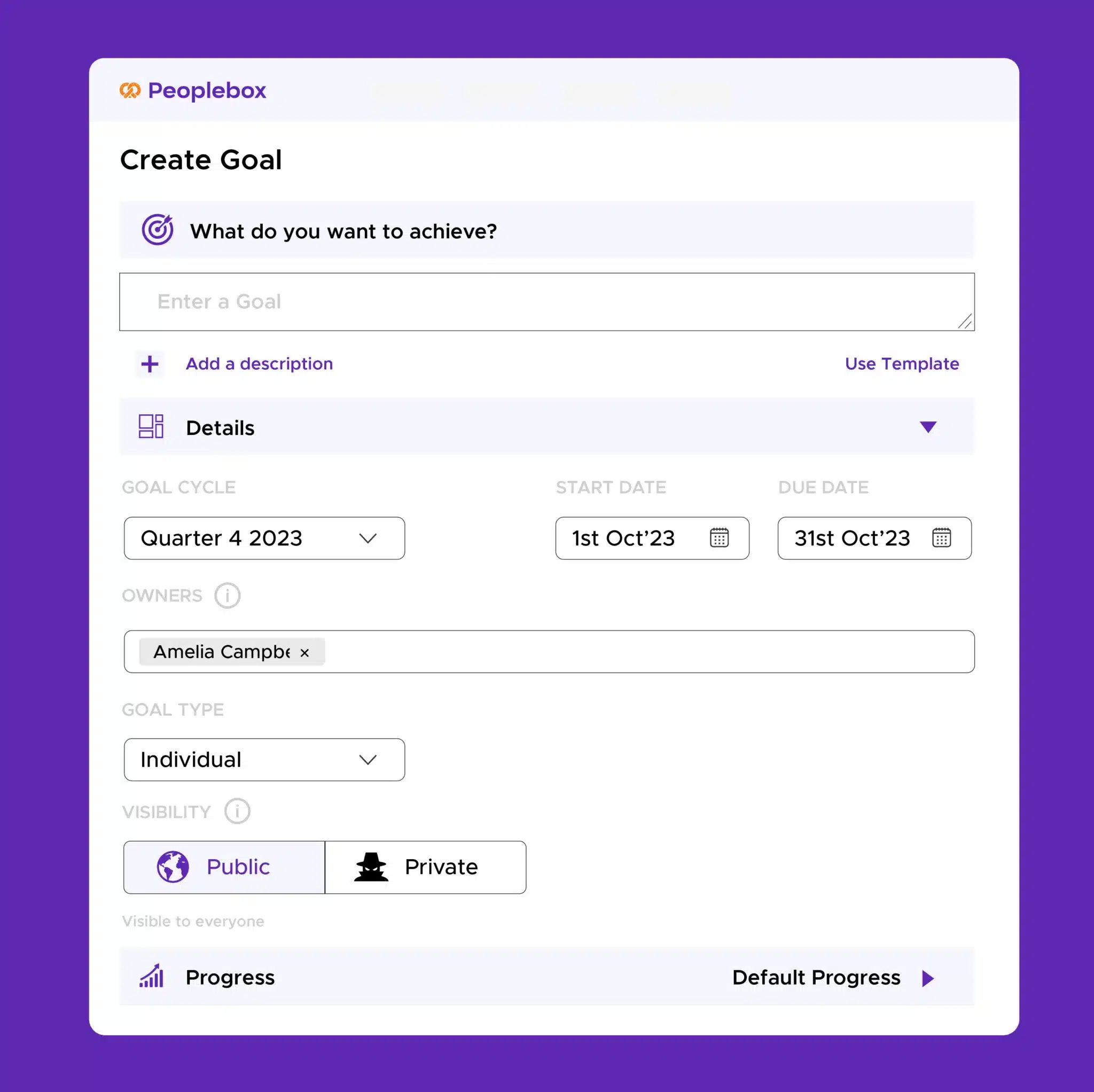
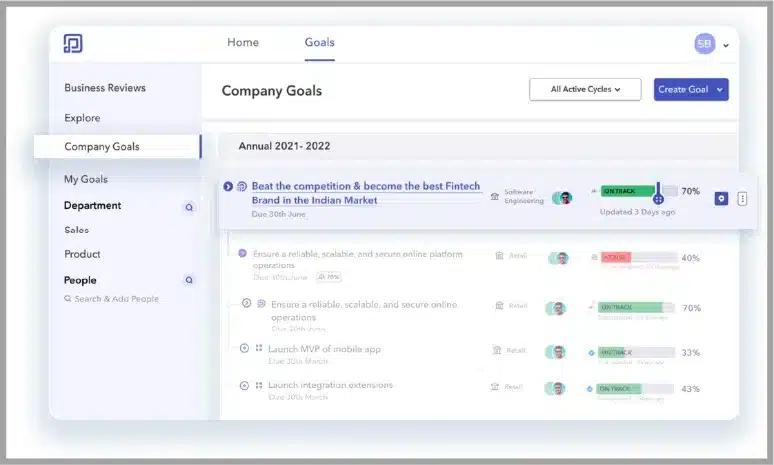
With performance review software like Peoplebox.ai, you can set goals in seconds.
Project-Based Reviews: Focused on contributions to specific projects, these evaluations provide insights into performance within particular contexts.
Probationary Reviews: Conducted during an employee’s probationary period, these reviews help determine suitability for continued employment and set early performance expectations.
Understanding the different types of performance reviews empowers organizations to tailor their approach, ensuring that the evaluation process aligns seamlessly with their goals and the unique dynamics of their workforce.
Who Conducts Employee Performance Review?
Employee performance reviews are typically conducted by a combination of key organizational stakeholders. The individuals involved in conducting performance reviews play distinct roles, each contributing to a comprehensive assessment of an employee’s contributions and development.
Here are the primary parties who commonly conduct employee performance reviews:
Supervisors and Managers: They serve as the main evaluators, possessing direct knowledge of the employee’s daily performance.
HR Professionals: These individuals facilitate the review process, ensuring it is well-structured and fair.
Peers: They participate in a 360-degree feedback system, providing valuable insights into collaboration and teamwork.
Subordinates: Occasionally, they offer upward evaluations, presenting distinct perspectives on leadership effectiveness.
Employees Themselves: They engage in self-assessments, reflecting on their achievements and setting future goals.
Executive Leadership: They establish the overall performance expectations, ensuring alignment with the organization’s objectives.
External Consultants (Occasionally): They may provide an impartial viewpoint, particularly for senior-level evaluations.
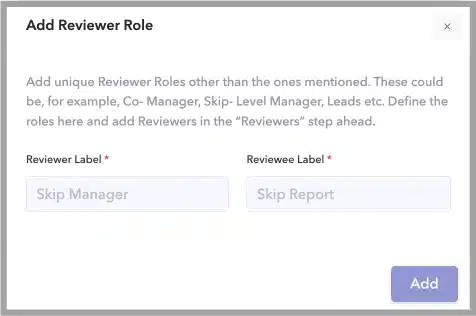
Peoplebox.ai lets you choose from the 4 primary reviewer roles and easily add customized additional roles for your organization.
What to Assess in Employee Performance Evaluation?
To ensure a comprehensive understanding of an individual’s contributions, various dimensions must be assessed. From job-specific competencies to interpersonal skills and alignment with organizational goals, the evaluation process encompasses various factors.
Here’s a quick look at the various employee evaluation factors:
Performance Dimension
Description
1. Job-Specific Competencies
Assess the employee’s proficiency in job-related skills and tasks. Evaluate technical knowledge, problem-solving abilities, and adherence to industry best practices.
2. Communication Skills
Evaluate written and verbal communication skills, including conveying ideas clearly, actively listening, and collaborating effectively with team members.
3. Teamwork and Collaboration
Examine the employee’s ability to work collaboratively, contribute to group goals, and foster a positive team environment.
4. Goal Achievement
Assess how the employee meets and exceeds established goals and targets, demonstrating a commitment to achieving individual and organizational objectives.
5. Adaptability and Flexibility
Evaluate how well the employee adapts to changing circumstances, handles ambiguity, and demonstrates flexibility in adjusting to evolving work requirements.
6. Leadership and Initiative
For those in leadership roles, assess leadership qualities, decision-making skills, and the ability to take initiative in driving projects and improvements.
7. Problem-solving and Critical Thinking
Examine the employee’s capacity to analyze problems, propose effective solutions, and demonstrate critical thinking in addressing challenges.
8. Interpersonal Skills
Evaluate how well the employee interacts with colleagues, clients, and stakeholders, considering factors such as empathy, conflict resolution, and relationship-building.
9. Time Management and Productivity
Assess the employee’s ability to manage time efficiently, prioritize tasks, and maintain high productivity.
10. Professional Development
Consider the employee’s commitment to continuous learning and professional growth, including participation in training, acquiring new skills, and staying updated on industry trends.
Here are the key performance competencies to focus on during evaluations in 2024.
What are the Benefits of Employee Performance Reviews?
Employee performance reviews are a valuable tool for both employees and organizations. When conducted effectively, they can yield numerous benefits.
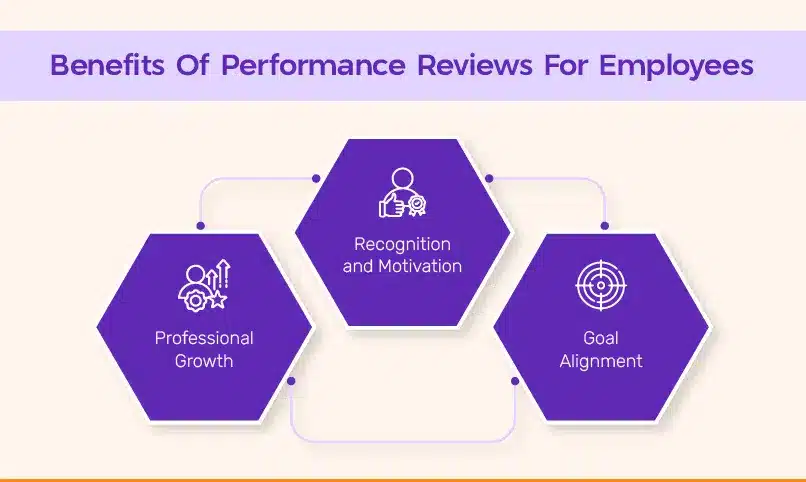
Benefits of Performance Reviews for Employees
1. Professional Growth
Performance reviews provide a structured platform for employees to receive helpful feedback, identify strengths, and pinpoint areas of improvement. This facilitates targeted professional development and enhances the employee’s career growth opportunities.
2. Recognition and Motivation
Positive feedback during performance reviews acknowledges employees’ hard work and achievements. This recognition is a motivational factor, boosting morale and reinforcing a sense of value within the organization.
3. Goal Alignment
Performance reviews align individual goals with organizational objectives. This clarity ensures that employees understand their roles in contributing to the company’s success, fostering a sense of purpose and direction.
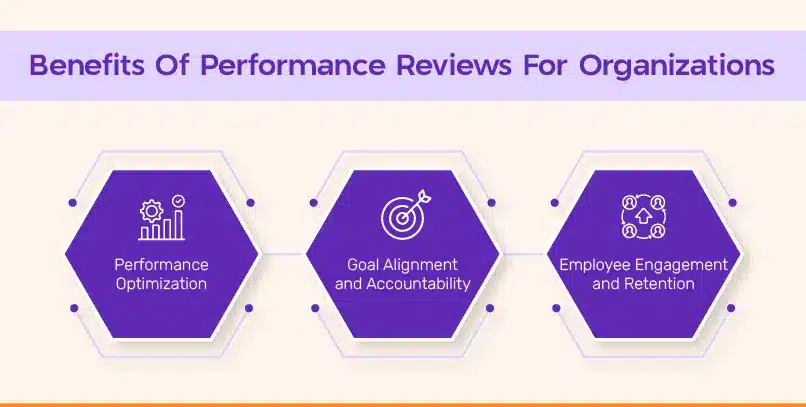
Benefits of Employee Performance Reviews for Organizations
1. Performance Optimization
Regular evaluations enable organizations to identify high performers and areas for improvement. This insight allows for strategic talent management, optimizing workforce performance, and addressing skill gaps.
2. Goal Alignment and Accountability
Performance reviews ensure employees’ efforts align with organizational goals. Organizations can enhance overall productivity and efficiency by establishing clear expectations and holding individuals accountable.
3. Employee Engagement and Retention
Constructive employee feedback and recognition foster a positive work environment, increasing employee satisfaction and engagement. This, in turn, contributes to higher retention rates, reducing recruitment costs and maintaining institutional knowledge.
How to Prepare for Employee Performance Reviews?
Now that we’ve established the significance of employee performance reviews, let’s look at how you can prepare for an effective review.
Step 1: Setting the Stage for Success
Creating an environment that fosters growth and open communication is not just a prelude to a performance review but an ongoing commitment to organizational excellence.
1.1: Schedule in Advance
Extend the courtesy of time to your employees by scheduling performance reviews well in advance. This demonstrates respect for their schedules and allows for meaningful reflection.
With performance review software like Peoplebox.ai, you can schedule regular one-on-ones with ease. Try it yourself!
1.2: Use Positive Language
Language shapes perception. Frame feedback positively, emphasizing achievements and growth opportunities rather than dwelling solely on challenges.
Make the performance review a two-way street. Actively listen to employees, acknowledging their insights and concerns, fostering a collaborative atmosphere.
1.4: Clearly Define Objectives
Articulate the purpose and objectives of the performance review clearly. This not only aligns expectations but also underscores the strategic importance of the process.
1.5: Share Evaluation Criteria
Transparency is key. Provide a detailed outline of the criteria against which employees will be evaluated. This transparency empowers employees to align their efforts with organizational goals.
Step 2: Gathering Relevant Data
The data collected before a performance review is not merely a set of numbers; it’s a narrative of an employee’s journey within the organization. Understanding the story behind the performance data is crucial for meaningful conversations.
With Peoplebox.ai, managers can easily provide goal-focused feedback, ensuring data-driven evaluations and avoiding arbitrary assessments.
Why does Collecting Data Matter?
✔️ Objective Assessment: Data provides the cornerstone for an objective evaluation, minimizing biases and ensuring fairness.
✔️ Identifying Patterns: Beyond numbers, data reveals performance patterns over time, offering a nuanced understanding of an employee’s journey.
✔️ Documenting Achievements: Data serves as a documented testament to an employee’s achievements, offering tangible evidence of their impact on the organization.
Here’s a list of data to gather for employee performance evaluations:
Checklist Item
Description
Performance Metrics
Analyze KPIs and job-related metrics during quarterly and half-yearly reviews for a focused understanding of employee contributions and areas to improve.
Feedback from Colleagues
Gather insights from colleagues during periodic assessments, fostering teamwork and providing a holistic view of collaborative skills.
Self-Assessment
Encourage active participation through regular self-assessments during quarterly and half-yearly reviews, promoting accountability and continuous improvement.
Project Highlights
Document key projects, contributions, and challenges faced to offer a comprehensive overview of an employee’s journey, enhancing motivation and purpose.
Training and Development Records
Recognize growth efforts by highlighting training sessions, certifications, and professional development activities during quarterly and half-yearly reviews, emphasizing their importance for individual and organizational success.
By infusing intention and thoughtfulness into the preparation for performance reviews, organizations not only navigate the evaluation process but also cultivate an environment where every review becomes a transformative moment in the professional journey of employees.
What Should be Included in an Employee Performance Review?
An employee performance review should include a comprehensive evaluation of the employee’s job performance, covering key areas such as achievements, strengths, areas for improvement, and progress toward previously set goals.
It should also incorporate specific examples to illustrate performance levels, feedback from peers or supervisors, and any relevant metrics or KPIs. Additionally, the review should outline future goals and development opportunities, fostering a constructive dialogue between the manager and the employee.
How to Conduct Employee Performance Review
1. Set Clear and Ambitious Goals
Goal setting is a cornerstone of effective performance management, pivotal in driving employee engagement, productivity, and overall organizational success.
Clear and ambitious goals provide a roadmap for employees, outlining expectations and fostering a sense of purpose within the workplace.
The performance review process is not just an annual formality; it’s a strategic opportunity to align individual objectives with broader organizational goals. By emphasizing the importance of goal setting, organizations can ensure that employees understand their role in contributing to the company’s success.
Tip: You can use strategy execution platforms like Peoplebox.ai to align individual objectives with organizational goals.
Objectives and Key Results (OKRs) are a powerful tool for goal setting, allowing organizations to define ambitious yet achievable targets.
When implementing OKRs in the performance review process, it’s crucial to align individual goals with the organization’s broader objectives.
1. Clarity is Key: Clearly articulate objectives to avoid ambiguity. Employees should have a precise understanding of what is expected of them.
2. Strategic Alignment: Ensure that individual goals contribute to achieving larger organizational objectives. This alignment fosters a sense of purpose and collective achievement.
3. Regular Check-ins: Establish a system of regular weekly check-ins to monitor progress and make necessary adjustments. This promotes continuous improvement and keeps goals relevant.
If you’re just diving into OKRs and feeling a bit overwhelmed, we get it! To make things easy, check out our guide, ‘The Ultimate OKR Cheat Sheet.’ It’s got all the what, why, and how covered. Give it a look!
2. What to Say in an Employee Performance Review?
Effective performance reviews involve more than just assessing achievements; they also require providing constructive feedback. The way feedback is delivered significantly impacts an employee’s motivation and career development. Here are strategies to ensure constructive feedback:
Be Specific and Timely
Provide specific, timely, and relevant feedback on the employee’s work performance. This allows for a clear understanding of expectations and areas for improvement.
The Sandwich Method
Balance constructive criticism with positive feedback. Start and end with positive remarks, sandwiching areas for improvement in between to soften the impact.
Encourage Two-way Communication
Foster an open dialogue during performance reviews. Encourage employees to share their perspectives and concerns, creating a collaborative environment.
Still wondering what to say? We know, performance reviews can be tricky, especially when you’re not sure what to say. That’s why, we curated a list of 45+ employee review examples that you can use this review season.
3. Performance Review Phrases to Avoid: What Not to Say
During performance reviews, the choice of language is crucial for fostering a positive and constructive environment.
Certain phrases, if used thoughtlessly, can hinder effective communication and demotivate employees. Steering clear of these phrases enhances the overall impact of the review process:
1. “You always/never…”
Avoid: “You always miss deadlines.”
Instead: “Occasionally, there have been challenges in meeting deadlines. Let’s discuss strategies for improvement.”
2. “This is how we’ve always done it.”
Avoid: “This is how we’ve always done things; no need for change.”
Instead: “Let’s explore innovative approaches that could enhance our processes. Your input is valuable.”
3. “You should know this already.”
Avoid: “You should know how to handle this; it’s basic.”
Instead: “Let’s review this together to ensure clarity. If there are any gaps, we can address them through additional training.”
4. “It’s not my job to teach you that.”
Avoid: “It’s not my job to teach you these basic skills.”
Instead: “I’m here to support your learning. If you’re unsure about something, let’s discuss how we can get you the resources you need.”
4. Utilizing Performance Metrics
Performance metrics add a quantitative dimension to the performance management process, offering objective insights into an employee’s contributions.
By utilizing metrics, organizations can measure progress, identify areas for improvement, and make informed decisions about promotions, training, or development opportunities.
1. Key Performance Indicators (KPIs)
Identify and measure KPIs relevant to each role. For sales, this might include conversion rates, while for customer service, it could be response time or customer experience. Interpretation involves comparing actual performance against established benchmarks.
Some metrics you can track include:
Role
Key Performance Indicator (KPI)
Description
Sales
Conversion Rate
Percentage of leads that convert into paying customers.
Average Deal Size
Average revenue generated per closed deal.
Sales Growth Rate
Percentage increase in sales over a specific period.
Customer Service
First Call Resolution Rate
Percentage of customer inquiries resolved on the first call.
Average Response Time
Average time taken to respond to customer inquiries.
Customer Satisfaction Score (CSAT)
Measure of customer satisfaction based on pulse surveys.
Marketing
Website Traffic
Total number of visitors to the website over a specific period.
Lead Generation Rate
Number of new leads generated through marketing efforts.
Return on Marketing Investment (ROMI)
Revenue generated for every dollar spent on marketing.
Manufacturing
Production Efficiency
Ratio of actual output to potential output in a given time.
Defect Rate
Percentage of products that fail quality standards.
Average Manufacturing Cycle Time
Average time taken to produce a product from start to finish.
Human Resources
Employee Turnover Rate
Percentage of employees who leave the organization over a specific period.
Employee Satisfaction Index
Measure of employee satisfaction based on surveys.
Time to Fill Positions
Average time taken to fill open job positions.
Finance
Net Profit Margin
Percentage of revenue remaining after all expenses are deducted.
Current Ratio
Measure of a company’s ability to pay short-term obligations.
Days Sales Outstanding (DSO)
Average number of days it takes to collect payment after a sale.
2. Quality and Accuracy Metrics
For roles where accuracy is crucial, track error rates and quality metrics. Interpretation involves understanding the root causes of errors and implementing corrective actions.
3. Project Timelines and Milestones
Evaluate team members involved in project management by examining their ability to meet deadlines and achieve project milestones. Interpretation involves assessing time management skills and identifying areas for improvement.
Now that we have covered how you can conduct effective performance reviews, let’s discuss the challenges you might face.
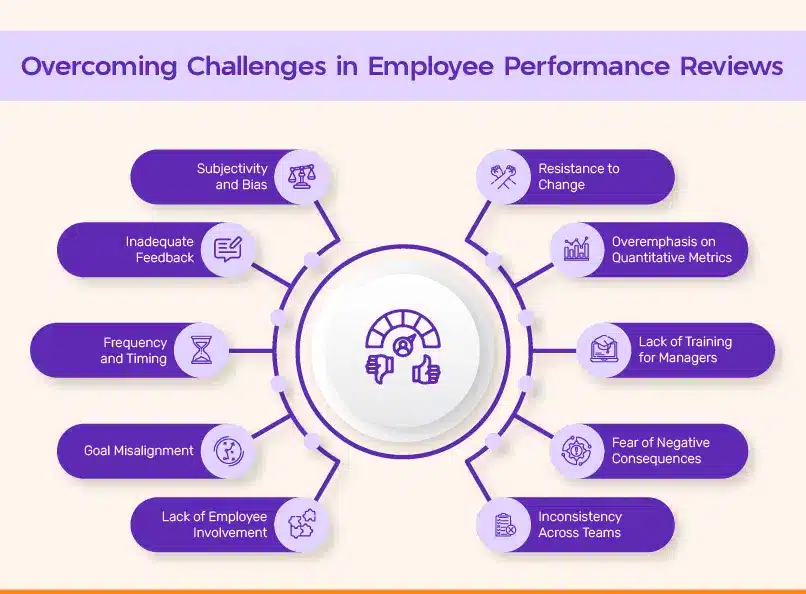
Employee Performance Reviews Challenges to Overcome
While employee performance reviews are a great way to grow your organization, they are not without their challenges.
Identifying and addressing these challenges is crucial for ensuring that employee reviews are fair, constructive, and contribute positively to both individual and organizational growth.
1. Subjectivity and Bias
Performance reviews are susceptible to subjectivity and bias, which can undermine the fairness of the evaluation process. Managers may unconsciously favor certain employees or rely on personal opinions rather than objective criteria.
How to Mitigate Subjectivity and Bias
Implement standardized evaluation criteria.
Train managers to focus on measurable performance metrics.
Incorporate multiple perspectives, including subordinate and peer feedback, for a holistic view.
2. Inadequate Feedback
Providing constructive and specific feedback is essential for employee development. However, inadequate feedback, such as vague comments or a lack of actionable insights, can hinder the improvement of employees.
How to Improve Feedback Quality
Emphasize detailed and constructive feedback in manager training.
Foster a culture of continuous feedback, beyond formal review periods.
Equip managers with skills to communicate both strengths and areas for improvement effectively.
3. Frequency and Timing
Irregular or infrequent performance reviews can diminish their effectiveness. A lack of consistent feedback may result in missed opportunities for employee growth and improvement.
How to Ensure Consistent Reviews
Establish a regular schedule for the performance review meeting, such as quarterly, semi-annually, or annually.
Communicate the purpose and timing of reviews consistently to help employees prepare and engage meaningfully.
With performance review platforms like Peoplebox.ai, you can easily schedule 1-on-1s and periodic check-ins to ensure your entire team performance is on track. The best part? You get all insights from each check-in in one place!
4. Goal Misalignment
When employees’ individual goals are not aligned with organizational objectives, it can lead to confusion and a lack of motivation.
How to Align Goals Effectively
Establish clear and transparent goal-setting processes.
Regularly communicate organizational objectives to employees.
Ensure individual goals align with broader organizational goals.
5. Lack of Employee Involvement
An effective performance review should not be a one-sided conversation dominated by managers. Lack of employee involvement can result in disengagement and dissatisfaction.
How to Foster Employee Involvement
Encourage employee self-assessment and reflection.
Actively seek input from employees about their achievements, challenges, and career aspirations.
Foster a collaborative approach to create a sense of ownership and ensure employees feel heard and valued.
6. Fear of Negative Consequences
Employees may fear that honest self-assessment or admitting to challenges could have negative repercussions, hindering open communication.
How to Avoid Fear of Negative Consequences
Emphasize the developmental nature of performance reviews rather than a punitive approach.
Focus on coaching and supporting employees instead of solely highlighting areas for improvement.
Create an environment where employees feel comfortable discussing challenges and seeking guidance without fear of reprisal.
What’s Changing in Performance Reviews
Performance reviews are evolving fast. Here are the key shifts shaping modern review practices:
Continuous Conversations Instead of once-a-year evaluations, companies are moving to regular check-ins—monthly or even weekly. It helps address issues early and drive real-time improvements.
AI-Powered Feedback Tools powered by AI help reduce biases, identify performance trends, and make reviews more data-driven. This adds fairness and consistency to evaluations.
Outcome-Focused Reviews Reviews are increasingly tied to OKRs and measurable business goals. This shift ensures that performance discussions are aligned with what truly drives impact.
Employee-Led Reflections Employees are encouraged to self-assess and come prepared to discuss progress, blockers, and goals. This fosters ownership and makes reviews more collaborative.
Make Modern Performance Reviews Effortless with Peoplebox.ai
Performance reviews are evolving—and so should the tools you use. Peoplebox.ai is your all-in-one platform to make modern reviews seamless, data-driven, and continuous.
Here’s how Peoplebox.ai makes it ridiculously easy:
All-in-One Platform – From OKRs to performance reviews to 1:1s, manage everything in one place.
Real-Time Sync – Integrates effortlessly with Slack, Teams, Jira, Asana, Google Sheets, and more for live updates and zero manual effort.
Continuous Feedback & Tracking – Run check-ins, gather 360° feedback, and monitor progress without jumping between tools.
Designed for Impact – Align individual goals to company priorities and make performance reviews a growth engine—not a checkbox task.
Ready to simplify your review process and drive real impact? Get started with Peoplebox.ai and turn performance management into your competitive edge.
FAQs
How to write a performance review as an employee?
When writing a performance review as an employee, focus on specific accomplishments and contributions over the review period. Be honest about areas for improvement, and outline actionable goals for the future. Highlight any skills developed or challenges overcome, and express a commitment to ongoing professional growth.
What to write on your own performance review?
In your own performance review, begin by summarizing your key achievements, focusing on quantifiable results that demonstrate your impact on the team or organization. Discuss any challenges you encountered and how you overcame them, showcasing your problem-solving skills. Include feedback on your areas for improvement and outline specific goals for the upcoming period.
If you’re having trouble writing a self evaluation, be sure to check out our exclusive blog post having 60+ self evaluation examples you can use in your next review!
How to write a review for a colleague?
When writing a review for a peer or colleague, start by acknowledging their strengths and contributions to the team. Provide specific examples of their achievements, teamwork, and how they have positively impacted projects or team dynamics.
Be constructive in addressing any areas for improvement, offering suggestions for development rather than criticism. Maintain a professional and supportive tone throughout the review, and encourage open communication about their goals and aspirations to foster a collaborative work environment.
What stood out is the deep understanding of the Peoplebox.ai team and their willingness to listen & enhance the platform to scale with our long-term needs.
Khilan Haria
VP and Head of Payments Product, Razorpay
I'm glad that we partnered with Peoplebox.ai for our company-wide OKR rollout. Thanks to its simplicity, we achieved significant adoption within two quarters
Rohit Arumugam
Business Head, Nova Benefits
Since we started using Peoplebox.ai, we have been able to bring all of our leadership across the organization together and show them how all of our goals align
Jaclyn Hoover
Senior Director HR, Propel School
Driving the entire interface through slack is simply brilliant especially for a tech product company! There was zero time spent on training! It can not get easier than that!
Swapna Nair
VP - HR, Khatabook
I chose Peoplebox.ai because it had integrations with the tools we use for sales and engineering to automate updating of key results and sync projects
How to Roll Out OKRs for First Time: 7 Steps Startegy
How to Roll out OKRs for the first time is a question common among organizations just introducing OKRs.
Imagine a scenario-
You are rolling out OKR for the first time.
One thing goes wrong and… Boom!
Your employees are already hating the process- even before it took a pace.
You certainly wouldn’t want that to happen in your organization. OKRs can surcharge and accelerate your organizational growth. But the key is to get this done right.
That’s why a well-planned rollout is significant for the success of an OKR system.
Introduce the new goal-setting approach strategically but not in a mechanical process. Every organization is unique and can face unique challenges while implementing OKRs.
[elementor-template id=”89725″]
How to roll out OKRs: Here are 7 Best Practices for a successful OKR rollout
1 Communicate the OKR Methodology to all the teams
Get everyone in the organization on board with OKRs. Present the concept clearly and precisely. Educate everyone on the OKR language.
While some people will embrace the changes with open arms, there are also going to be some skeptics into the bargain. You must let them express their concerns and provide answers to their “why, how, and what?” questions.
Explain to them the benefits of implementing the OKR framework. Highlight how it’s going to impact the business and the individual success of the employees.
Organize workshops, training, discussions, introductory presentations, and seminars to help your employees’ design quality OKRs. Transparently explain to them the strategic execution, alignment, expectations, and tools they will be required to use for the purpose.
To help everyone speak the same language, document your company OKR framework
2 Inspire with success stories
List the names of reputed companies like Google, Netflix, Intel, LinkedIn, Twitter, etc. which have successfully implemented OKRs. Narrate their success stories to help them visualize how OKRs can cater to their individual success.
For example, OKRs helped LinkedIn become a 20 Billion Company. Jeff Weiner, CEO of LinkedIn, describes OKRs as, “something you want to accomplish over a specific period of time that leans toward a stretch goal rather than a stated plan.
It’s something where you want to create greater urgency, greater mindshare.”
You can either go for an organization-wide rollout Consider running an OKR Pilot first, depending on what fits you best.
If you have a culture that’s open to change and a flexible structure of functioning, an organization-wide rollout will work best for you. But it’s always best to take small steps. Start from one part and gradually move to others.
[elementor-template id=”89725″]
Crafting and implementing OKRs across the entire organization can seem overwhelming especially if you are a large organization. Instead, choose a particular part of the organization and run a pilot project.
“If you concentrate on small, manageable steps you can cross unimaginable distances.”
It’s also important to decide “how often?” will OKRs be reviewed. Will it be done quarterly or annually?
4 Go for the Top-down approach
A top-down approach to OKRs was the first pattern attempted. The top management has a significant role in setting the overall direction of the company. Starting from the top provides clarity for the rest of the organization.
“People buy into the leader before they buy into the vision.”
For example, you can start with the senior leadership team. Make them an example to roll out OKRs to the departmental heads. From there you can move on to team leaders, and to the rest of your teams.
5 Get aligned
You can’t just sit with a blank sheet in front and magically start crafting the perfect OKRs. You need to understand the context. Make the company mission and vision your starting point and tailor your OKRs accordingly.
Buy-ins are critical for OKR success. The success of OKRs depends on the collective effort of each team member. You can imagine it as a group dance performance where everyone needs to perform their parts well to make it a masterpiece.
Thus you need to align the efforts of the workforce, executive leaders, and company heads both horizontally and vertically. This will help you foster transparency, smooth cross-functional communication, and reduce overlap among departments.
6 Track and monitor progress
Tracking OKRs are important to evaluate and measure the progress and understand which teams are falling short.
You can identify any issues and make course corrections as required by Monitoring progress.
Leverage technology to track OKRs. It will make the process transparent.
Using OKR software will also automate the calculations and save your time as you are no longer required to manually update the progress of each team member.
Bonus tip: Remember to celebrate whenever you Hit the nail on the head through OKR win meetings and shoutouts to keep
7 Do frequent check-ins
To stay on top of OKR progress, you need to do regular check-ins. Employees might feel overwhelmed with concerns and doubts, especially in the initial days.
Regular check-ins will give your employees direction. And provide them the required assistance and guidance. Frequent Check-in meetings will also identify the overlappings, increase accountability and ensure execution.
Define your preferred frequency of Check-in meetings. You can do it weekly or monthly as per your organization’s needs. Although weekly check-ins are most recommended to keep track of the progress and evaluate continuously.
Have OKR Champions
Consider having OKR champion who starts implementing the OKR framework with a strong war cry. Build a team of champions who will work as ambassadors to head the change. And make the OKR framework run smoothing across the organization.
They work as mentors and internal OKR experts. And can help you adopt and execute OKRs at all levels of the organization. These OKR enthusiasts will make sure that every concern is addressed, every ‘whys and wherefores’ are explained.
Too many objectives and key results: Less is more. Don’t set more than 5-7 Objectives and 3-5 key results.
Fill it, Forget it: Don’t set OKRs just to forget in a few days.
Mixing KPIs with OKRs: KPIs aren’t a substitution for OKRs. They have separate roles and outcomes.
Rigidity: Rigid adherence to rules can lead to disengagement. Instead, move forward with a flexible and intuitive OKR approach
Link OKRs with Recognition: Don’t make the mistake of making OKRs a base for your reward and recognition program. It can negatively affect performance. And compromises the business output.
The start is never perfect
You might struggle when you are just starting. But after a few OKR cycles, you are sure to hit your stride.
To end, OKR’s success depends on consistency. So, remember to continuously reflect, learn, and refine the process.
Hope we were able to answer all your queries in our blog How to roll out OKRs for the first time? If you have questions feel free to comment below.
Pooja Pooja
Types of OKRs: Aspirational OKRs vs Committed OKRs
Every organization wants to grow, but how do you set goals that are both achievable and visionary? The answer lies in the types of OKRs: committed and aspirational.
Whether it’s near-term performance or long-term innovation for your business, you’ll know just how to leverage the power of committed and aspirational OKRs effectively to unlock new levels of success for your business.
Committed OKRs are about clear, attainable targets that teams can confidently deliver within a set timeframe. This type of OKR delivers accountability and is important for day-to-day business success.
Aspirational OKRs, on the other hand; push teams to be bigger and challenge themselves. The moonshots: ambitious OKRs are meant to stretch an organization from its comfort zone, kindling innovation and long-term growth.
In the rest of this blog, we will take the difference between these two types of OKR apart and see how to balance them in such a way that they enable performance as well as inspiration.
What are Aspirational OKRs and Other Types of OKRs?
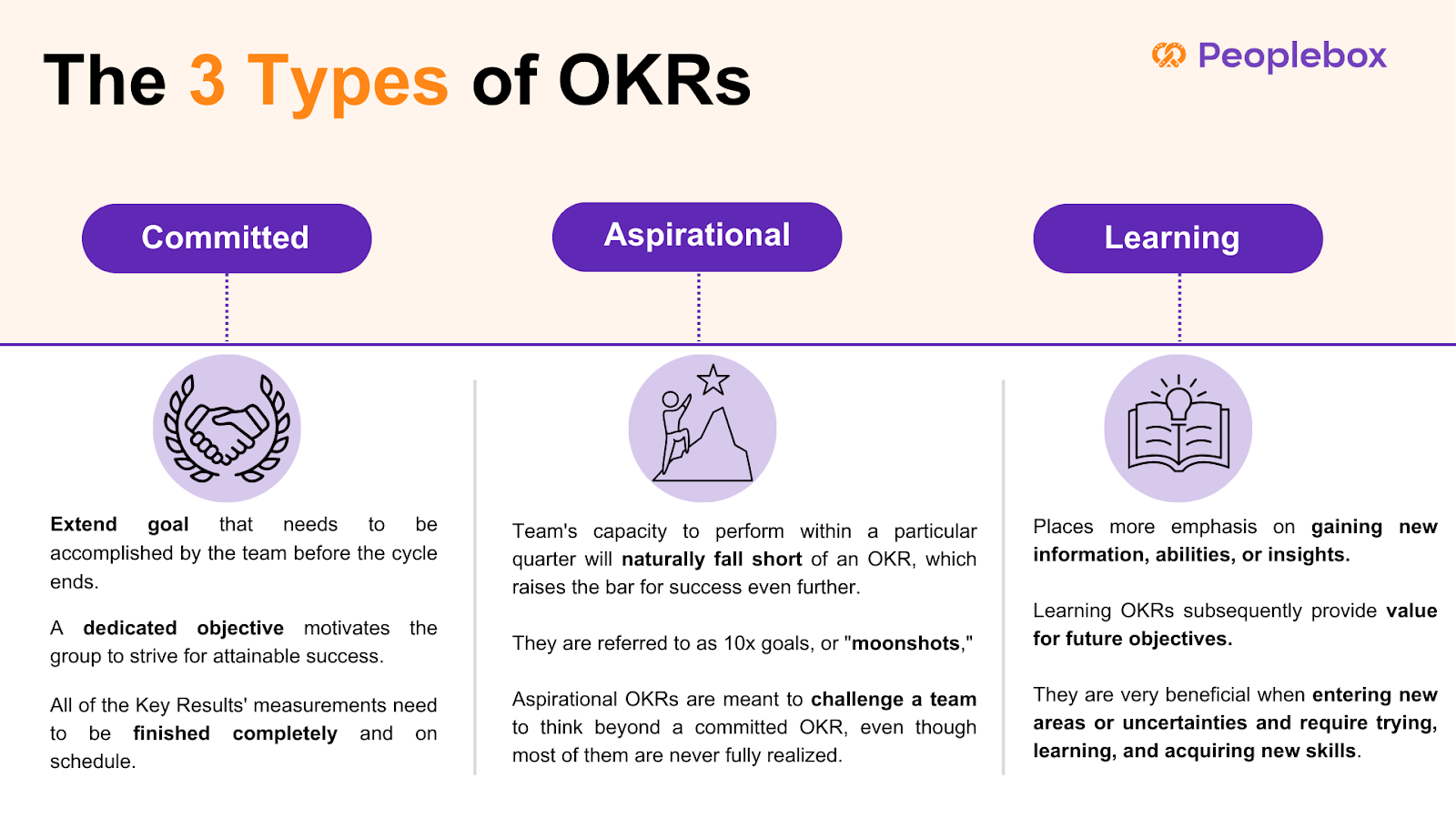
A committed OKR is a stretch goal that the team has to achieve or complete before the cycle is over. A committed goal pushes the team to reach, but still achievable attainment. All metrics of the Key Results must be completed fully and on time. Consider a situation like this:
Daniel’s organization and his teams have agreed to execute certain OKRs and have mapped a precise action plan on how they are going to do so.
These are called Committed OKRs.
An aspirational OKR sets the bar for success further out, and by design will exceed a team’s ability to execute in a given quarter. When they set such a high bar as to be seemingly impossible they are called 10x goals, or “moonshots.” While most aspirational OKRs are never fully achieved, they exist to push a team to think bigger than a committed OKR. Consider the following case:
Martha’s organization is more visionary. They have stretched goals. And her teams are not likely to fully achieve these ambitious goals.
These are called Aspirational OKRs.
Understanding the distinction between aspirational and committed goals is crucial for effective goal-setting and team motivation within the OKR framework. Aspirational goals encourage ambitious thinking and long-term vision, while committed goals focus on immediate, measurable outcomes.
Learning OKR focuses on the acquisition of knowledge, new skills, or insights rather than a direct achievement of business outputs. Extremely helpful when entering new areas or uncertainties and requires experimenting, learning, and developing new skills, Learning OKRs distinguish between usual output measuring of success and measuring acquisition of knowledge, that will later add value for future objectives. For example:
Jerry wants to gain a deep understanding of machine learning to drive full product development. He wants to finish three advanced courses and test his skills by building a model in sandbox.
These are called Learning OKRs.
Aspirational OKRs and Committed OKRs: Key differences
When you aim for the stars, you may come up short, but still reach the moon.
– Larry Page
Read on to find out the key difference between Committed OKRs and Aspirational OKRs.
Objective
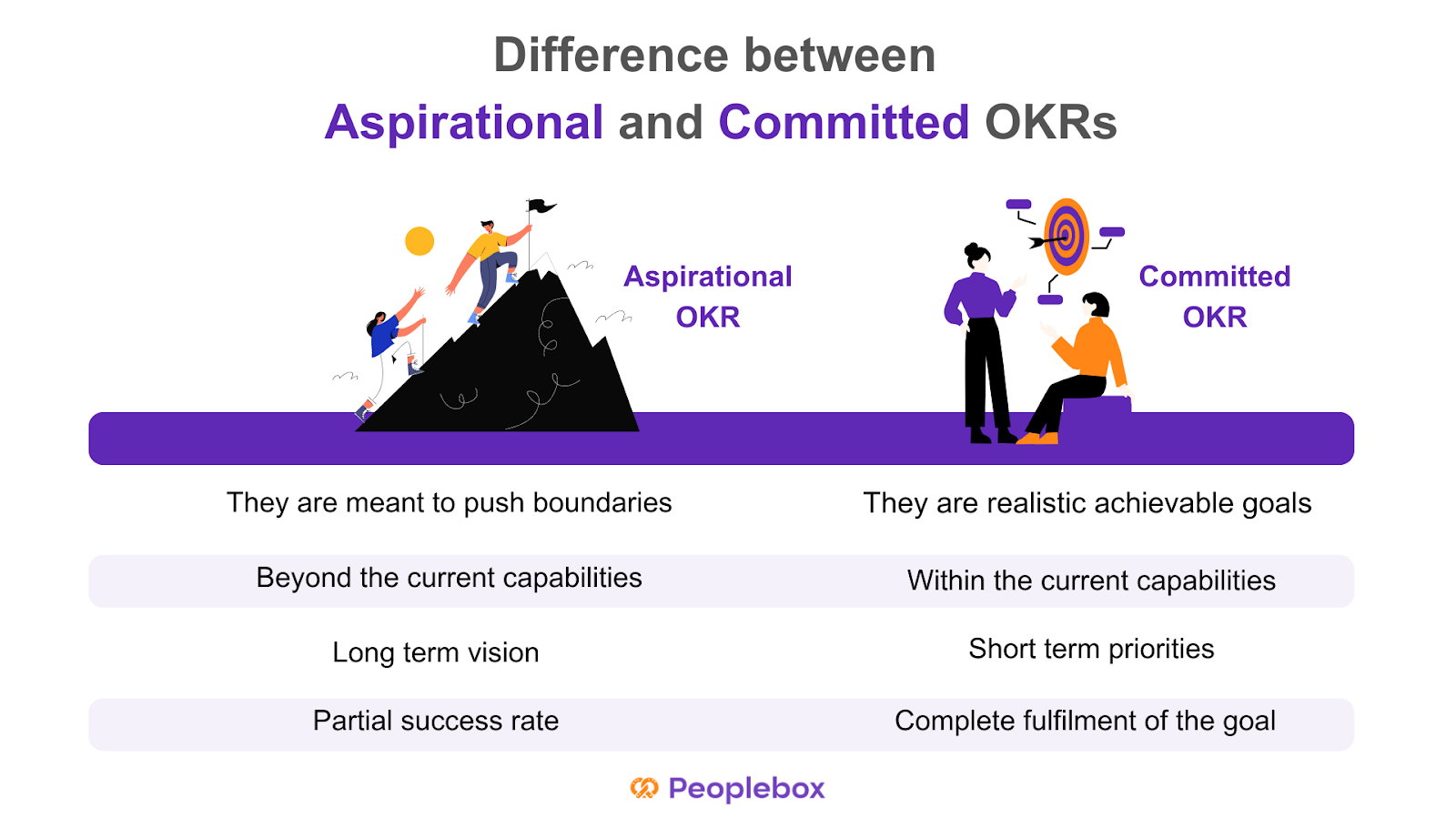
Aspirational OKRs are meant to push the boundaries and encourage employees to achieve visionary objectives. Committed OKRs, on the other hand, focus on committed objectives that offer a more realistic vision of goals with fully achievable results.
Aim
Committed OKRs help companies achieve their goals through individual and team achievements. Aspirational OKRs are often beyond the current capacities of the organization but help in pushing boundaries.
Timeframe
Aspirational OKRs are usually created to focus on long-term strategic vision while Committed OKRs offer short-term operational priorities to guarantee progress in the short term.
Committed OKRs are supposed to have a 100% success rate as each key result comprises fully achievable targets. Aspirational OKRs are usually found to have a success rate of 60-70%.
Committed and Aspirational OKR examples
The difference between committed and aspirational OKRs is subtle. Committed objectives are meant to be fully achievable, requiring teams to concentrate on straightforward priorities without taking unnecessary risks, ultimately serving as motivational tools to foster small wins and consistent progress.
A standard example in the sales team scenario might be like:
Committed OKR
O: Expand to the US market
KR1: Close first 6 start-ups
KR2: Get a meeting-to-close rate of 6%
KR3: Reach average deal size of $200
Aspirational OKR
O: Capture the entire US market in one quarter
KR1: Get onboard 95% of big customers in the US market to grow over competitors
KR2: Get a meeting-to-close rate of 30%
KR3: Reach average deal size of $2000
In the managerial team, these OKRs can manifest like such:
Committed OKR
O: Improve customer satisfaction with the existing solutions
KR1: Increase customer satisfaction score (CSAT) from 85% to 90% by the end of the quarter.
KR2: Reduce average response time from 15 minutes to 10 minutes within the next three months.
KR3: Train 100% of the support team on the new customer service tools within six weeks.
Aspirational OKR
O: Become the market leader in AI-powered customer service solutions.
KR1: Achieve a 30% market share in the AI customer service industry by the end of next year.
KR2: Launch three groundbreaking AI features that no competitor currently offers within 18 months.
KR3: Secure a partnership with at least two top-tier companies by the end of next year.
In a tech context, OKRs like these can come up:
Committed OKR
O: Improve the performance of the app and reliability
KR1: Reduce app crash rate from 2.5% to under 1% within the next quarter.
KR2: Decrease page load times by 30% in six months.
KR3: Fix 100% of the top ten reported bugs within the next two sprints.
Aspirational OKR
O: Revolutionize the user experience of our mobile app.
KR1: Increase daily active users (DAU) by 100% within 12 months.
KR2: Develop and launch a fully AI-driven recommendation system that personalizes the user experience by the end of the year.
KR3: Achieve a 4.8+ rating across app stores by introducing five innovative features within the next 18 months.
How to decide between Committed OKRs and Aspirational OKRs?
Committed OKRs will work best if your organization is newly introduced to the framework or is still in the rolling-out phase.
With each goal achieved, your team’s motivation and engagement will rise higher. In addition, teams easily get into the habit of running Committed OKRs and make it part of their work culture.
But if you have already used the framework in the past, aspirational OKRs can do wonders for you.
Creating a result-driven work culture takes time. It demands discipline, continuous effort, and a mindset shift of employees and management. So you should start simple and focus on learning the methodology first. And set up the necessary processes to make it work.
Setting aspirational OKRs in the very beginning would make your teams feel overwhelmed and over-pressurized. Extremely ambitious Key Results soon become too much to handle. Learning a new methodology takes time. Once your teams are used to the framework and it becomes a part of their work-life, you can consider aspirational OKRs.
With the later process, you can have objectives and a combination of committed and aspirational key results. While some key results will be easier to achieve, others will aim higher. Understanding the distinction between aspirational and committed goals is crucial for better goal-setting and team motivation.
Choosing the Right Type of OKRs
Choosing the right type of OKRs depends on the organization’s goals, culture, and priorities. Committed OKRs are suitable for organizations that need to achieve specific, measurable outcomes within a set timeframe. They are ideal for teams that require a clear direction and a sense of accountability. Aspirational OKRs, on the other hand, are suitable for organizations that want to drive innovation, creativity, and excellence. They are ideal for teams that want to push the boundaries and strive for something bigger.
When choosing between Committed and Aspirational OKRs, consider the following factors:
What are the organization’s goals and priorities?
What type of culture do we want to foster?
What kind of outcomes do we want to achieve?
What level of risk are we willing to take?
By considering these factors, organizations can choose the right type of OKRs that align with their goals, culture, and priorities. Whether you opt for committed or aspirational OKRs, the key is to ensure that they are aligned with your company aims and internal communication processes, fostering a balanced approach to achieving both immediate and long-term objectives.
How to balance Committed and Aspirational OKRs?
There is no one-size-fits-all answer, but where OKRs are aligned with company strategy, teams are well educated, open communication exists, and performance is reviewed regularly, it will help keep the balance between aspirational and committed OKRs intact.
However, the first step in finding equilibrium between the two forms of OKRs is that there has to be a knowledge of the difference. It needs to be apparent from the outset that everyone involved makes it clear the distinction between the two OKRs.
Teams and employees may have suitable insights that will assist in determining what is realistically achievable (committed) and what is a stretch but possible (aspirational). This can help determine what the balance ratio for the OKRs is going to be.
A very critical element to succeed with OKRs is reviewing and tracking the progress. With weekly check-ins, teams can go through their OKRs regularly and update the same performance data. It becomes easy to track how they have progressed on the outcome of the OKR in the OKR review process.
The grading of OKRs is very clear on the distinction between committed and aspirational goals. Committed OKRs are things to be accomplished within the cycle, and grading is binary: pass or fail. That is, an OKR is said to be successful if 100% of it is accomplished; otherwise, it is regarded as a failure. Aspirational OKRs, on the other hand, are graded along a more nuanced scale.
Common mistakes to avoid while setting up Aspirational OKRs
Here are 6 common mistakes organizations commit while setting up aspirational OKRs-
1️⃣Ignoring organizational structure and needs
A common mistake most organizations commit while writing aspirational OKRs is to write something like, “What can be done more if we have extra resources and luck favors us ?” Instead, you can pretend to be a genie and strive to understand “What our customer needs at present moment?”
2️⃣Unrealistic aspirational OKRs
Aspirational OKRs don’t imply setting unrealistic goals. It should be achievable, with the understanding that your teams won’t have any clue about how to achieve these OKRs. Aspirational OKRs demand overuse of resources. They are fluid and flexible. But still helps your teams focus on well-defined goals.
3️⃣Writing a low-value objective (LVO)
Moving forward with a “Who cares?” attitude is a common pitfall among organizations. Low-value objectives go unnoticed even after the successful completion of the key results.
4️⃣OKRs should be framed to gain tangible benefit
OKRs are a tool for organizations to work for big goals in the long run by breaking them into small chunks that can be achieved within a shorter cycle.
5️⃣A committed OKR must deliver a 1.0
It makes the framework stiff and doesn’t leave scope for improvement.
6️⃣Too many OKRs
How many aspirational OKRs you should set for one cycle will depend on your company’s resources. But never aim for too many Objectives and key results. As it can easily divert your focus altogether.
Best Practices for Implementing OKRs
Implementing OKRs requires a structured approach to ensure success. Here are some best practices to consider:
Align OKRs with company goals: Ensure that OKRs align with the organization’s overall goals and priorities.
Make OKRs specific and measurable: Ensure that OKRs are specific, measurable, achievable, relevant, and time-bound (SMART).
Set ambitious yet achievable goals: Set goals that are challenging yet achievable, and provide a clear direction for the team.
Establish clear key results: Establish clear key results that indicate progress towards achieving the objective.
Track progress regularly: Track progress regularly and provide feedback to teams and individuals.
Foster a culture of transparency and accountability: Foster a culture of transparency and accountability, where teams and individuals are held accountable for their progress.
Provide training and support: Provide training and support to teams and individuals to ensure they understand the OKR framework and how to use it effectively.
Review and adjust OKRs regularly: Review and adjust OKRs regularly to ensure they remain relevant and aligned with the organization’s goals.
By following these best practices, organizations can implement OKRs effectively and achieve their goals. Regularly reviewing and adjusting OKRs ensures that they stay aligned with the evolving needs of the organization, helping teams to maintain focus and drive continuous improvement.
Conclusion
Now that you know the difference between committed and aspirational OKRs and how they can impact your organization’s success, it’s the decision time. Choose the one that will best suit your purpose.
And don’t forget it’s a trial and error method. Have regular OKR check-ins and reviews. Collect feedback during and after each cycle. And use your learnings to avoid further mistakes in the next OKR cycle.
Pooja Pooja
Quarterly OKRs: 5 Tips for Successful Wrap-Up
Imagine a scene! the quarter is about to end and it’s time to review and wrap up quarterly OKRs.
The clock’s ticking. Everyone is in a rush. And you are busy evaluating which goals are yet to be achieved. And what has already been done. It’s also time to think about your priorities for the next quarter.
There are so many checklists and questions going in your head.
Have my teams found ways of closing out quarterly OKRs? Will my teams beat the clock and tick all the boxes? Have they reflected on their OKR progress? How will I deal with this end-of-quarter OKRs rush?
Feeling overwhelmed!!
Here is a step by step guide to help you prepare best to wrap up your quarterly OKRs–
Before you start to review and wrap up quarterly OKRs- remember that wrapping up quarterly OKRs is teamwork. And to see the best results every team irrespective of their department have to come together.
Track your team’s OKR progress and gather the key results scores. You can score your OKRs on a scale of 1 to 10 on the basis of how far the objectives have been achieved.
This will help you evaluate your progress in a truly data-driven manner.
If the scores are low this might suggest that your OKRs were unrealistic. On the other hand, if the score is too high it may suggest that your OKRs were not ambitious enough.
Whatever learning you made from this process. It will help you to form the basis for designing your next set of quarterly OKRs.
Make sure everyone is up to date
It is important to ensure that your teams have clarity about their OKR status. At the same time, they have visibility into what other teams have been doing. It can be achieved through regular check-ins with your teams. Check this ebook on OKR handbook.
This step will help you check if your teams are aligned or not. When everyone in your team is on the same page taking decisions based on priorities becomes easy. As you have the data in hand to rely on instead of guessing.
Organize OKR check-ins
The importance of check-ins for OKR success cannot be emphasized enough. OKR check-ins provide you an opportunity to have 1 on 1 discussion in all OKR matters.
With OKR check-ins you can discuss with your leaders and team members about – what went well, what didn’t work for them, what needs to be dealt with immediately, what problems they are facing etc. at an individual as well as team level.
OKR check-ins will help you understand what’s holding teams back. You will further get the chance to push priorities that might have shifted midway.
Dig into opportunities
Organize Quarterly OKRs review meetings to dig into opportunities. During these meetings, go through each key result with your teams. Find out what went well and what needs to be done better.
Let the OKR leaders from each team present their learnings and achievements before everyone. Here teams can give a small presentation highlighting the most important lessons with context.
So that other teams can benefit from their learnings and experiences. And use them in designing their OKRs for the next quarter.
If you are a large-scale company working with multiple departments. The OKR review meetings can be held at the departmental level.
Plan the future
Now that you have gathered the data and matrix you need through OKR check-ins and OKR review meetings. It’s high time to plan for the next quarter.
OKRs have the power to build the future of your organization. But OKR failures can cost you a fortune.
Hence it’s important to find out the core reasons behind your OKR success or failure for the present quarter. And use it as context while designing OKRs for the next quarter.
[elementor-template id=”89725″]
Do you need to plan new OKRs every quarter?
“Should OKRs change every quarter?” is a question often left unanswered.
Even after an OKR is achieved, you can roll it forward for the next quarter if necessary.
For example, if your OKR was to increase customer satisfaction by 20% in the present quarter. This could be relevant even for the next few quarters.
In case, of missed OKRs, you need to take a call. And decide whether you want to carry it forward or set new OKRs based on the data gathered.
When should you review and wrap up Quarterly OKRs
You should preferably wrap up the quarterly OKRs at least a week prior to the beginning of the next quarter.
But the preparation and discussions for the next quarter should be initiated almost a month before the new quarter begins. This is because designing OKRs takes dedication, time, and effort.
Bonus Tips:
Maintain Transparency from day one. Keep data transparent so that everyone knows how it’s going.
Create a culture of critical feedback. Be honest when it comes to feedback. At the same time be open to getting feedback from your teams as well.
Celebrate wins– even the smallest ones. Recognize your teams for their achievements more often.
Over-communicate. Communication is the key when it comes to wrapping up quarterly OKRs.
Take a moment
Wrapping up end-of-quarter OKRs will allow you to pause and take a moment to think. It provides you time to reflect on your wins, failures, and setbacks. It’s a stitch in time to make sure that your OKR framework is a success.
Follow the steps given to close out quarterly OKRs and make the most out of the process.