Every sector, including HR, is rapidly adopting AI in 2024. As of early 2024, about 38% of HR leaders are actively piloting or have already implemented generative AI technologies within their operations, showing a significant increase from 19% in mid-2023. This is in line with another survey where 61% of CHROs planned to invest in AI in 2024.
The role of a hiring manager has evolved significantly in recent years. Gone are the days when their primary responsibility was simply to fill open positions. Today’s hiring managers are tasked with more than just recruitment; they are also responsible for ensuring employee welfare and engagement.
In essence, hiring managers have become strategic partners in organizational success.
So, what exactly does this new role entail? What challenges do hiring managers face in this evolving landscape? And most importantly, what skills do they need to be successful?
Let us find the answers to all these questions in this blog.
Who is a Hiring Manager?
A hiring manager is a key individual within an organization who oversees the recruitment process for roles within their specific team or department. They collaborate with HR to identify staffing needs, create job descriptions, review candidate applications, conduct interviews, and ultimately make hiring decisions that align with their team’s goals and company culture.
✔️ Roles and Responsibilities of a Hiring Manager
Here are the key roles and responsibilities of a hiring manager in an organization
Collaborate with HR on workforce planning and hiring strategies
Hiring managers collaborate closely with the HR department to discuss staffing needs. This includes discussing workforce planning, understanding the skill sets required, and ensuring that the hiring process aligns with company policies and practices.
They also collaborate in developing strategies for hiring the right candidates. For instance, they decide together on the channel where the job will be posted.
Craft compelling job descriptions to attract top talent
Hiring managers are responsible for creating and maintaining job descriptions that attract the right candidates. They need to craft job descriptions after carefully studying the responsibilities, qualifications, experience, and skills required for each position.
Their main goal is to ensure that candidates understand what is expected and whether they are a good fit for the particular role.
Screen and interview candidates to identify the best fit
Hiring managers ensure that only the most qualified candidates move forward in the hiring process. They supervise the evaluation of resumes and applications and help in shortlisting candidates who meet the job’s minimum qualifications and requirements.
They also conduct phone or video screenings to assess candidates’ basic skills, cultural fit, and interest in the role.
Make informed hiring decisions based on candidate assessments
Hiring managers often make the final hiring decision, balancing input from various stakeholders. They need to review all candidate assessments, feedback, and interview notes to make informed decisions. They should also work with department heads, HR, and other relevant stakeholders to discuss and agree on the final selection.
They also collaborate with HR to finalize job offers, including salary, benefits, and other terms, and participate in discussions if negotiations arise.
Ensure compliance with hiring laws and regulations
A hiring manager must make sure that all recruitment practices adhere to employment laws and regulations. For instance, they need to ensure compliance with anti-discrimination laws and implement fair hiring practices that promote diversity and inclusion.
They must also maintain accurate and secure records of the recruitment process and prepare for potential audits by keeping comprehensive documentation and adhering to legal standards.
Promote the organization’s brand as an employer of choice
Hiring managers play a key role in promoting the organization’s brand throughout the hiring process. They create a positive experience for candidates, from the initial application to the final decision, by being transparent, communicative, and respectful.
They also clearly communicate the organization’s mission, values, culture, and benefits to potential candidates to attract top talent.
Continuously improve hiring processes for optimal results
Hiring managers are responsible for continuously improving the hiring process by implementing changes based on feedback and outcomes. They analyze data from previous hiring efforts to identify strengths and weaknesses in the recruitment process. They gather feedback from candidates, interviewers, and HR staff to refine hiring practices.
Using the insights generated, they streamline the recruitment processes to reduce time-to-hire and improve candidate quality.
Hiring Managers Vs Recrutier: What is the difference?
To explain the difference, let us use a simple analogy.
In newspapers, there is a writer and an editor. While the writers focus on creating the content, the editors give the ultimate stamp of approval. Without writers, there would be no articles, but the editor ensures that whatever they publish is of a certain quality.
Similarly, a recruiter is someone who builds a strong pool of candidates (articles). A recruiter ensures that the supply meets the demands of the organization when it comes to human capital.
A recruiter also focuses on building a strong employer brand to consistently attract good applicants. By offering good candidates, a good recruiter makes the hiring manager’s job easier.
However, ultimately, the hiring manager makes the final decision about who gets hired and who doesn’t.
On that note, here is a quick table summarizing the differences between the two:
Aspect
Recruiter
Hiring Manager
Primary Role
Responsible for finding and attracting candidates.
Responsible for making the final hiring decision.
Main Focus
Building a talent pipeline and managing the candidate search process.
Ensuring the selected candidate meets team needs and contributes to organizational goals.
Performance Metrics
Measured by the number of qualified candidates sourced, time-to-fill, and cost-per-hire.
Measured by the success and retention of new hires, and team performance.
Budget Involvement
Manages costs related to sourcing, job ads, and recruitment tools.
Oversees the overall hiring budget, including advertising, agency fees, and onboarding costs.
Employer Branding
Promotes the organization’s brand through candidate engagement and communication.
Reinforces the brand by providing a positive interview experience and clear role expectations.
Hiring Managers Vs HR
Hiring Managers and HR professionals play distinct yet complementary roles in the recruitment and employee management process. While the hiring managers focus on making final hiring decisions, HR professionals work relentlessly to build a positive organizational culture through effective employee engagement initiatives.
In simple words, an HR professional manages tasks related to the functioning of existing employees, while the hiring manager focuses on activities connected to transforming a candidate into an employee.
Here are the main differences between the two roles:
Aspect
HR Professional
Hiring Manager
Primary Role
Oversees the employee management process, ensuring it aligns with organizational policies, laws, and best practices.
Responsible for making final hiring decisions and ensuring the new hire fits the team and department needs.
Main Focus
Managing the entire employee lifecycle, including recruitment, onboarding, performance management, and compliance.
Selecting the most suitable candidate for the specific role and team.
Onboarding
Manages most of the onboarding process, including paperwork, compliance training, and organizational orientation.
They participate in the initial training and orientation.
Compliance Responsibility
Ensures employees are managed in accordance with employment laws, anti-discrimination regulations, and company policies.
Ensures hiring decisions adhere to organizational policies and legal requirements.
Performance Metrics
Measured by employee satisfaction, retention rates, and compliance.
Measured by the success and retention of new hires, and the overall team performance.
Budget Management
Oversees the broader HR budget, including recruitment, benefits, training, and employee engagement initiatives.
Manages the hiring budget related to team-specific needs, including advertising and recruitment agency costs.
Training and Development
Designs and implements training programs and development initiatives for the broader organization.
Identifies training needs for new hires and ensures they receive the necessary guidance.
Why Your Organization Needs A Strong Recruiter And Hiring Manager Relationship
There are several reasons. For starters, when these two roles work in harmony, they create a seamless hiring process. Identifying and attracting the best talent will no longer be a challenge for your organization.
On one hand, recruiters build talent pipelines and screen initial applications. On the other hand, hiring managers provide the specific insights and expertise needed to assess whether the candidates are the right fit.
When both parties work in tandem, your organization can experience reduced time-to-hire and an improved candidate experience.
A strong partnership between recruiters and hiring managers also creates an environment of better communication and collaboration. This, in turn, leads to more informed decision-making. For instance, recruiters rely on hiring managers to provide clear job requirements and feedback on candidates.
Hiring managers depend on recruiters to present qualified candidates who meet those specifications. When both sides understand each other’s needs and priorities, misunderstandings are minimized, and frustration is reduced in hiring.
This alignment ultimately enhances the overall quality of hires and contributes to higher employee retention. Your organization will also be perceived as an employer of choice in a competitive talent market.
Essential Skills and Qualities of a Hiring Manager
If you wish to become a hiring manager of an organization, here are some key skills you need to possess
Communication Skills
A hiring manager must communicate clearly with both candidates and internal stakeholders. This involves conveying job expectations and role specifics to prospective hires and collaborating effectively with HR, department heads, and other team members to ensure that everyone is aligned on the hiring strategy.
Analytical Skills
These skills enable the effective evaluation of resumes, interviews, and other data points. They also help interpret various indicators of a candidate’s potential performance, from their past experience to their responses during interviews. Strong analytical skills ensure that only the most qualified candidates move forward in the hiring process, a key responsibility of a hiring manager.
Decision-Making Skills
To be a successful hiring manager, you also need to possess excellent decision-making skills. You must be able to make informed choices quickly and confidently. You need to balance a range of factors, such as skills, cultural fit, and team dynamics, to select the best candidates.
Good decision-making is key to ensuring that the right hires are made efficiently, reducing time-to-fill in the process.
Problem-Solving Skills
The hiring process often involves unforeseen challenges, such as misalignment of expectations, unpredictable candidate behavior, sudden conflicts with other members of the hiring team or the HR team, and so on. A strong problem-solver can quickly identify such issues and evaluate potential solutions. This capability ensures that the recruiting process remains on track without any obstacles.
Adaptability
Today’s job market is incredibly fast-paced. A hiring manager must stay current with the latest hiring trends, technologies, and best practices. This is absolutely necessary to keep the recruitment process efficient and competitive.
An adaptable hiring manager is flexible and responsive to new tools and changing candidate expectations. This is critical to the continued success of the hiring process.
Challenges Faced by Today’s Hiring Managers
While the role of a hiring manager may seem extremely attractive to outsiders, it is not without its fair share of challenges. Here are some common issues faced by today’s hiring managers.
High Volume Hiring
Thanks to high attrition rates and organizations growing rapidly, hiring managers are always managing multiple open roles simultaneously. This can be overwhelming, especially when each position has its unique requirements and deadlines.
One way to overcome this challenge is to leverage resume screening software. These tools use artificial intelligence to quickly sift through large volumes of applications and highlight the most suitable candidates based on predefined criteria.
By automating the initial stages of candidate screening, hiring managers can focus their efforts on the most promising candidates and ensure that no potential hire is overlooked.
Finding Qualified Candidates
Finding qualified candidates is always daunting. With many organizations vying for top talent, hiring managers must be proactive and strategic in their approach. Building a strong relationship with recruiters can definitely help.
Start by clearly specifying your requirements to them and ensure that both of you are aligned. Recruiters have extensive networks and resources to help identify and attract the best candidates. All they need is a direction to find qualified candidates, which a hiring manager can provide.
Time Constraints
Balancing recruitment tasks with other managerial duties can be challenging. Hiring managers often juggle multiple responsibilities. This makes it difficult to dedicate sufficient time to each task. To manage time effectively, you can adopt the following best practices:
Use a task management system to prioritize and schedule recruitment tasks alongside other responsibilities.
Where possible, delegate aspects of the recruitment process, such as initial screening or scheduling interviews, to team members or HR staff.
Allocate specific time blocks for recruitment activities and adhere to these limits to ensure that other managerial duties are not neglected.
Develop a detailed calendar that outlines key milestones and deadlines for each stage of the recruitment process. This helps ensure that all tasks are completed on time and allows you to track progress easily.
Bias in the Hiring Process
Bias in hiring can occur at various stages, be it in resume screening or at the time of actual interviews. To eliminate biases in the hiring process, take the help of technology wherever possible. For instance, interview tools like Talview and BarRaiser standardize the interview process and help in evaluating candidates objectively.
How Peoplebox Supports Hiring Managers?
Peoplebox is a comprehensive employee management platform designed for organizations to manage OKRs (Objectives and Key Results), performance, and employee engagement. With the help of Peoplebox, businesses can align their people strategy with their business strategy while hiring managers enjoy the following capabilities to streamline the hiring process:
Automated Candidate Screening and Shortlisting
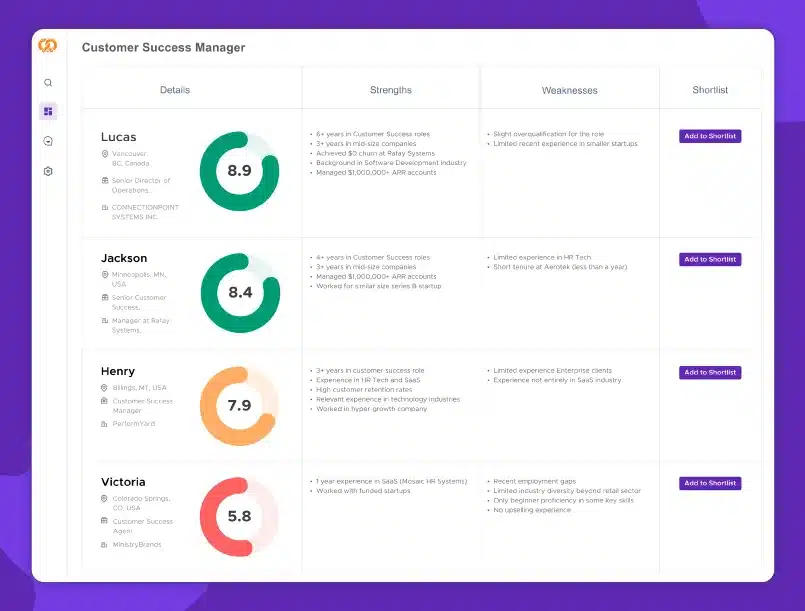
Peoplebox leverages AI to automate resume screening. It helps hiring managers process tens of thousands of applications to shortlist the most qualified candidates. The platform automates skill-gap analysis and matches talent to suitable positions, facilitating the hiring, growth, and retention of skilled employees.
Each candidate receives a score that highlights their strengths and weaknesses based on their skills and experience. This feature enables hiring managers to quickly pinpoint the best-fit candidates, making the recruitment process faster and more effective.
Seamless Integration with ATS and HRIS
Peoplebox offers seamless integration with over 50 different HRIS, ATS, and communication platforms. This enables hiring managers to handle the entire hiring process within their existing workflows and tools.
This integration also facilitates a smooth transition of resumes into the desired format, making it easy to share them with relevant stakeholders of the department that wants the resource.
Long story short, by incorporating Peoplebox into your current systems, you can maintain efficiency without the need for additional software or disruptions to your established workflows. Sounds too good to be true? Check it out yourself!
[elementor-template id=”68379″]
Real-Time Reporting and Analytics
Peoplebox delivers real-time reporting and dashboards that empower hiring managers to make quicker, more informed talent decisions. By connecting talent acquisition data with performance insights, Peoplebox offers a comprehensive view of the candidate pool. This holistic perspective enables hiring managers to align their decisions with business objectives.
Streamlined Collaboration and Communication
Peoplebox’s integration with Slack and Microsoft Teams facilitates seamless collaboration and communication for hiring managers. By facilitating interactions within teams and with candidates directly via these platforms, Peoplebox reduces friction and saves time.
Hiring managers can also efficiently track goals, write reviews, and plan interviews without needing to switch between different systems. This ultimately streamlines workflows and enhances overall productivity.
Ready to elevate your hiring game? Try Peoplebox today and experience the difference.
FAQs
What qualifications does a hiring manager need?
A hiring manager should have strong interpersonal skills, excellent communication abilities, a deep understanding of the company’s culture and goals, and a solid grasp of recruitment processes and best practices. They should also be able to evaluate candidates effectively, negotiate offers, and build positive relationships with both candidates and team members.
How does a hiring manager differ from a recruiter?
The recruiter is responsible for building the talent pool for the organization while the hiring manager is responsible for selecting the right candidate for a new position in the organization.
What tools and technologies do hiring managers use to improve their hiring process?
Hiring managers use tools like Applicant Tracking Systems (ATS) for managing applications, AI-powered resume screening tools, and video interview platforms like Zoom or Talview for remote interviews. Peoplebox is also a valuable tool, providing real-time reporting and AI-driven candidate screening, helping hiring managers streamline their hiring process and make data-driven decisions.
What is the role of a hiring manager in employer branding?
A hiring manager shapes the candidate’s perception of the organization throughout the recruitment process. As one of the first points of contact for potential hires(along with the recruiter), a hiring manager represents the company’s values, culture, and work environment.
What stood out is the deep understanding of the Peoplebox.ai team and their willingness to listen & enhance the platform to scale with our long-term needs.
Khilan Haria
VP and Head of Payments Product, Razorpay
I'm glad that we partnered with Peoplebox.ai for our company-wide OKR rollout. Thanks to its simplicity, we achieved significant adoption within two quarters
Rohit Arumugam
Business Head, Nova Benefits
Since we started using Peoplebox.ai, we have been able to bring all of our leadership across the organization together and show them how all of our goals align
Jaclyn Hoover
Senior Director HR, Propel School
Driving the entire interface through slack is simply brilliant especially for a tech product company! There was zero time spent on training! It can not get easier than that!
Swapna Nair
VP - HR, Khatabook
I chose Peoplebox.ai because it had integrations with the tools we use for sales and engineering to automate updating of key results and sync projects
How to Roll Out OKRs for First Time: 7 Steps Startegy
How to Roll out OKRs for the first time is a question common among organizations just introducing OKRs.
Imagine a scenario-
You are rolling out OKR for the first time.
One thing goes wrong and… Boom!
Your employees are already hating the process- even before it took a pace.
You certainly wouldn’t want that to happen in your organization. OKRs can surcharge and accelerate your organizational growth. But the key is to get this done right.
That’s why a well-planned rollout is significant for the success of an OKR system.
Introduce the new goal-setting approach strategically but not in a mechanical process. Every organization is unique and can face unique challenges while implementing OKRs.
[elementor-template id=”89725″]
How to roll out OKRs: Here are 7 Best Practices for a successful OKR rollout
1 Communicate the OKR Methodology to all the teams
Get everyone in the organization on board with OKRs. Present the concept clearly and precisely. Educate everyone on the OKR language.
While some people will embrace the changes with open arms, there are also going to be some skeptics into the bargain. You must let them express their concerns and provide answers to their “why, how, and what?” questions.
Explain to them the benefits of implementing the OKR framework. Highlight how it’s going to impact the business and the individual success of the employees.
Organize workshops, training, discussions, introductory presentations, and seminars to help your employees’ design quality OKRs. Transparently explain to them the strategic execution, alignment, expectations, and tools they will be required to use for the purpose.
To help everyone speak the same language, document your company OKR framework
2 Inspire with success stories
List the names of reputed companies like Google, Netflix, Intel, LinkedIn, Twitter, etc. which have successfully implemented OKRs. Narrate their success stories to help them visualize how OKRs can cater to their individual success.
For example, OKRs helped LinkedIn become a 20 Billion Company. Jeff Weiner, CEO of LinkedIn, describes OKRs as, “something you want to accomplish over a specific period of time that leans toward a stretch goal rather than a stated plan.
It’s something where you want to create greater urgency, greater mindshare.”
You can either go for an organization-wide rollout Consider running an OKR Pilot first, depending on what fits you best.
If you have a culture that’s open to change and a flexible structure of functioning, an organization-wide rollout will work best for you. But it’s always best to take small steps. Start from one part and gradually move to others.
[elementor-template id=”89725″]
Crafting and implementing OKRs across the entire organization can seem overwhelming especially if you are a large organization. Instead, choose a particular part of the organization and run a pilot project.
“If you concentrate on small, manageable steps you can cross unimaginable distances.”
It’s also important to decide “how often?” will OKRs be reviewed. Will it be done quarterly or annually?
4 Go for the Top-down approach
A top-down approach to OKRs was the first pattern attempted. The top management has a significant role in setting the overall direction of the company. Starting from the top provides clarity for the rest of the organization.
“People buy into the leader before they buy into the vision.”
For example, you can start with the senior leadership team. Make them an example to roll out OKRs to the departmental heads. From there you can move on to team leaders, and to the rest of your teams.
5 Get aligned
You can’t just sit with a blank sheet in front and magically start crafting the perfect OKRs. You need to understand the context. Make the company mission and vision your starting point and tailor your OKRs accordingly.
Buy-ins are critical for OKR success. The success of OKRs depends on the collective effort of each team member. You can imagine it as a group dance performance where everyone needs to perform their parts well to make it a masterpiece.
Thus you need to align the efforts of the workforce, executive leaders, and company heads both horizontally and vertically. This will help you foster transparency, smooth cross-functional communication, and reduce overlap among departments.
6 Track and monitor progress
Tracking OKRs are important to evaluate and measure the progress and understand which teams are falling short.
You can identify any issues and make course corrections as required by Monitoring progress.
Leverage technology to track OKRs. It will make the process transparent.
Using OKR software will also automate the calculations and save your time as you are no longer required to manually update the progress of each team member.
Bonus tip: Remember to celebrate whenever you Hit the nail on the head through OKR win meetings and shoutouts to keep
7 Do frequent check-ins
To stay on top of OKR progress, you need to do regular check-ins. Employees might feel overwhelmed with concerns and doubts, especially in the initial days.
Regular check-ins will give your employees direction. And provide them the required assistance and guidance. Frequent Check-in meetings will also identify the overlappings, increase accountability and ensure execution.
Define your preferred frequency of Check-in meetings. You can do it weekly or monthly as per your organization’s needs. Although weekly check-ins are most recommended to keep track of the progress and evaluate continuously.
Have OKR Champions
Consider having OKR champion who starts implementing the OKR framework with a strong war cry. Build a team of champions who will work as ambassadors to head the change. And make the OKR framework run smoothing across the organization.
They work as mentors and internal OKR experts. And can help you adopt and execute OKRs at all levels of the organization. These OKR enthusiasts will make sure that every concern is addressed, every ‘whys and wherefores’ are explained.
Too many objectives and key results: Less is more. Don’t set more than 5-7 Objectives and 3-5 key results.
Fill it, Forget it: Don’t set OKRs just to forget in a few days.
Mixing KPIs with OKRs: KPIs aren’t a substitution for OKRs. They have separate roles and outcomes.
Rigidity: Rigid adherence to rules can lead to disengagement. Instead, move forward with a flexible and intuitive OKR approach
Link OKRs with Recognition: Don’t make the mistake of making OKRs a base for your reward and recognition program. It can negatively affect performance. And compromises the business output.
The start is never perfect
You might struggle when you are just starting. But after a few OKR cycles, you are sure to hit your stride.
To end, OKR’s success depends on consistency. So, remember to continuously reflect, learn, and refine the process.
Hope we were able to answer all your queries in our blog How to roll out OKRs for the first time? If you have questions feel free to comment below.
Pooja Pooja
Types of OKRs: Aspirational OKRs vs Committed OKRs
Every organization wants to grow, but how do you set goals that are both achievable and visionary? The answer lies in the types of OKRs: committed and aspirational.
Whether it’s near-term performance or long-term innovation for your business, you’ll know just how to leverage the power of committed and aspirational OKRs effectively to unlock new levels of success for your business.
Committed OKRs are about clear, attainable targets that teams can confidently deliver within a set timeframe. This type of OKR delivers accountability and is important for day-to-day business success.
Aspirational OKRs, on the other hand; push teams to be bigger and challenge themselves. The moonshots: ambitious OKRs are meant to stretch an organization from its comfort zone, kindling innovation and long-term growth.
In the rest of this blog, we will take the difference between these two types of OKR apart and see how to balance them in such a way that they enable performance as well as inspiration.
What are Aspirational OKRs and Other Types of OKRs?
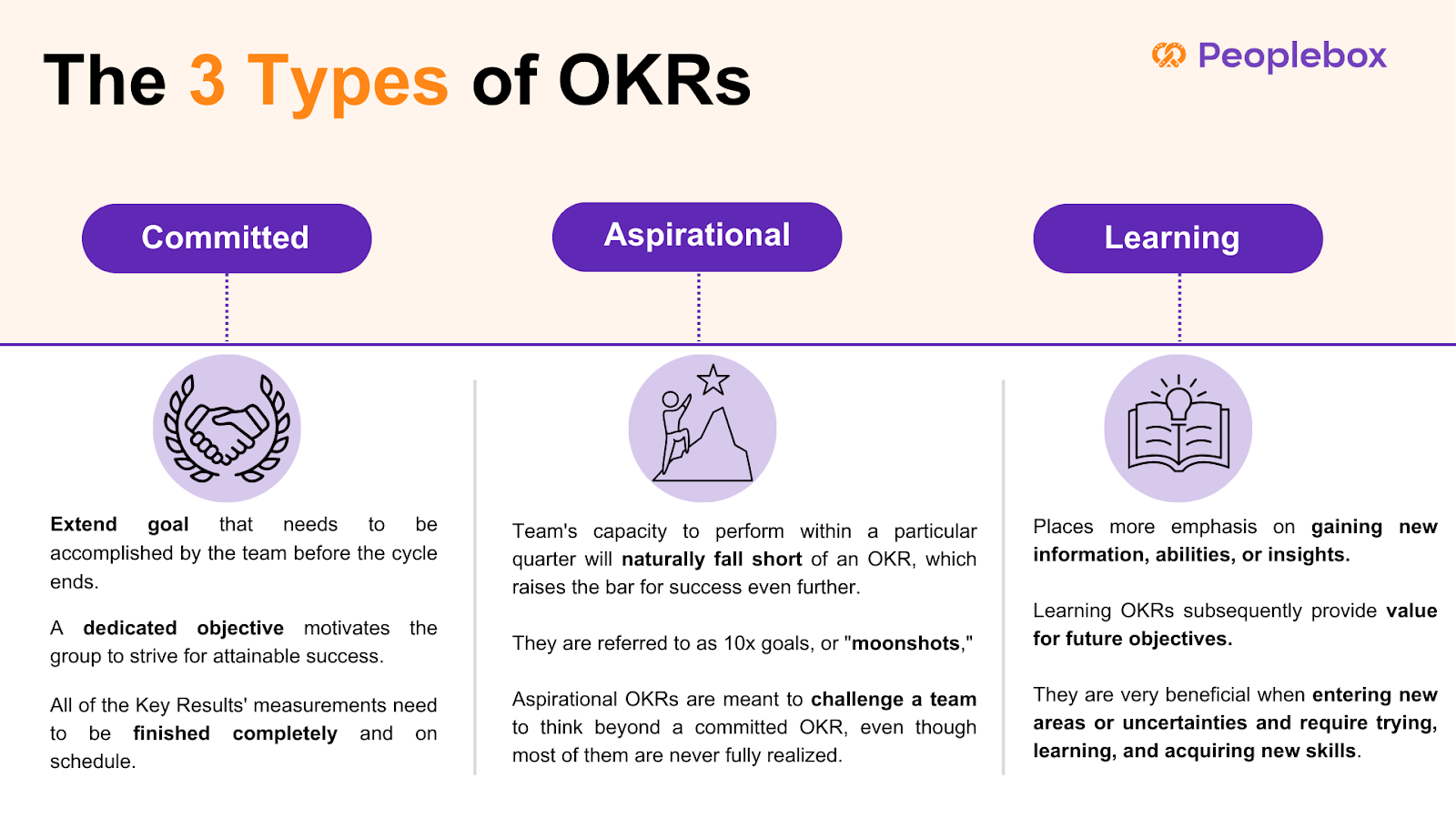
A committed OKR is a stretch goal that the team has to achieve or complete before the cycle is over. A committed goal pushes the team to reach, but still achievable attainment. All metrics of the Key Results must be completed fully and on time. Consider a situation like this:
Daniel’s organization and his teams have agreed to execute certain OKRs and have mapped a precise action plan on how they are going to do so.
These are called Committed OKRs.
An aspirational OKR sets the bar for success further out, and by design will exceed a team’s ability to execute in a given quarter. When they set such a high bar as to be seemingly impossible they are called 10x goals, or “moonshots.” While most aspirational OKRs are never fully achieved, they exist to push a team to think bigger than a committed OKR. Consider the following case:
Martha’s organization is more visionary. They have stretched goals. And her teams are not likely to fully achieve these ambitious goals.
These are called Aspirational OKRs.
Understanding the distinction between aspirational and committed goals is crucial for effective goal-setting and team motivation within the OKR framework. Aspirational goals encourage ambitious thinking and long-term vision, while committed goals focus on immediate, measurable outcomes.
Learning OKR focuses on the acquisition of knowledge, new skills, or insights rather than a direct achievement of business outputs. Extremely helpful when entering new areas or uncertainties and requires experimenting, learning, and developing new skills, Learning OKRs distinguish between usual output measuring of success and measuring acquisition of knowledge, that will later add value for future objectives. For example:
Jerry wants to gain a deep understanding of machine learning to drive full product development. He wants to finish three advanced courses and test his skills by building a model in sandbox.
These are called Learning OKRs.
Aspirational OKRs and Committed OKRs: Key differences
When you aim for the stars, you may come up short, but still reach the moon.
– Larry Page
Read on to find out the key difference between Committed OKRs and Aspirational OKRs.
Objective
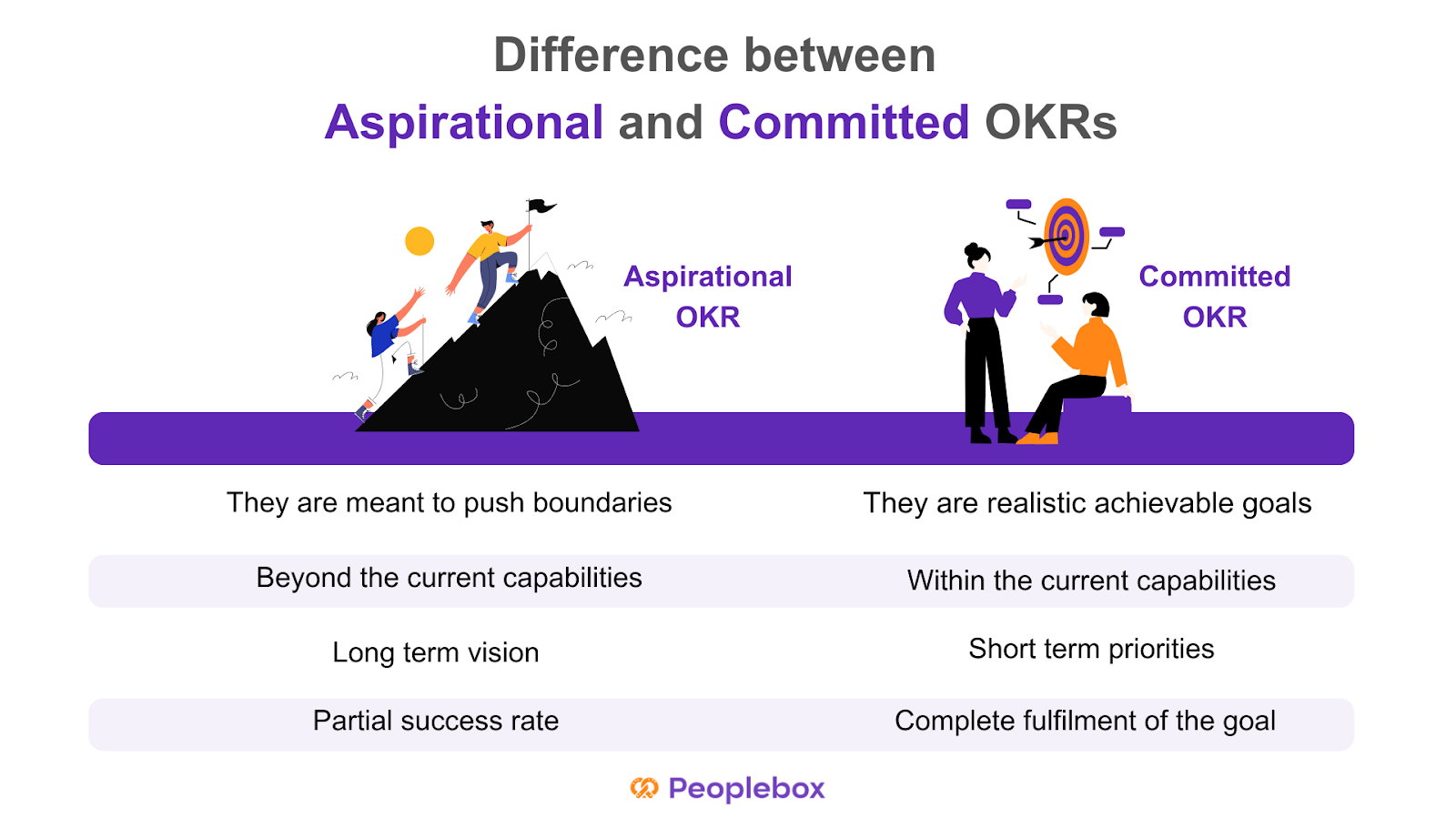
Aspirational OKRs are meant to push the boundaries and encourage employees to achieve visionary objectives. Committed OKRs, on the other hand, focus on committed objectives that offer a more realistic vision of goals with fully achievable results.
Aim
Committed OKRs help companies achieve their goals through individual and team achievements. Aspirational OKRs are often beyond the current capacities of the organization but help in pushing boundaries.
Timeframe
Aspirational OKRs are usually created to focus on long-term strategic vision while Committed OKRs offer short-term operational priorities to guarantee progress in the short term.
Committed OKRs are supposed to have a 100% success rate as each key result comprises fully achievable targets. Aspirational OKRs are usually found to have a success rate of 60-70%.
Committed and Aspirational OKR examples
The difference between committed and aspirational OKRs is subtle. Committed objectives are meant to be fully achievable, requiring teams to concentrate on straightforward priorities without taking unnecessary risks, ultimately serving as motivational tools to foster small wins and consistent progress.
A standard example in the sales team scenario might be like:
Committed OKR
O: Expand to the US market
KR1: Close first 6 start-ups
KR2: Get a meeting-to-close rate of 6%
KR3: Reach average deal size of $200
Aspirational OKR
O: Capture the entire US market in one quarter
KR1: Get onboard 95% of big customers in the US market to grow over competitors
KR2: Get a meeting-to-close rate of 30%
KR3: Reach average deal size of $2000
In the managerial team, these OKRs can manifest like such:
Committed OKR
O: Improve customer satisfaction with the existing solutions
KR1: Increase customer satisfaction score (CSAT) from 85% to 90% by the end of the quarter.
KR2: Reduce average response time from 15 minutes to 10 minutes within the next three months.
KR3: Train 100% of the support team on the new customer service tools within six weeks.
Aspirational OKR
O: Become the market leader in AI-powered customer service solutions.
KR1: Achieve a 30% market share in the AI customer service industry by the end of next year.
KR2: Launch three groundbreaking AI features that no competitor currently offers within 18 months.
KR3: Secure a partnership with at least two top-tier companies by the end of next year.
In a tech context, OKRs like these can come up:
Committed OKR
O: Improve the performance of the app and reliability
KR1: Reduce app crash rate from 2.5% to under 1% within the next quarter.
KR2: Decrease page load times by 30% in six months.
KR3: Fix 100% of the top ten reported bugs within the next two sprints.
Aspirational OKR
O: Revolutionize the user experience of our mobile app.
KR1: Increase daily active users (DAU) by 100% within 12 months.
KR2: Develop and launch a fully AI-driven recommendation system that personalizes the user experience by the end of the year.
KR3: Achieve a 4.8+ rating across app stores by introducing five innovative features within the next 18 months.
How to decide between Committed OKRs and Aspirational OKRs?
Committed OKRs will work best if your organization is newly introduced to the framework or is still in the rolling-out phase.
With each goal achieved, your team’s motivation and engagement will rise higher. In addition, teams easily get into the habit of running Committed OKRs and make it part of their work culture.
But if you have already used the framework in the past, aspirational OKRs can do wonders for you.
Creating a result-driven work culture takes time. It demands discipline, continuous effort, and a mindset shift of employees and management. So you should start simple and focus on learning the methodology first. And set up the necessary processes to make it work.
Setting aspirational OKRs in the very beginning would make your teams feel overwhelmed and over-pressurized. Extremely ambitious Key Results soon become too much to handle. Learning a new methodology takes time. Once your teams are used to the framework and it becomes a part of their work-life, you can consider aspirational OKRs.
With the later process, you can have objectives and a combination of committed and aspirational key results. While some key results will be easier to achieve, others will aim higher. Understanding the distinction between aspirational and committed goals is crucial for better goal-setting and team motivation.
Choosing the Right Type of OKRs
Choosing the right type of OKRs depends on the organization’s goals, culture, and priorities. Committed OKRs are suitable for organizations that need to achieve specific, measurable outcomes within a set timeframe. They are ideal for teams that require a clear direction and a sense of accountability. Aspirational OKRs, on the other hand, are suitable for organizations that want to drive innovation, creativity, and excellence. They are ideal for teams that want to push the boundaries and strive for something bigger.
When choosing between Committed and Aspirational OKRs, consider the following factors:
What are the organization’s goals and priorities?
What type of culture do we want to foster?
What kind of outcomes do we want to achieve?
What level of risk are we willing to take?
By considering these factors, organizations can choose the right type of OKRs that align with their goals, culture, and priorities. Whether you opt for committed or aspirational OKRs, the key is to ensure that they are aligned with your company aims and internal communication processes, fostering a balanced approach to achieving both immediate and long-term objectives.
How to balance Committed and Aspirational OKRs?
There is no one-size-fits-all answer, but where OKRs are aligned with company strategy, teams are well educated, open communication exists, and performance is reviewed regularly, it will help keep the balance between aspirational and committed OKRs intact.
However, the first step in finding equilibrium between the two forms of OKRs is that there has to be a knowledge of the difference. It needs to be apparent from the outset that everyone involved makes it clear the distinction between the two OKRs.
Teams and employees may have suitable insights that will assist in determining what is realistically achievable (committed) and what is a stretch but possible (aspirational). This can help determine what the balance ratio for the OKRs is going to be.
A very critical element to succeed with OKRs is reviewing and tracking the progress. With weekly check-ins, teams can go through their OKRs regularly and update the same performance data. It becomes easy to track how they have progressed on the outcome of the OKR in the OKR review process.
The grading of OKRs is very clear on the distinction between committed and aspirational goals. Committed OKRs are things to be accomplished within the cycle, and grading is binary: pass or fail. That is, an OKR is said to be successful if 100% of it is accomplished; otherwise, it is regarded as a failure. Aspirational OKRs, on the other hand, are graded along a more nuanced scale.
Common mistakes to avoid while setting up Aspirational OKRs
Here are 6 common mistakes organizations commit while setting up aspirational OKRs-
1️⃣Ignoring organizational structure and needs
A common mistake most organizations commit while writing aspirational OKRs is to write something like, “What can be done more if we have extra resources and luck favors us ?” Instead, you can pretend to be a genie and strive to understand “What our customer needs at present moment?”
2️⃣Unrealistic aspirational OKRs
Aspirational OKRs don’t imply setting unrealistic goals. It should be achievable, with the understanding that your teams won’t have any clue about how to achieve these OKRs. Aspirational OKRs demand overuse of resources. They are fluid and flexible. But still helps your teams focus on well-defined goals.
3️⃣Writing a low-value objective (LVO)
Moving forward with a “Who cares?” attitude is a common pitfall among organizations. Low-value objectives go unnoticed even after the successful completion of the key results.
4️⃣OKRs should be framed to gain tangible benefit
OKRs are a tool for organizations to work for big goals in the long run by breaking them into small chunks that can be achieved within a shorter cycle.
5️⃣A committed OKR must deliver a 1.0
It makes the framework stiff and doesn’t leave scope for improvement.
6️⃣Too many OKRs
How many aspirational OKRs you should set for one cycle will depend on your company’s resources. But never aim for too many Objectives and key results. As it can easily divert your focus altogether.
Best Practices for Implementing OKRs
Implementing OKRs requires a structured approach to ensure success. Here are some best practices to consider:
Align OKRs with company goals: Ensure that OKRs align with the organization’s overall goals and priorities.
Make OKRs specific and measurable: Ensure that OKRs are specific, measurable, achievable, relevant, and time-bound (SMART).
Set ambitious yet achievable goals: Set goals that are challenging yet achievable, and provide a clear direction for the team.
Establish clear key results: Establish clear key results that indicate progress towards achieving the objective.
Track progress regularly: Track progress regularly and provide feedback to teams and individuals.
Foster a culture of transparency and accountability: Foster a culture of transparency and accountability, where teams and individuals are held accountable for their progress.
Provide training and support: Provide training and support to teams and individuals to ensure they understand the OKR framework and how to use it effectively.
Review and adjust OKRs regularly: Review and adjust OKRs regularly to ensure they remain relevant and aligned with the organization’s goals.
By following these best practices, organizations can implement OKRs effectively and achieve their goals. Regularly reviewing and adjusting OKRs ensures that they stay aligned with the evolving needs of the organization, helping teams to maintain focus and drive continuous improvement.
Conclusion
Now that you know the difference between committed and aspirational OKRs and how they can impact your organization’s success, it’s the decision time. Choose the one that will best suit your purpose.
And don’t forget it’s a trial and error method. Have regular OKR check-ins and reviews. Collect feedback during and after each cycle. And use your learnings to avoid further mistakes in the next OKR cycle.
Pooja Pooja
Quarterly OKRs: 5 Tips for Successful Wrap-Up
Imagine a scene! the quarter is about to end and it’s time to review and wrap up quarterly OKRs.
The clock’s ticking. Everyone is in a rush. And you are busy evaluating which goals are yet to be achieved. And what has already been done. It’s also time to think about your priorities for the next quarter.
There are so many checklists and questions going in your head.
Have my teams found ways of closing out quarterly OKRs? Will my teams beat the clock and tick all the boxes? Have they reflected on their OKR progress? How will I deal with this end-of-quarter OKRs rush?
Feeling overwhelmed!!
Here is a step by step guide to help you prepare best to wrap up your quarterly OKRs–
Before you start to review and wrap up quarterly OKRs- remember that wrapping up quarterly OKRs is teamwork. And to see the best results every team irrespective of their department have to come together.
Track your team’s OKR progress and gather the key results scores. You can score your OKRs on a scale of 1 to 10 on the basis of how far the objectives have been achieved.
This will help you evaluate your progress in a truly data-driven manner.
If the scores are low this might suggest that your OKRs were unrealistic. On the other hand, if the score is too high it may suggest that your OKRs were not ambitious enough.
Whatever learning you made from this process. It will help you to form the basis for designing your next set of quarterly OKRs.
Make sure everyone is up to date
It is important to ensure that your teams have clarity about their OKR status. At the same time, they have visibility into what other teams have been doing. It can be achieved through regular check-ins with your teams. Check this ebook on OKR handbook.
This step will help you check if your teams are aligned or not. When everyone in your team is on the same page taking decisions based on priorities becomes easy. As you have the data in hand to rely on instead of guessing.
Organize OKR check-ins
The importance of check-ins for OKR success cannot be emphasized enough. OKR check-ins provide you an opportunity to have 1 on 1 discussion in all OKR matters.
With OKR check-ins you can discuss with your leaders and team members about – what went well, what didn’t work for them, what needs to be dealt with immediately, what problems they are facing etc. at an individual as well as team level.
OKR check-ins will help you understand what’s holding teams back. You will further get the chance to push priorities that might have shifted midway.
Dig into opportunities
Organize Quarterly OKRs review meetings to dig into opportunities. During these meetings, go through each key result with your teams. Find out what went well and what needs to be done better.
Let the OKR leaders from each team present their learnings and achievements before everyone. Here teams can give a small presentation highlighting the most important lessons with context.
So that other teams can benefit from their learnings and experiences. And use them in designing their OKRs for the next quarter.
If you are a large-scale company working with multiple departments. The OKR review meetings can be held at the departmental level.
Plan the future
Now that you have gathered the data and matrix you need through OKR check-ins and OKR review meetings. It’s high time to plan for the next quarter.
OKRs have the power to build the future of your organization. But OKR failures can cost you a fortune.
Hence it’s important to find out the core reasons behind your OKR success or failure for the present quarter. And use it as context while designing OKRs for the next quarter.
[elementor-template id=”89725″]
Do you need to plan new OKRs every quarter?
“Should OKRs change every quarter?” is a question often left unanswered.
Even after an OKR is achieved, you can roll it forward for the next quarter if necessary.
For example, if your OKR was to increase customer satisfaction by 20% in the present quarter. This could be relevant even for the next few quarters.
In case, of missed OKRs, you need to take a call. And decide whether you want to carry it forward or set new OKRs based on the data gathered.
When should you review and wrap up Quarterly OKRs
You should preferably wrap up the quarterly OKRs at least a week prior to the beginning of the next quarter.
But the preparation and discussions for the next quarter should be initiated almost a month before the new quarter begins. This is because designing OKRs takes dedication, time, and effort.
Bonus Tips:
Maintain Transparency from day one. Keep data transparent so that everyone knows how it’s going.
Create a culture of critical feedback. Be honest when it comes to feedback. At the same time be open to getting feedback from your teams as well.
Celebrate wins– even the smallest ones. Recognize your teams for their achievements more often.
Over-communicate. Communication is the key when it comes to wrapping up quarterly OKRs.
Take a moment
Wrapping up end-of-quarter OKRs will allow you to pause and take a moment to think. It provides you time to reflect on your wins, failures, and setbacks. It’s a stitch in time to make sure that your OKR framework is a success.
Follow the steps given to close out quarterly OKRs and make the most out of the process.