Every sector, including HR, is rapidly adopting AI in 2024. As of early 2024, about 38% of HR leaders are actively piloting or have already implemented generative AI technologies within their operations, showing a significant increase from 19% in mid-2023. This is in line with another survey where 61% of CHROs planned to invest in AI in 2024.
So, you have a “reward and recognition” segment planned in your annual general meeting and a “best employee” award for every month?
Do you think this is enough for recognizing and appreciating your employees?
Employee recognition is much more than a fleeting term included in management books and training.
A good manager would know that employee recognition is not just about distributing awards or monetary incentives.
It is channelized by genuine interest, honest feedback and a long-term relationship beyond work matters.
Let’s discuss how employee recognition helps a manager.
Why does employee recognition matter for managers?
It encompasses ongoing efforts to build an honest relationship of trust between a manager and her employees.
When a manager recognizes her employees’ efforts, the employees are more likely to feel connected to the manager and the team.
You cannot achieve this level of reliance unless your employees know that you value their work and acknowledge their efforts.
Most studies reveal a direct correlation between employee recognition and employees’ happiness.
In the words of Richard Branson, a British business magnate, investor, author and former philanthropist
I have always believed that the way you treat your employees is the way they will treat your customers, and that people flourish when they are praised.
When an employee knows that her work matters for the team, they do not shy away from going an extra mile.
Employees are the thread that connects your organizations.
They are the hands that help your team achieve its goals and prove your competency as a leader.
As a manager, your primary job is to nurture and retain such talent which can catapult your team goals into a success story.
And, the first step towards securing your employees’ loyalty begins with recognizing their worth and acknowledging their abilities.
[elementor-template id=”89725″]
Why is employee recognition important for remote employees?
When you have remote employees, the need for effective employee recognition becomes all the more important.
Especially during the times of Covid-19, a little praise and recognition from their manager can lift an employee’s spirit.
When you work with your team in the same office space, it is easier to go up to them and pat their backs.
However, the lack of face-to-face connection deprives us of these benefits during remote work.
As a result, a remote employee may start feeling under-appreciated and uninspired.
Hence, it becomes even more crucial to take extra efforts in making them feel recognized and valued.
When they are recognized for the impact of their work, they feel more aligned with the team goal and develop a sense of belonging to the organization.
Working from home in their comfort zone may seem like a great perk but nothing can compare to the feeling of being applauded by their leader.
In this article, we discuss employee recognition at length and talk about the importance of one on one meetings in making an employee feel appreciated.
So, read on as we discover the do’s of employee recognition and how to make them work.
What makes employee recognition effective?
“Hey Taylor, your weekly report was fantastic this time around. The analysis was accurate and to the point – especially the addition of charts made it simple and effective. Thank you for taking care of extra details and keep up the good work.”
The above statement is a great example of what an effective employee recognition looks like.
While it looks simple, it requires considering certain points to deliver a statement that helps employees feel recognized.
Here’s what you need to keep in mind to ensure that your employee recognition efforts are effective
1 Be regular
As stated above, you need to be regular with employee recognition.
Giving an award once a year doesn’t help in creating an environment of trust and value-exchange. In fact, it may seem formal and forceful.
You don’t want your employee to feel like Tina!
When you recognize an employee regularly, they know that you’re paying attention to their work and truly recognize their hard work.
2 Be specific
Saying “good job”may make an employee feel great temporarily.
However, saying “hey, nice work on the presentation’s graphics” tells an employee that you followed their presentation earnestly and appreciate the details they toiled over.
It is more effective and encourages them to continue putting the same efforts.
Thus, you need to dig deeper into their work and find what made it stand out.
3 Be spontaneous
Receiving praise for a job well done immediately after it is over is a different kind of a high for an employee.
Their hard work is fresh in their mind and their manager’s appreciation helps them in realizing that it was worth it.
Recognition delayed is recognition denied!
If you wait for too long to recognize their efforts, its impact will lower down.
This is why it is advised to appreciate your employees regularly, especially in the one on one meetings.
Why are one on one meetings a great idea for employee recognition?
One on one meetings are meant for a manager to give ample amounts of time to each of her employees.
They help in building a relationship that goes beyond workplace requirements and transnational nature.
One on one meetings add a human touch to your communication with your employees and cultivate empathy.
They’re also a great space to praise your employee and appreciate their work due to many reasons.
Here’s why you should include employee appreciation in your next one on one meeting.
1 Personalized discussion
A one one meeting provides a space where a manager can get to know her employees on an individual level.
In a general meeting or scenario, you wouldn’t get a chance to speak more about a single employee and would appreciate the team efforts more.
In a one on one meeting, you can focus on their singular performance and its highlights rather than speaking in generalized terms.
2 Opportunity to get into details
Praise is an outcome of extraordinary efforts and continuous hard work.
During a one on one meeting, you can be more specific with your com pliments and explain how an individual employees’ behaviour has benefited the team goals.
You can discuss the hows’ and why’s of good behaviour and inspire your employees to practice them in future.
3 Regular occurrence
A one on one meeting is a regular part of a manager’s calendar.
You don’t have to find a special time in your schedule to discuss your direct report’s good performance.
You can include it in your one on one meetings’ agenda and dedicate some time to its discussion.
8 ideas for employee recognition during one on one meetings
1 Give positive feedback
Giving feedback is the easiest idea for employee recognition.
It tells your direct report that their work is significant enough to be evaluated and discussed.
Remote employees, especially, look forward to positive feedback as it is their only way to assess how they’ve been doing at their work.
However, it is more than saying “good job” in a zoom meeting or giving a thumbs up while you pass by them in the hallway.
Positive feedback which comprises productive and meaningful actionable insights can lead to the adoption of the right behaviour.
This kind of feedback would require a detailed discussion between you and your direct report.
One on one meetings are the perfect spot for you to give feedback to your employees.
As it is an individual meeting, you can tell each of your direct reports what part of their performance stood out and what made it better.
If you’re unsure about how to give feedback in a manner that it drives better performance. Here are a few real-life examples–
When an employee performs better than usual “Hey, your performance was exceptional last week and it helped us in exceeding our target by 40%. How did you do it? Did you try something new?
When an employee executes a task out of her comfort zone “You were really good at the presentation yesterday. I know that you shy away from public speaking and I really appreciate that you decided to give it a go. Especially the way that you gave examples made the presentation more interesting”
When an employee sets the right examples for behaviour “ We really appreciated the way you asked everyone’s opinion while moderating the conversation. Teamwork has always been our core value and your gesture was a great example of that. Thank you.”
2 Boost morale with positive conversation
Busy schedules and approaching deadlines leave little or no time for meaningful conversations between a manager and her direct report.
Our conversations either revolve around correcting behaviour or discussing technical aspects.
However, if used thoughtfully, a positive conversation can become your go-to ideas for employee recognition.
A conversation involving details of an employee’s behaviour and performance can be of great help to boost morale.
Now, there’s only one way to ensure that you indulge in the right conversations with your direct reports – one on one meetings.
One on one meetings are designed to encourage deeper conversations with a positive outlook between a manager and her direct report.
You have more time to focus on every individual and drive them to right behaviour by stimulating their triggers.
Let’s look at a real-life example of starting a positive conversation –
Dina handles a team of 10 sales associates and is responsible for their performance.
She notices that one of her direct reports, Bryan, has converted a few good leads this week.
In her next one on one meeting with him, she decides to concentrate on this aspect.
She asks him, “your efforts were tremendous this week. We all are so proud of you. What helped you be the star this week? What do you think is going right?”.
Here’s how this conversation helped her make this conversation positive and fruitful
It had praise and recognition for the employee.
It told him that the team has noticed his efforts.
It made him ponder upon the external factors that led him to success.
A positive conversation helps a direct report feel valued, recognized and drives him to identify his support for a good performance.
3 Give them opportunities
Nothing makes an employee feel recognized than getting the right opportunities in their workplace.
When you offer more opportunities to your direct report, you inadvertently recognize their skills and potential to grow.
When employees work from home, they become unsure about where their career is going.
Talking to them about growth opportunities can help them get reassurance about their work.
These opportunities could range from suggesting them the right learning programs to giving them a bigger role in a project.
If these learning opportunities are personalized, they become even more encouraging.
In a one on one meeting, you can discuss each employee’s aspiration and learning curve.
Through detailed conversations, you can help them in choosing what’s good for their growth.
When most ideas for employee recognition fall flat, carving fruitful opportunities help in engaging employees.
Here’re some real-life examples to help you make better opportunities for your direct report in a one on one meeting –
When you see potential in an employee “Hey, I have been noticing that you’re great at analytical reporting. Do you know about this online course which can help you get professional expertise in the same field?”
When you want a direct report to get more responsibility “Hey, your support has helped me a lot in this project. There’s a new project coming up, would you have time to join me on it?”
When you want your direct report to become to be more visible in the organization “Our annual meeting is coming up. I have noticed that you’re great at team activities. Why don’t you join the organization committee?”
Express interest in your employees’ professional development and growth Studies reveal that most employees cite a lack of growth and career development opportunities as the top reason for leaving a job.
During one on one meetings, you get to know the long-term plan an employee has for himself.
You also learn more about their skills, their strengths and can guide them more closely.
However, a good discussion about your direct reports’ career requires the right set of questions and probing.
Here’s a set of questions for you to begin a discussion about your employee’s career growth in your next one on one meeting –
“What future are you looking at in the organization by the end of this year?”
“What skills do you think would be required to achieve it?”
“ What do you enjoy the most in your job?”
“What demonstrated strengths can become your asset in the future?”
4 Ask for their feedback
Suppose you have a direct report called Tim.
Lately, you’ve been noticing that Tim seems to be losing confidence and has become inactive in the team.
You’ve tried giving him the pep talk, and have reassured him about his skills; yet, nothing seems to work.
In this situation, what would you do?
How would you ensure that an employee feels recognized and starts feeling valuable again?
One of the simplest ideas of employee recognition is to ask them for their feedback and opinion.
In this case, you could ask Tim to evaluate a task and ask for his feedback on it.
This act will help him know that you acknowledge and value his skills enough to ask for his validation.
Your gesture of confidence in his talent will reinstate his faith in himself.
While you could always ask for their feedback at any time of the day, a one on one meeting is an ideal setup to start this conversation.
One on one meetings are private and help in making employees feel confident.
They would be able to express themselves with freedom and put forward their real opinion.
When they can express themselves and see their opinion being given the right importance, it helps them in feeling recognized.
So, next time if you feel your direct report seems lost, ask her for feedback on current projects and prevalent organizational practices.
5 Go beyond regular status updates
One on one meetings were conceptualized to help build rapport between a manager and her direct employee.
If you want to build a team that goes an extra mile, you need to have a relationship which goes above professional exchanges with your direct reports.
Your status updates and information regarding ongoing projects can be left for your regular meetings.
In one on one settings, you need to discuss the real person behind your direct report.
Your willingness to understand their stance and their ambitions can act as a major motivator and make them feel recognized.
In times such as the current pandemic, you need to make yourself even more available for your direct reports.
They might be facing multiple issues owing to sudden shifts in work setup and additional responsibilities.
In a one on one meeting, you must allow your direct reports to vent out their feelings and assure them your support.
While there may be a hundred ideas for employee recognition, all you need in reality is a genuine interest in your direct reports and their journey.
Begin your conversations with topics that can help you break the ice. Here are some questions to help you through.
Start with a question about their well-being. A “How are you?” asking with an earnest interest can help you start the conversation in a good mood.
Ask them about their family and share details about your own.
Collaborate with them on setting the agenda. It will help them to mention important topics to cover.
Share stories from your career and tell them how they shaped you.
Discuss your failures and encourage them not to get disheartened.
Pro tip: If you are finding it difficult to gather your thoughts around one on one meeting, you can always take help from an online one on one meetings tool. It can help you in setting agenda, fixing reminders and follow-up actions.
[elementor-template id=”89725″]
6 Keep some time in every one on one to talk about their accomplishments
When an employee walks in their office every day, they bring with themselves a hope to make a difference with their performance.
Receiving praise and getting recognized from their seniors boosts their confidence which translates into better results.
What makes the praise even better is personalization and details.
And there’s only one way a manager can make compliments long and honest – one on one meetings.
In a one on one meeting, you can discuss the trivial points which made your direct report perform better.
The more specific your praise is, the more valued your direct report will feel.
When employees work from home, they live in a constant fear of their work being overshadowed.
So, when you discuss their good performance and its minute details, they get reassured of their work’s value in the organization.
Thus, keeping some time aside to discuss the progress in a one on one meeting is crucial for meaningful employee recognition.
Here’s how you can start discussing your employees’ progress in a one on one meeting-
Suppose you have a direct report called Tina and she’s become much better at preparing excel reports.
During your one on one meeting, you can start the conversation about this topic in the following manner – “ hey, I noticed that your reports are crisper now. Have you learned new tricks?”
This statement will act as praise, help them feel recognized and inspire them to put more effort.
7 Set small targets for your employees
Right goals are important for an employee to know how her career is shaping up and is aligned with the company’s objectives.
According to research, only 14% of employees understand their company’s strategies and direction.
When an employee knows the importance of her role in the organization, she feels engaged and motivated.
As a manager, it is your responsibility to help them envision the importance of their task in the bigger picture.
The best time to do that is in a one on one meeting where you can explain how their performance adds up to the efficiency of the team goal.
During a one on one meeting, you can help them set achievable goals for themselves so that they know where their career is headed.
Knowing that their manager is interested in their goals brings about an immense feeling of recognition and value.
Thus, ensure that your next one on one meeting has time kept aside for discussing goals for your direct reports.
8 Express gratitude
Sometimes, it just takes a small but genuine “thank you” to make an employee feel immensely appreciated and recognized.
The power of these two simple words have a ripple effect and it shows on direct reports’ morale, enthusiasm and proactiveness.
An expression of gratitude shows that the organization cares about them and values their hard work.
In fact, expressing gratitude can be a great way to start your one on one meeting.
It can steer the conversation towards your direct report’s strength and positive aspects.
And showing gratitude directly impacts an employee’s engagement, morale and happiness quotient.
Saying “thank you” can even help you change your direct reports mood in a jiffy. Let us show you by an example –
Suppose you’ve an employee named Rob in your team. He has been working long hours in a project as another member of your team had to take a sick leave.
The work pressure is quite visible on his demeanour and he seems to be losing morale.
Here’s how you can make him feel better by recognizing his extra efforts –
Start your one on one meeting with the following statements –
“Firstly, I need to thank you for giving your all to this project. We wouldn’t have reached this stage without you.
“Hey, the management is extremely grateful to you for pitching in. You have set an example for others.”
Wrapping up
Employee recognition begins the day a manager starts treating each direct report like her mentee and lets them open up to her.
Employee recognition begins when a manager ensures that her one on one meetings are productive and contribute to the growth of an employee.
One on one meetings are your most effective tool to help employees feel valued, cared for and listened to.
All you need to do is take an honest interest in an employee’s well-being and rest assured – you won’t need a list of ideas for employee recognition.
PS: Read the full guide to employee engagement for remote managers HERE.
What stood out is the deep understanding of the Peoplebox.ai team and their willingness to listen & enhance the platform to scale with our long-term needs.
Khilan Haria
VP and Head of Payments Product, Razorpay
I'm glad that we partnered with Peoplebox.ai for our company-wide OKR rollout. Thanks to its simplicity, we achieved significant adoption within two quarters
Rohit Arumugam
Business Head, Nova Benefits
Since we started using Peoplebox.ai, we have been able to bring all of our leadership across the organization together and show them how all of our goals align
Jaclyn Hoover
Senior Director HR, Propel School
Driving the entire interface through slack is simply brilliant especially for a tech product company! There was zero time spent on training! It can not get easier than that!
Swapna Nair
VP - HR, Khatabook
I chose Peoplebox.ai because it had integrations with the tools we use for sales and engineering to automate updating of key results and sync projects
How to Roll Out OKRs for First Time: 7 Steps Startegy
How to Roll out OKRs for the first time is a question common among organizations just introducing OKRs.
Imagine a scenario-
You are rolling out OKR for the first time.
One thing goes wrong and… Boom!
Your employees are already hating the process- even before it took a pace.
You certainly wouldn’t want that to happen in your organization. OKRs can surcharge and accelerate your organizational growth. But the key is to get this done right.
That’s why a well-planned rollout is significant for the success of an OKR system.
Introduce the new goal-setting approach strategically but not in a mechanical process. Every organization is unique and can face unique challenges while implementing OKRs.
[elementor-template id=”89725″]
How to roll out OKRs: Here are 7 Best Practices for a successful OKR rollout
1 Communicate the OKR Methodology to all the teams
Get everyone in the organization on board with OKRs. Present the concept clearly and precisely. Educate everyone on the OKR language.
While some people will embrace the changes with open arms, there are also going to be some skeptics into the bargain. You must let them express their concerns and provide answers to their “why, how, and what?” questions.
Explain to them the benefits of implementing the OKR framework. Highlight how it’s going to impact the business and the individual success of the employees.
Organize workshops, training, discussions, introductory presentations, and seminars to help your employees’ design quality OKRs. Transparently explain to them the strategic execution, alignment, expectations, and tools they will be required to use for the purpose.
To help everyone speak the same language, document your company OKR framework
2 Inspire with success stories
List the names of reputed companies like Google, Netflix, Intel, LinkedIn, Twitter, etc. which have successfully implemented OKRs. Narrate their success stories to help them visualize how OKRs can cater to their individual success.
For example, OKRs helped LinkedIn become a 20 Billion Company. Jeff Weiner, CEO of LinkedIn, describes OKRs as, “something you want to accomplish over a specific period of time that leans toward a stretch goal rather than a stated plan.
It’s something where you want to create greater urgency, greater mindshare.”
You can either go for an organization-wide rollout Consider running an OKR Pilot first, depending on what fits you best.
If you have a culture that’s open to change and a flexible structure of functioning, an organization-wide rollout will work best for you. But it’s always best to take small steps. Start from one part and gradually move to others.
[elementor-template id=”89725″]
Crafting and implementing OKRs across the entire organization can seem overwhelming especially if you are a large organization. Instead, choose a particular part of the organization and run a pilot project.
“If you concentrate on small, manageable steps you can cross unimaginable distances.”
It’s also important to decide “how often?” will OKRs be reviewed. Will it be done quarterly or annually?
4 Go for the Top-down approach
A top-down approach to OKRs was the first pattern attempted. The top management has a significant role in setting the overall direction of the company. Starting from the top provides clarity for the rest of the organization.
“People buy into the leader before they buy into the vision.”
For example, you can start with the senior leadership team. Make them an example to roll out OKRs to the departmental heads. From there you can move on to team leaders, and to the rest of your teams.
5 Get aligned
You can’t just sit with a blank sheet in front and magically start crafting the perfect OKRs. You need to understand the context. Make the company mission and vision your starting point and tailor your OKRs accordingly.
Buy-ins are critical for OKR success. The success of OKRs depends on the collective effort of each team member. You can imagine it as a group dance performance where everyone needs to perform their parts well to make it a masterpiece.
Thus you need to align the efforts of the workforce, executive leaders, and company heads both horizontally and vertically. This will help you foster transparency, smooth cross-functional communication, and reduce overlap among departments.
6 Track and monitor progress
Tracking OKRs are important to evaluate and measure the progress and understand which teams are falling short.
You can identify any issues and make course corrections as required by Monitoring progress.
Leverage technology to track OKRs. It will make the process transparent.
Using OKR software will also automate the calculations and save your time as you are no longer required to manually update the progress of each team member.
Bonus tip: Remember to celebrate whenever you Hit the nail on the head through OKR win meetings and shoutouts to keep
7 Do frequent check-ins
To stay on top of OKR progress, you need to do regular check-ins. Employees might feel overwhelmed with concerns and doubts, especially in the initial days.
Regular check-ins will give your employees direction. And provide them the required assistance and guidance. Frequent Check-in meetings will also identify the overlappings, increase accountability and ensure execution.
Define your preferred frequency of Check-in meetings. You can do it weekly or monthly as per your organization’s needs. Although weekly check-ins are most recommended to keep track of the progress and evaluate continuously.
Have OKR Champions
Consider having OKR champion who starts implementing the OKR framework with a strong war cry. Build a team of champions who will work as ambassadors to head the change. And make the OKR framework run smoothing across the organization.
They work as mentors and internal OKR experts. And can help you adopt and execute OKRs at all levels of the organization. These OKR enthusiasts will make sure that every concern is addressed, every ‘whys and wherefores’ are explained.
Too many objectives and key results: Less is more. Don’t set more than 5-7 Objectives and 3-5 key results.
Fill it, Forget it: Don’t set OKRs just to forget in a few days.
Mixing KPIs with OKRs: KPIs aren’t a substitution for OKRs. They have separate roles and outcomes.
Rigidity: Rigid adherence to rules can lead to disengagement. Instead, move forward with a flexible and intuitive OKR approach
Link OKRs with Recognition: Don’t make the mistake of making OKRs a base for your reward and recognition program. It can negatively affect performance. And compromises the business output.
The start is never perfect
You might struggle when you are just starting. But after a few OKR cycles, you are sure to hit your stride.
To end, OKR’s success depends on consistency. So, remember to continuously reflect, learn, and refine the process.
Hope we were able to answer all your queries in our blog How to roll out OKRs for the first time? If you have questions feel free to comment below.
Pooja Pooja
Types of OKRs: Aspirational OKRs vs Committed OKRs
Every organization wants to grow, but how do you set goals that are both achievable and visionary? The answer lies in the types of OKRs: committed and aspirational.
Whether it’s near-term performance or long-term innovation for your business, you’ll know just how to leverage the power of committed and aspirational OKRs effectively to unlock new levels of success for your business.
Committed OKRs are about clear, attainable targets that teams can confidently deliver within a set timeframe. This type of OKR delivers accountability and is important for day-to-day business success.
Aspirational OKRs, on the other hand; push teams to be bigger and challenge themselves. The moonshots: ambitious OKRs are meant to stretch an organization from its comfort zone, kindling innovation and long-term growth.
In the rest of this blog, we will take the difference between these two types of OKR apart and see how to balance them in such a way that they enable performance as well as inspiration.
What are Aspirational OKRs and Other Types of OKRs?
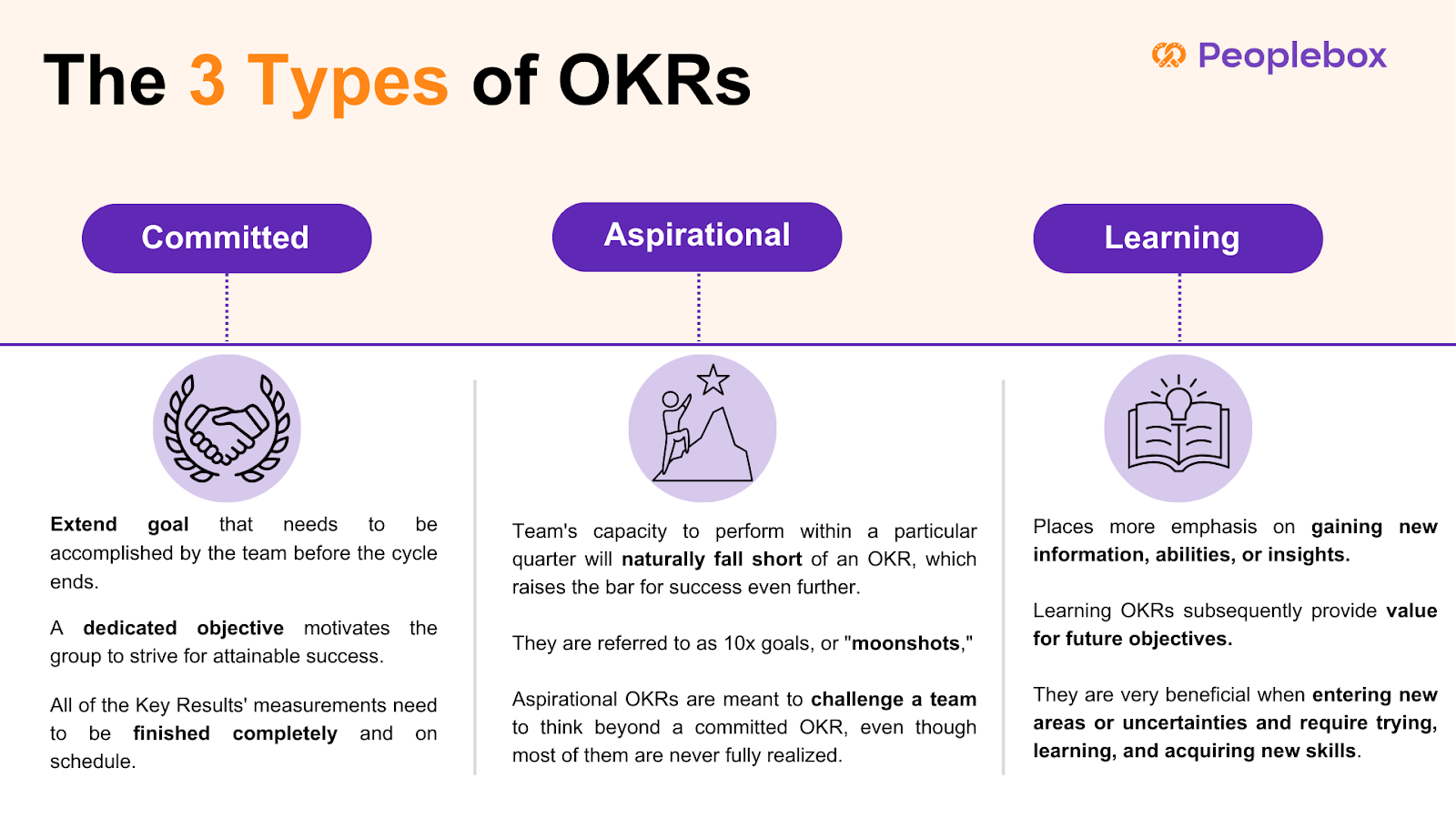
A committed OKR is a stretch goal that the team has to achieve or complete before the cycle is over. A committed goal pushes the team to reach, but still achievable attainment. All metrics of the Key Results must be completed fully and on time. Consider a situation like this:
Daniel’s organization and his teams have agreed to execute certain OKRs and have mapped a precise action plan on how they are going to do so.
These are called Committed OKRs.
An aspirational OKR sets the bar for success further out, and by design will exceed a team’s ability to execute in a given quarter. When they set such a high bar as to be seemingly impossible they are called 10x goals, or “moonshots.” While most aspirational OKRs are never fully achieved, they exist to push a team to think bigger than a committed OKR. Consider the following case:
Martha’s organization is more visionary. They have stretched goals. And her teams are not likely to fully achieve these ambitious goals.
These are called Aspirational OKRs.
Understanding the distinction between aspirational and committed goals is crucial for effective goal-setting and team motivation within the OKR framework. Aspirational goals encourage ambitious thinking and long-term vision, while committed goals focus on immediate, measurable outcomes.
Learning OKR focuses on the acquisition of knowledge, new skills, or insights rather than a direct achievement of business outputs. Extremely helpful when entering new areas or uncertainties and requires experimenting, learning, and developing new skills, Learning OKRs distinguish between usual output measuring of success and measuring acquisition of knowledge, that will later add value for future objectives. For example:
Jerry wants to gain a deep understanding of machine learning to drive full product development. He wants to finish three advanced courses and test his skills by building a model in sandbox.
These are called Learning OKRs.
Aspirational OKRs and Committed OKRs: Key differences
When you aim for the stars, you may come up short, but still reach the moon.
– Larry Page
Read on to find out the key difference between Committed OKRs and Aspirational OKRs.
Objective
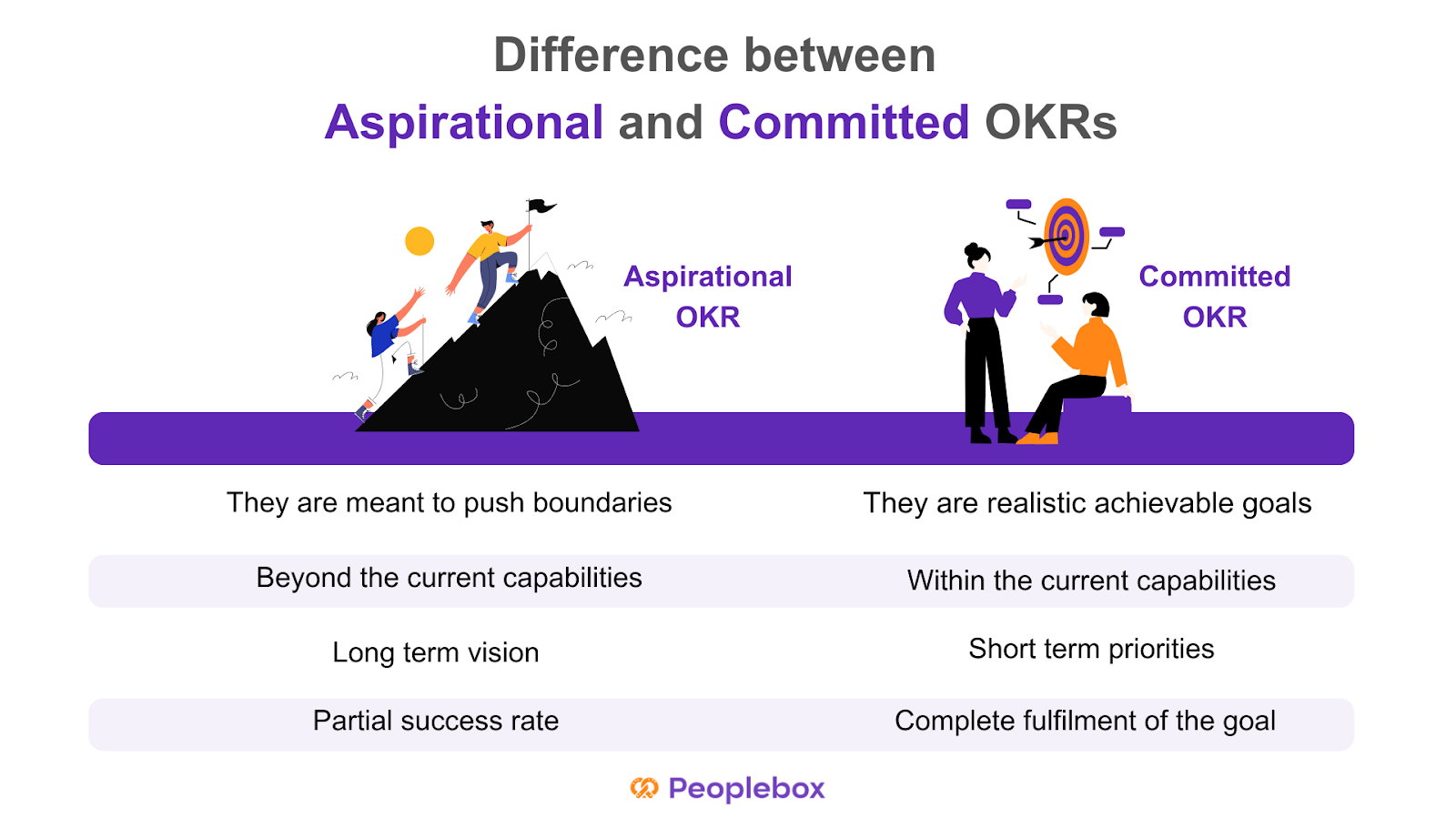
Aspirational OKRs are meant to push the boundaries and encourage employees to achieve visionary objectives. Committed OKRs, on the other hand, focus on committed objectives that offer a more realistic vision of goals with fully achievable results.
Aim
Committed OKRs help companies achieve their goals through individual and team achievements. Aspirational OKRs are often beyond the current capacities of the organization but help in pushing boundaries.
Timeframe
Aspirational OKRs are usually created to focus on long-term strategic vision while Committed OKRs offer short-term operational priorities to guarantee progress in the short term.
Committed OKRs are supposed to have a 100% success rate as each key result comprises fully achievable targets. Aspirational OKRs are usually found to have a success rate of 60-70%.
Committed and Aspirational OKR examples
The difference between committed and aspirational OKRs is subtle. Committed objectives are meant to be fully achievable, requiring teams to concentrate on straightforward priorities without taking unnecessary risks, ultimately serving as motivational tools to foster small wins and consistent progress.
A standard example in the sales team scenario might be like:
Committed OKR
O: Expand to the US market
KR1: Close first 6 start-ups
KR2: Get a meeting-to-close rate of 6%
KR3: Reach average deal size of $200
Aspirational OKR
O: Capture the entire US market in one quarter
KR1: Get onboard 95% of big customers in the US market to grow over competitors
KR2: Get a meeting-to-close rate of 30%
KR3: Reach average deal size of $2000
In the managerial team, these OKRs can manifest like such:
Committed OKR
O: Improve customer satisfaction with the existing solutions
KR1: Increase customer satisfaction score (CSAT) from 85% to 90% by the end of the quarter.
KR2: Reduce average response time from 15 minutes to 10 minutes within the next three months.
KR3: Train 100% of the support team on the new customer service tools within six weeks.
Aspirational OKR
O: Become the market leader in AI-powered customer service solutions.
KR1: Achieve a 30% market share in the AI customer service industry by the end of next year.
KR2: Launch three groundbreaking AI features that no competitor currently offers within 18 months.
KR3: Secure a partnership with at least two top-tier companies by the end of next year.
In a tech context, OKRs like these can come up:
Committed OKR
O: Improve the performance of the app and reliability
KR1: Reduce app crash rate from 2.5% to under 1% within the next quarter.
KR2: Decrease page load times by 30% in six months.
KR3: Fix 100% of the top ten reported bugs within the next two sprints.
Aspirational OKR
O: Revolutionize the user experience of our mobile app.
KR1: Increase daily active users (DAU) by 100% within 12 months.
KR2: Develop and launch a fully AI-driven recommendation system that personalizes the user experience by the end of the year.
KR3: Achieve a 4.8+ rating across app stores by introducing five innovative features within the next 18 months.
How to decide between Committed OKRs and Aspirational OKRs?
Committed OKRs will work best if your organization is newly introduced to the framework or is still in the rolling-out phase.
With each goal achieved, your team’s motivation and engagement will rise higher. In addition, teams easily get into the habit of running Committed OKRs and make it part of their work culture.
But if you have already used the framework in the past, aspirational OKRs can do wonders for you.
Creating a result-driven work culture takes time. It demands discipline, continuous effort, and a mindset shift of employees and management. So you should start simple and focus on learning the methodology first. And set up the necessary processes to make it work.
Setting aspirational OKRs in the very beginning would make your teams feel overwhelmed and over-pressurized. Extremely ambitious Key Results soon become too much to handle. Learning a new methodology takes time. Once your teams are used to the framework and it becomes a part of their work-life, you can consider aspirational OKRs.
With the later process, you can have objectives and a combination of committed and aspirational key results. While some key results will be easier to achieve, others will aim higher. Understanding the distinction between aspirational and committed goals is crucial for better goal-setting and team motivation.
Choosing the Right Type of OKRs
Choosing the right type of OKRs depends on the organization’s goals, culture, and priorities. Committed OKRs are suitable for organizations that need to achieve specific, measurable outcomes within a set timeframe. They are ideal for teams that require a clear direction and a sense of accountability. Aspirational OKRs, on the other hand, are suitable for organizations that want to drive innovation, creativity, and excellence. They are ideal for teams that want to push the boundaries and strive for something bigger.
When choosing between Committed and Aspirational OKRs, consider the following factors:
What are the organization’s goals and priorities?
What type of culture do we want to foster?
What kind of outcomes do we want to achieve?
What level of risk are we willing to take?
By considering these factors, organizations can choose the right type of OKRs that align with their goals, culture, and priorities. Whether you opt for committed or aspirational OKRs, the key is to ensure that they are aligned with your company aims and internal communication processes, fostering a balanced approach to achieving both immediate and long-term objectives.
How to balance Committed and Aspirational OKRs?
There is no one-size-fits-all answer, but where OKRs are aligned with company strategy, teams are well educated, open communication exists, and performance is reviewed regularly, it will help keep the balance between aspirational and committed OKRs intact.
However, the first step in finding equilibrium between the two forms of OKRs is that there has to be a knowledge of the difference. It needs to be apparent from the outset that everyone involved makes it clear the distinction between the two OKRs.
Teams and employees may have suitable insights that will assist in determining what is realistically achievable (committed) and what is a stretch but possible (aspirational). This can help determine what the balance ratio for the OKRs is going to be.
A very critical element to succeed with OKRs is reviewing and tracking the progress. With weekly check-ins, teams can go through their OKRs regularly and update the same performance data. It becomes easy to track how they have progressed on the outcome of the OKR in the OKR review process.
The grading of OKRs is very clear on the distinction between committed and aspirational goals. Committed OKRs are things to be accomplished within the cycle, and grading is binary: pass or fail. That is, an OKR is said to be successful if 100% of it is accomplished; otherwise, it is regarded as a failure. Aspirational OKRs, on the other hand, are graded along a more nuanced scale.
Common mistakes to avoid while setting up Aspirational OKRs
Here are 6 common mistakes organizations commit while setting up aspirational OKRs-
1️⃣Ignoring organizational structure and needs
A common mistake most organizations commit while writing aspirational OKRs is to write something like, “What can be done more if we have extra resources and luck favors us ?” Instead, you can pretend to be a genie and strive to understand “What our customer needs at present moment?”
2️⃣Unrealistic aspirational OKRs
Aspirational OKRs don’t imply setting unrealistic goals. It should be achievable, with the understanding that your teams won’t have any clue about how to achieve these OKRs. Aspirational OKRs demand overuse of resources. They are fluid and flexible. But still helps your teams focus on well-defined goals.
3️⃣Writing a low-value objective (LVO)
Moving forward with a “Who cares?” attitude is a common pitfall among organizations. Low-value objectives go unnoticed even after the successful completion of the key results.
4️⃣OKRs should be framed to gain tangible benefit
OKRs are a tool for organizations to work for big goals in the long run by breaking them into small chunks that can be achieved within a shorter cycle.
5️⃣A committed OKR must deliver a 1.0
It makes the framework stiff and doesn’t leave scope for improvement.
6️⃣Too many OKRs
How many aspirational OKRs you should set for one cycle will depend on your company’s resources. But never aim for too many Objectives and key results. As it can easily divert your focus altogether.
Best Practices for Implementing OKRs
Implementing OKRs requires a structured approach to ensure success. Here are some best practices to consider:
Align OKRs with company goals: Ensure that OKRs align with the organization’s overall goals and priorities.
Make OKRs specific and measurable: Ensure that OKRs are specific, measurable, achievable, relevant, and time-bound (SMART).
Set ambitious yet achievable goals: Set goals that are challenging yet achievable, and provide a clear direction for the team.
Establish clear key results: Establish clear key results that indicate progress towards achieving the objective.
Track progress regularly: Track progress regularly and provide feedback to teams and individuals.
Foster a culture of transparency and accountability: Foster a culture of transparency and accountability, where teams and individuals are held accountable for their progress.
Provide training and support: Provide training and support to teams and individuals to ensure they understand the OKR framework and how to use it effectively.
Review and adjust OKRs regularly: Review and adjust OKRs regularly to ensure they remain relevant and aligned with the organization’s goals.
By following these best practices, organizations can implement OKRs effectively and achieve their goals. Regularly reviewing and adjusting OKRs ensures that they stay aligned with the evolving needs of the organization, helping teams to maintain focus and drive continuous improvement.
Conclusion
Now that you know the difference between committed and aspirational OKRs and how they can impact your organization’s success, it’s the decision time. Choose the one that will best suit your purpose.
And don’t forget it’s a trial and error method. Have regular OKR check-ins and reviews. Collect feedback during and after each cycle. And use your learnings to avoid further mistakes in the next OKR cycle.
Pooja Pooja
Quarterly OKRs: 5 Tips for Successful Wrap-Up
Imagine a scene! the quarter is about to end and it’s time to review and wrap up quarterly OKRs.
The clock’s ticking. Everyone is in a rush. And you are busy evaluating which goals are yet to be achieved. And what has already been done. It’s also time to think about your priorities for the next quarter.
There are so many checklists and questions going in your head.
Have my teams found ways of closing out quarterly OKRs? Will my teams beat the clock and tick all the boxes? Have they reflected on their OKR progress? How will I deal with this end-of-quarter OKRs rush?
Feeling overwhelmed!!
Here is a step by step guide to help you prepare best to wrap up your quarterly OKRs–
Before you start to review and wrap up quarterly OKRs- remember that wrapping up quarterly OKRs is teamwork. And to see the best results every team irrespective of their department have to come together.
Track your team’s OKR progress and gather the key results scores. You can score your OKRs on a scale of 1 to 10 on the basis of how far the objectives have been achieved.
This will help you evaluate your progress in a truly data-driven manner.
If the scores are low this might suggest that your OKRs were unrealistic. On the other hand, if the score is too high it may suggest that your OKRs were not ambitious enough.
Whatever learning you made from this process. It will help you to form the basis for designing your next set of quarterly OKRs.
Make sure everyone is up to date
It is important to ensure that your teams have clarity about their OKR status. At the same time, they have visibility into what other teams have been doing. It can be achieved through regular check-ins with your teams. Check this ebook on OKR handbook.
This step will help you check if your teams are aligned or not. When everyone in your team is on the same page taking decisions based on priorities becomes easy. As you have the data in hand to rely on instead of guessing.
Organize OKR check-ins
The importance of check-ins for OKR success cannot be emphasized enough. OKR check-ins provide you an opportunity to have 1 on 1 discussion in all OKR matters.
With OKR check-ins you can discuss with your leaders and team members about – what went well, what didn’t work for them, what needs to be dealt with immediately, what problems they are facing etc. at an individual as well as team level.
OKR check-ins will help you understand what’s holding teams back. You will further get the chance to push priorities that might have shifted midway.
Dig into opportunities
Organize Quarterly OKRs review meetings to dig into opportunities. During these meetings, go through each key result with your teams. Find out what went well and what needs to be done better.
Let the OKR leaders from each team present their learnings and achievements before everyone. Here teams can give a small presentation highlighting the most important lessons with context.
So that other teams can benefit from their learnings and experiences. And use them in designing their OKRs for the next quarter.
If you are a large-scale company working with multiple departments. The OKR review meetings can be held at the departmental level.
Plan the future
Now that you have gathered the data and matrix you need through OKR check-ins and OKR review meetings. It’s high time to plan for the next quarter.
OKRs have the power to build the future of your organization. But OKR failures can cost you a fortune.
Hence it’s important to find out the core reasons behind your OKR success or failure for the present quarter. And use it as context while designing OKRs for the next quarter.
[elementor-template id=”89725″]
Do you need to plan new OKRs every quarter?
“Should OKRs change every quarter?” is a question often left unanswered.
Even after an OKR is achieved, you can roll it forward for the next quarter if necessary.
For example, if your OKR was to increase customer satisfaction by 20% in the present quarter. This could be relevant even for the next few quarters.
In case, of missed OKRs, you need to take a call. And decide whether you want to carry it forward or set new OKRs based on the data gathered.
When should you review and wrap up Quarterly OKRs
You should preferably wrap up the quarterly OKRs at least a week prior to the beginning of the next quarter.
But the preparation and discussions for the next quarter should be initiated almost a month before the new quarter begins. This is because designing OKRs takes dedication, time, and effort.
Bonus Tips:
Maintain Transparency from day one. Keep data transparent so that everyone knows how it’s going.
Create a culture of critical feedback. Be honest when it comes to feedback. At the same time be open to getting feedback from your teams as well.
Celebrate wins– even the smallest ones. Recognize your teams for their achievements more often.
Over-communicate. Communication is the key when it comes to wrapping up quarterly OKRs.
Take a moment
Wrapping up end-of-quarter OKRs will allow you to pause and take a moment to think. It provides you time to reflect on your wins, failures, and setbacks. It’s a stitch in time to make sure that your OKR framework is a success.
Follow the steps given to close out quarterly OKRs and make the most out of the process.