
























Logo of Peoplebox.ai - blue font

BLOG / Ai Interview, Talent Acquisition

20 Best AI Recruiting Software to Consider in 2026

Written by:
Zenobia Zenobia

The art of aligning Performance

New research into how marketers are using AI and key insights into the future of marketing with AI.
Download for Free
December 19, 2025

Hiring teams wrestle with packed inboxes, fight through slow scheduling, and see one strong candidate after another vanish. Top AI interview tools for recruiters tackle these problems by automating screening, cutting bias, and getting applicants from résumé to offer faster than it takes to finish your morning coffee. 

Recruiters shave hours off their workload, candidates hear back in no time, and companies lock in the right hire before the coffee’s gone cold.

How Top AI Interview Tool for Recruiters Improves Efficiency and Candidate Experience?

  • It handles resume screening and takes care of the first round of interviews, quickly sorting through stacks of applications. 
  • It taps into predictive analytics to quickly rank the best candidates, like spotting the strongest résumé in the stack within seconds. 
  • It helps you connect right away, skipping that long, uncomfortable pause—like waiting for a text that never comes.

Key Features to Look for in Top AI interview tool for recruiters

  1. Automated Resume Screening and Enrichment
  • AI combs through resumes, then pieces together profiles using LinkedIn details and stray bits of public data, like a job title tucked in an old press release. 
  • Recruiters can pick out top talent in seconds, cutting down long hours of resume screening sometimes by nearly 90%.
  1. AI recruitment toolsVideo Interviews and Assessments
  • A genuine, face-to-face interview weighs your skills, watches how you carry yourself, and tunes into your voice catching, for example, the slight drop in tone halfway through a sentence as steam curls from a fresh cup of coffee. 
  • The built-in scoring system keeps the playing field level by applying the same clear standards to everyone, such as tapping out each note to a steady, unchanging rhythm.
  1. Seamless ATS Integration and Data Analytics
  • It plugs right into Applicant Tracking Systems (ATS) and keeps the workflow moving, as effortlessly as fresh ink gliding across paper. 
  • It gives you clear, practical analytics that fine-tune your hiring strategy and let you spot future stars early sometimes before you’ve even shaken their hand.

At a Glance: 20 Best AI recruitment tools for 2026

Tool Best For Unique Strengths Pricing Model 
Peoplebox.ai  AI Interviews + Screening + Full automation Human-like AI voice/video interviews, resume enrichment, structured reports, ATS integrations Starts ~$7–$15/user/mo (AI hiring add-on tiers vary)
Skima AI AI search + resume matching On-prem option, secure models (no external LLMs), deep resume analysis Custom / Enterprise
HireVue AI video interviews + assessments Enterprise compliance + structured scoring Custom pricing
Paradox Olivia AI chatbot engagement + scheduling 24/7 hiring assistant, candidate Q&A Custom / Usage-based
Pymetrics Behavioral & cognitive AI assessments Neuroscience-based job matching Custom pricing
Eightfold AI Talent intelligence + internal mobility Skill maps, career path prediction Enterprise custom
SeekOut AI sourcing + diversity hiring Deep web + public data sourcing Custom pricing
HireEZ Passive talent sourcing Contact discovery + cross-platform aggregation Custom pricing
Fetcher Automated sourcing + outreach AI sourcing plus automated personalized sequencing Custom pricing
XOR AI chatbot for screening SMS + WhatsApp automation Custom pricing

20 Best AI recruitment tools for 2026

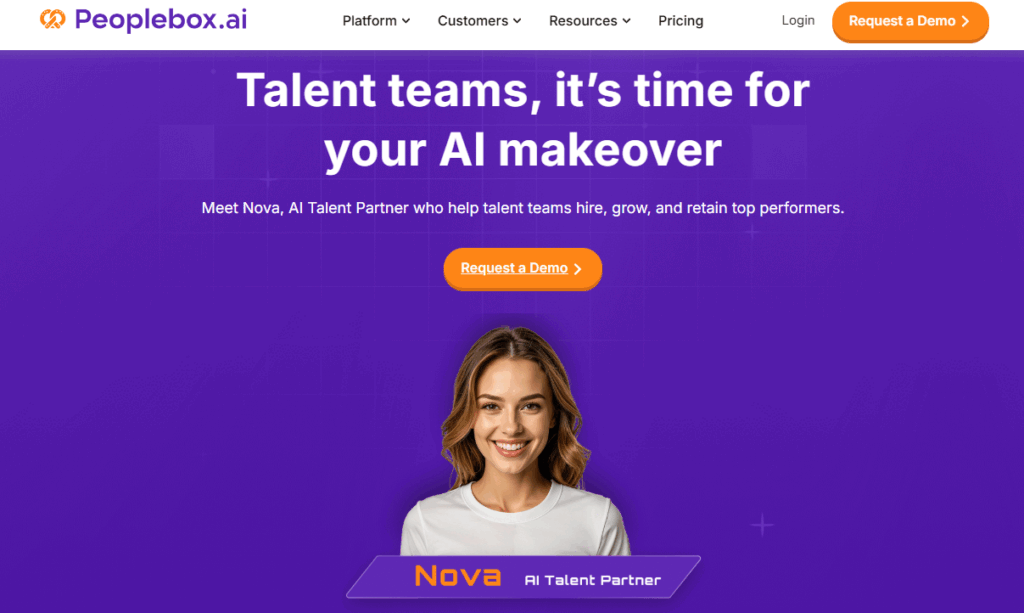
A purple-themed hero section from the Peoplebox.ai website featuring Nova, an AI Talent Partner. The banner headline reads, “Talent teams, it’s time for your AI makeover.” Below it, a smiling woman represents Nova, with buttons inviting visitors to request a demo of Peoplebox.ai’s AI-powered hiring platform.
  1. Peoplebox.ai: Peoplebox.ai is the go-to AI interview tool for recruiters, cutting hiring time in half and handling dozens of candidates without breaking a sweat. Nova, the AI recruiter, 
  1. handles resume screening, adds missing details, and runs interviews seamlessly, like pages sliding through a printer. 
  2. It slashes the wait for a second round from weeks to just 30 minutes about the time it takes to sip a cup of coffee. 
  3. Cuts candidate drop-offs by 80% and slashes recruiter screening time by 90%. 
  4. Hiring managers save up to 30% of interview hours enough to zero in on the applicants who really stand out. 
  5. It scales smoothly from bringing on one new team member to rolling out hires by the thousands across every department.
https://www.youtube.com/watch?v=jNqugi34uOU

Watch Nova, our AI interviewer, in action

Unique features of Peplebox.AI’s Nova – 

  • Nova, the AI recruiter at Peoplebox.ai, quickly boosts a résumé by weaving in LinkedIn facts and public records, shaping a candidate profile so vivid you can almost see the ink on the page. 
  • Human-like AI interviews take care of the pre-screen and first round, speaking in a warm, natural tone over crisp video like talking to someone right across the table. 
  • Structured Candidate Reports give you transcripts, skill scores, and sharp behavior insights in seconds like glancing at a snapshot of the interview printed on smooth white paper. 
  • ATS integration clicks right into platforms like Greenhouse and Lever, fitting as neatly as a puzzle piece sliding into its spot. 
  • High-Volume Hiring Power: From a single résumé to a stack that towers like a pile of printer paper, it speeds through them all in no time.
See Why Teams Choose Peoplebox.ai

Already impressed by what Peoplebox.ai can do? Here’s your chance to see it live.Let Nova, your AI interviewer, run human-like interviews, generate structured reports, and help your team hire faster with zero manual effort.

Request a Demo and experience smarter hiring today.

  1. Skima AI – AI-powered Recruiting Tool: Skima AI is an AI recruitment software designed to help recruiters hire faster and smarter. It centralises candidate sourcing by integrating with your ATS, spreadsheets, cloud storage, LinkedIn, and global talent pools. With AI-driven search and relevance scoring, it finds the best candidates in seconds, providing clear explanations. For teams with strict data requirements, Skima AI offers an on-premises deployment option. It also meets high security standards like SOC2 and GDPR.

Features of Skima AI

  • AI Search (Trained on Millions of Resumes)
  • AI Candidate Matching and Ranking with Explanations
  • AI Resume Parsing and Candidate Segmentation
  • Talent Pipeline Management
  • Skill Evidence Detection (Industry-first)
  • Seamless Integrations with ATSs, Payroll, Job Boards, LinkedIn, etc.
  • Secure In-House AI Models (No External APIs)
  • Enterprise-Grade Security & Compliance (GDPR & SOC)
  • On-premises Deployment Option
  • Dedicated Account Manager

Best for:Skima AI is best suited for small, medium, and large enterprises. Its AI features can make hiring faster and better with accuracy

  1. HireVue – Advanced Video Interviewing and AI Analytics: Runs structured video interviews, then uses AI to score them helping you spot the right candidate fast, like seeing the standout in a room full of handshakes. Delivers real-time analytics so you can spot trends and make hiring calls backed by hard numbers.
  1. Paradox Olivia – Conversational AI for Candidate Engagement: It’s a round‑the‑clock chatbot that books interviews, answers candidates’ questions, and keeps every message flowing like a quick tap on your phone screen.
  1. Pymetrics – AI-Based Behavioral Assessments: It uses AI and neuroscience-based games to pair candidates with roles that play to their cognitive and emotional strengths like matching a quick problem-solver to a fast-paced startup team.
  1. Eightfold AI – Talent Intelligence Platform: By tapping into deep-learning insights, it maps out career paths and uncovers chances for internal moves, guiding people in big companies toward their next role, sometimes just a short walk past the coffee machine.
  1. SeekOut – AI Sourcing and Diversity Hiring: It sifts through public data to find diverse, hard-to-reach talent, then hands you focused, practical sourcing tips like pinpointing a brilliant designer tucked away on a little-known portfolio site.
  1. HireEZ – AI-Powered Candidate Sourcing: It gathers data from all over the web, then quickly hands you sharp, current candidate lists like skimming crisp pages still warm from the printer.
  1. Fetcher – Automated Candidate Outreach: It combines AI-driven sourcing with personalized, automated emails that keep your pipeline flowing like slipping a folded note into someone’s hand the moment they look up.
  1. XOR – AI Chatbot for Recruitment: Handles the scheduling and pre-screening, then dives right into conversations with candidates, whether it’s a brief text or a back-and-forth that feels like swapping notes over a warm cup of coffee.
  1. Ideal – Intelligent Screening and Shortlisting: Intelligent Screening and Shortlisting: It runs machine learning to sift through piles of resumes, score every applicant, and cut out human bias like a sharp-eyed reviewer catching even the faint smudge in the margin.
  1. Humanly – AI for High-Volume Hourly Hiring: It quickly screens candidates and handles scheduling for frontline jobs like locking in a cashier’s Saturday shift with a single click.
  1. Ceipal – AI-Driven Applicant Tracking: takes the usual ATS features further, using predictive matching and full automation to handle everything from posting the job to firing off the offer letter.
  1. HiredScore – Talent Orchestration with AI Insights: It delivers enterprise-grade analytics and sharp, real-time insights, helping you fine-tune workforce plans and place talent where it’s needed most right down to the last open seat.
  1. Talview – AI Interview and Assessment Platform: It lets you take proctored exams online and uses AI-driven interviews to gauge skills and behaviors, like noticing how you solve a tricky problem on the spot.
  1. AllyO: delivers end-to-end AI recruitment, finding candidates, screening them, scheduling interviews, and steering onboarding all through a conversational AI that’s as effortless as a quick chat over morning coffee.
  1. HireVue Builder – Structured AI Interviews: lets teams create consistent interview templates, then uses AI to review answers catching subtle cues like a brief, nervous pause or a sudden change in wording.
  1. Mya – AI Recruiting Assistant: It talks to candidates in clear, everyday language, answers their questions, and fires off quick updates like a brief note letting them know their résumé just moved to the next stage.
  1. Breezy HR – AI-Powered Hiring Pipelines: It reaches out to candidates, keeps things moving, and schedules interviews so you can go from that first “hello” to a signed offer in no time.
  1. TurboHire – AI Recruiting Automation: handles the whole process from first search to final offer, uses predictive analytics to spot promising candidates early, and gives teams streamlined tools so working together feels as smooth as passing notes across a desk.
  1. Lattice – AI Insights for Talent Development and Internal Hiring: Think of it like a coach with freaky-good instincts, spotting raw talent before anyone else even notices.

It mashes up the usual performance tracking with some legit smart AI sleuthing, so you’re not just staring at numbers you’re actually finding those low-key rockstars and all the wild skills your team’s been hiding. Basically, it’s a talent radar with an attitude.

Comparing the Top AI Interview Tool for Recruiters

Peoplebox.ai vs Other AI Recruitment Tools – Key Differentiators

  • Nova cuts the hiring timeline from weeks to just minutes, while competitors can still be found days later, surrounded by stacks of paperwork before they send out an offer.
  • It handles thousands of applications without a hitch, scaling smoothly so nothing gets stuck in the queue. 
  • Candidate Experience: Gives instant feedback no more radio silence and strengthens the employer’s brand. 
  • Cost, scalability, and integration: Peoplebox.ai keeps hiring costs low think less than a coffee a day per role and plugs straight into your ATS without extra tools. 
  • Some tools might require a custom setup, and others could come with steeper enterprise fees think thousands extra just to get started..

How to Choose the Right AI Recruitment Tool for Your Organization? 

  1. Evaluating Hiring Needs and Budget 
  • Figure out how many people you need to hire and how challenging the roles are whether it’s a single junior analyst or a dozen seasoned engineers. 
  • Weigh the subscription price against how much time you’ll save and the money you’ll keep picture finishing a report an hour early.
  1. Matching Features to Business Goals
  • When you’re hiring at scale, you need automated interviews—think of Peoplebox.ai firing off questions the moment a candidate clicks “apply.”
  • Some niche jobs call for targeted tests, sometimes using tools like Pymetrics or Eightfold AI, the way a chef might reach for a rare spice to get the flavor just right.

Future Trends in Top AI interview tool for recruiters

  1. Predictive Analytics and AI-Powered Talent Intelligence
  • AI will spot which candidates are likely to succeed and stay, catching subtle signs like the calm, even pressure of a sure handshake with uncanny precision. 
  • Predictive models help HR teams stay a step ahead, spotting trends and planning staffing needs before an empty desk ever shows up.
  1. Balancing Human Touch with AI Efficiency
  • Recruiters will blend AI’s speedy results with real conversations, maybe a relaxed coffee chat where the aroma drifts between sentences to be certain a person truly fits the company’s culture. 
  • In fast-moving industries, hybrid approaches are about to become the norm, steady and constant, like the low hum of machinery working in a crowded factory.

Conclusion: The Rise of AI Recruitment Tools in 2026

With Peoplebox.ai, Nova slashes hiring from six weeks to just 30 minutes, lightens recruiters’ workload by 90%, and still gives candidates a smooth, welcoming experience. With this cutting-edge AI interview tool, recruiters can zip through hundreds of resumes, spotting tiny details like a lone comma hidden in a sentence, cutting costs, and still giving every candidate a fair shot. 

For large-scale hiring across the globe, Peoplebox.ai stands out as recruiters’ top AI interview tool, while the other nineteen excel in niche tasks like spotting a single standout designer in a towering stack of resumes. Like a well-maintained machine running smoothly during a hectic recruiting day, combining these technologies with human judgment results in a hiring approach that is quicker, more accurate, and prepared for 2026 and beyond.

TABLE OF CONTENTS

Our Customers Love us
Khilan Haria - VP and Head of payments product, Razorpay
Rohit Arumugam - Business head,Nova Benefits
Jaclyn Hoover - Senior director HR, Propel School
Swapna Nair, Senior Vice President & Head Human Resources, Khatabook
Dominic Williamson - CTO,Hindsite

What stood out is the deep understanding of the Peoplebox.ai team and their willingness to listen & enhance the platform to scale with our long-term needs.

Khilan Haria
VP and Head of Payments Product, Razorpay

I'm glad that we partnered with Peoplebox.ai for our company-wide OKR rollout. Thanks to its simplicity, we achieved significant adoption within two quarters

Rohit Arumugam
Business Head, Nova Benefits

Since we started using Peoplebox.ai, we have been able to bring all of our leadership across the organization together and show them how all of our goals align

Jaclyn Hoover
Senior Director HR, Propel School

Driving the entire interface through slack is simply brilliant especially for a tech product company! There was zero time spent on training! It can not get easier than that!

Swapna Nair
VP - HR, Khatabook

I chose Peoplebox.ai because it had integrations with the tools we use for sales and engineering to automate updating of key results and sync projects

Dominic Williamson
CTO, Hindsite

Top Picks

How to Roll Out OKRs for First Time: 7 Steps Startegy

How to Roll out OKRs for the first time is a question common among organizations just introducing OKRs.

Imagine a scenario-

You are rolling out OKR for the first time.

One thing goes wrong and… Boom! 

Your employees are already hating the process- even before it took a pace. 

You certainly wouldn’t want that to happen in your organization. OKRs can surcharge and accelerate your organizational growth. But the key is to get this done right.

That’s why a well-planned rollout is significant for the success of an OKR system.

Click Here to download ready to use OKR templates for your organization

How to roll out OKRs for the first time

Introduce the new goal-setting approach strategically but not in a mechanical process. Every organization is unique and can face unique challenges while implementing OKRs

[elementor-template id=”89725″]

How to roll out OKRs: Here are 7 Best Practices for a successful OKR rollout

1 Communicate the OKR Methodology to all the teams

Get everyone in the organization on board with OKRs. Present the concept clearly and precisely. Educate everyone on the OKR language.

While some people will embrace the changes with open arms, there are also going to be some skeptics into the bargain. You must let them express their concerns and provide answers to their “why, how, and what?” questions.

Explain to them the benefits of implementing the OKR framework. Highlight how it’s going to impact the business and the individual success of the employees. 

Organize workshops, training, discussions,  introductory presentations, and seminars to help your employees’ design quality OKRs. Transparently explain to them the strategic execution, alignment, expectations, and tools they will be required to use for the purpose.

To help everyone speak the same language, document your company OKR framework 

2 Inspire with success stories

List the names of reputed companies like Google, Netflix, Intel, LinkedIn, Twitter, etc. which have successfully implemented OKRs. Narrate their success stories to help them visualize how OKRs can cater to their individual success.

For example, OKRs helped LinkedIn become a 20 Billion Company. Jeff Weiner, CEO of LinkedIn, describes OKRs as, “something you want to accomplish over a specific period of time that leans toward a stretch goal rather than a stated plan.

It’s something where you want to create greater urgency, greater mindshare.”  

To read more OKR success stories, click here.

3 Decide on your approach and framework

You can either go for an organization-wide rollout Consider running an OKR Pilot first, depending on what fits you best.

If you have a culture that’s open to change and a flexible structure of functioning, an organization-wide rollout will work best for you. But it’s always best to take small steps. Start from one part and gradually move to others. 

[elementor-template id=”89725″]

Crafting and implementing OKRs across the entire organization can seem overwhelming especially if you are a large organization. Instead, choose a particular part of the organization and run a pilot project. 

“If you concentrate on small, manageable steps you can cross unimaginable distances.” 

It’s also important to decide “how often?” will OKRs be reviewed. Will it be done quarterly or annually?

4 Go for the Top-down approach

A top-down approach to OKRs was the first pattern attempted. The top management has a significant role in setting the overall direction of the company. Starting from the top provides clarity for the rest of the organization. 

“People buy into the leader before they buy into the vision.”

For example, you can start with the senior leadership team. Make them an example to roll out OKRs to the departmental heads. From there you can move on to team leaders, and to the rest of your teams.

5 Get aligned

You can’t just sit with a blank sheet in front and magically start crafting the perfect OKRs. You need to understand the context. Make the company mission and vision your starting point and tailor your OKRs accordingly. 

Buy-ins are critical for OKR success. The success of OKRs depends on the collective effort of each team member. You can imagine it as a group dance performance where everyone needs to perform their parts well to make it a masterpiece. 

Thus you need to align the efforts of the workforce,  executive leaders, and company heads both horizontally and vertically. This will help you foster transparency, smooth cross-functional communication, and reduce overlap among departments.

6 Track and monitor progress

Tracking OKRs are important to evaluate and measure the progress and understand which teams are falling short. 

You can identify any issues and make course corrections as required by Monitoring progress.

Leverage technology to track OKRs. It will make the process transparent.

Using OKR software will also automate the calculations and save your time as you are no longer required to manually update the progress of each team member.  

Bonus tip: Remember to celebrate whenever you Hit the nail on the head through OKR win meetings and shoutouts to keep 

7 Do frequent check-ins

To stay on top of OKR progress, you need to do regular check-ins. Employees might feel overwhelmed with concerns and doubts, especially in the initial days. 

Regular check-ins will give your employees direction. And provide them the required assistance and guidance. Frequent Check-in meetings will also identify the overlappings, increase accountability and ensure execution.

Define your preferred frequency of Check-in meetings. You can do it weekly or monthly as per your organization’s needs. Although weekly check-ins are most recommended to keep track of the progress and evaluate continuously.

Have OKR Champions

Consider having OKR champion who starts implementing the OKR framework with a strong war cry. Build a team of champions who will work as ambassadors to head the change. And make the OKR framework run smoothing across the organization.

They work as mentors and internal OKR experts. And can help you adopt and execute OKRs at all levels of the organization. These OKR enthusiasts will make sure that every concern is addressed, every ‘whys and wherefores’ are explained.  

Also Read: Essential Guide for OKR Champions in 2022

What to avoid?

  • Too many objectives and key results: Less is more. Don’t set more than 5-7 Objectives and 3-5 key results.
  • Fill it, Forget it: Don’t set OKRs just to forget in a few days.
  • Mixing KPIs with OKRs: KPIs aren’t a substitution for OKRs. They have separate roles and outcomes.
  • Rigidity: Rigid adherence to rules can lead to disengagement. Instead, move forward with a flexible and intuitive OKR approach 
  • Link OKRs with Recognition: Don’t make the mistake of making OKRs a base for your reward and recognition program. It can negatively affect performance. And compromises the business output.

The start is never perfect

You might struggle when you are just starting. But after a few OKR cycles, you are sure to hit your stride.

To end, OKR’s success depends on consistency. So, remember to continuously reflect, learn, and refine the process.

Hope we were able to answer all your queries in our blog How to roll out OKRs for the first time? If you have questions feel free to comment below.

Pooja Pooja
Types of OKRs: Aspirational OKRs vs Committed OKRs

Every organization wants to grow, but how do you set goals that are both achievable and visionary? The answer lies in the types of OKRs: committed and aspirational. 

Whether it’s near-term performance or long-term innovation for your business, you’ll know just how to leverage the power of committed and aspirational OKRs effectively to unlock new levels of success for your business.

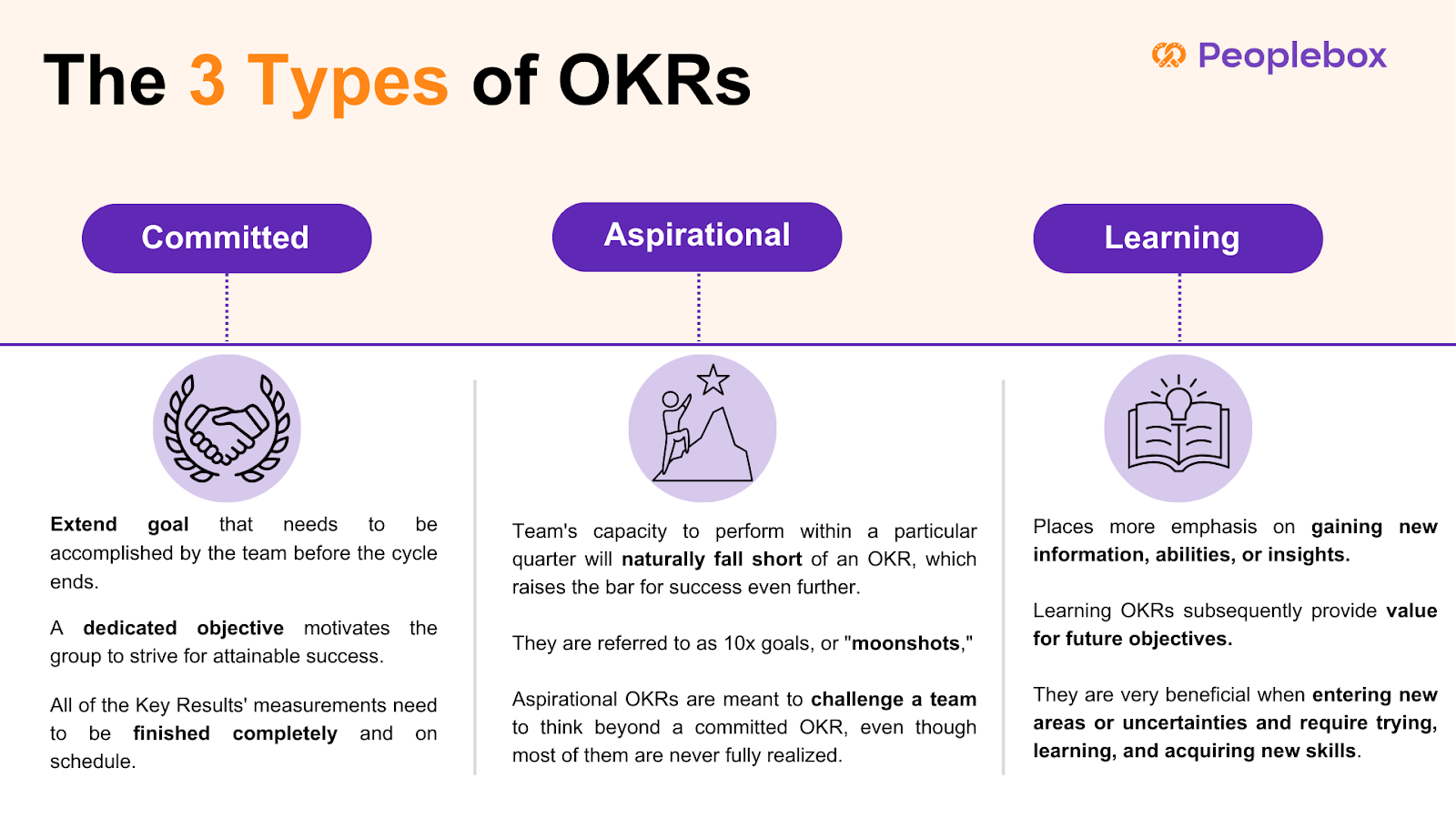
Committed OKRs are about clear, attainable targets that teams can confidently deliver within a set timeframe. This type of OKR delivers accountability and is important for day-to-day business success. 

Aspirational OKRs, on the other hand; push teams to be bigger and challenge themselves. The moonshots: ambitious OKRs are meant to stretch an organization from its comfort zone, kindling innovation and long-term growth.

In the rest of this blog, we will take the difference between these two types of OKR apart and see how to balance them in such a way that they enable performance as well as inspiration. 

What are Aspirational OKRs and Other Types of OKRs?

A committed OKR is a stretch goal that the team has to achieve or complete before the cycle is over. A committed goal pushes the team to reach, but still achievable attainment. All metrics of the Key Results must be completed fully and on time. Consider a situation like this:

Daniel’s organization and his teams have agreed to execute certain OKRs and have mapped a precise action plan on how they are going to do so.

These are called Committed OKRs.

An aspirational OKR sets the bar for success further out, and by design will exceed a team’s ability to execute in a given quarter. When they set such a high bar as to be seemingly impossible they are called 10x goals, or “moonshots.” While most aspirational OKRs are never fully achieved, they exist to push a team to think bigger than a committed OKR. Consider the following case:

Martha’s organization is more visionary. They have stretched goals. And her teams are not likely to fully achieve these ambitious goals.

These are called Aspirational OKRs.

Understanding the distinction between aspirational and committed goals is crucial for effective goal-setting and team motivation within the OKR framework. Aspirational goals encourage ambitious thinking and long-term vision, while committed goals focus on immediate, measurable outcomes.

Learning OKR focuses on the acquisition of knowledge, new skills, or insights rather than a direct achievement of business outputs. Extremely helpful when entering new areas or uncertainties and requires experimenting, learning, and developing new skills, Learning OKRs distinguish between usual output measuring of success and measuring acquisition of knowledge, that will later add value for future objectives. For example:

Jerry wants to gain a deep understanding of machine learning to drive full product development. He wants to finish three advanced courses and test his skills by building a model in sandbox.

These are called Learning OKRs.

Aspirational OKRs and Committed OKRs: Key differences

When you aim for the stars, you may come up short, but still reach the moon.

Larry Page 

Read on to find out the key difference between Committed OKRs and Aspirational OKRs. 

Objective 

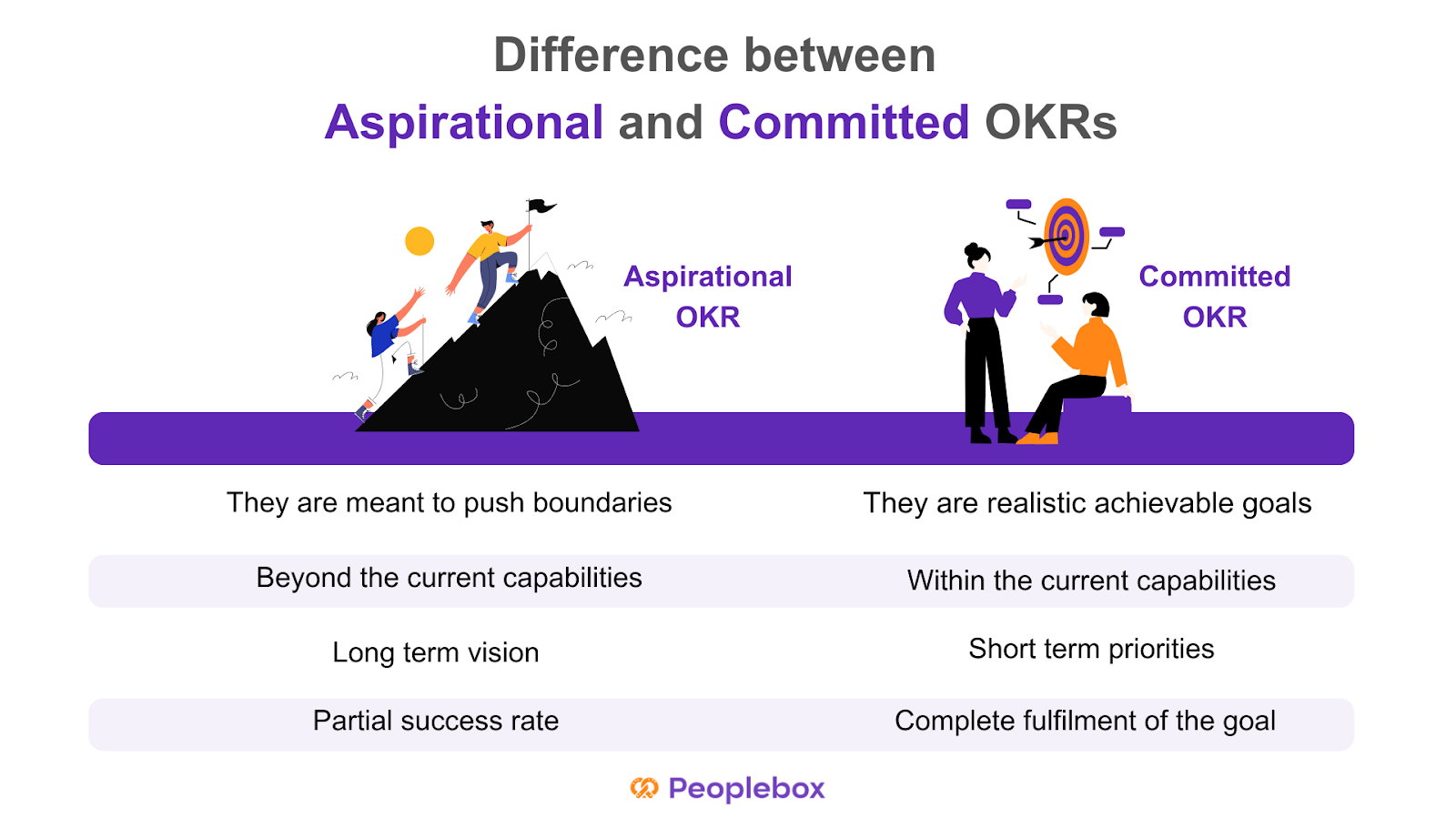
Aspirational OKRs are meant to push the boundaries and encourage employees to achieve visionary objectives. Committed OKRs, on the other hand, focus on committed objectives that offer a more realistic vision of goals with fully achievable results.

Aim 

Committed OKRs help companies achieve their goals through individual and team achievements. Aspirational OKRs are often beyond the current capacities of the organization but help in pushing boundaries.

Timeframe 

Aspirational OKRs are usually created to focus on long-term strategic vision while Committed OKRs offer short-term operational priorities to guarantee progress in the short term. 

Success rate 

Committed OKRs are supposed to have a 100% success rate as each key result comprises fully achievable targets. Aspirational OKRs are usually found to have a success rate of 60-70%.

Committed and Aspirational OKR examples

The difference between committed and aspirational OKRs is subtle. Committed objectives are meant to be fully achievable, requiring teams to concentrate on straightforward priorities without taking unnecessary risks, ultimately serving as motivational tools to foster small wins and consistent progress.

A standard example in the sales team scenario might be like:

Committed OKR

  • O: Expand to the US market
  • KR1: Close first 6 start-ups
  • KR2: Get a meeting-to-close rate of 6%
  • KR3: Reach average deal size of $200

Aspirational OKR

  • O: Capture the entire US market in one quarter
  • KR1: Get onboard 95% of big customers in the US market to grow over competitors
  • KR2: Get a meeting-to-close rate of 30%
  • KR3: Reach average deal size of $2000

In the managerial team, these OKRs can manifest like such:

Committed OKR

  • O: Improve customer satisfaction with the existing solutions
  • KR1: Increase customer satisfaction score (CSAT) from 85% to 90% by the end of the quarter.
  • KR2: Reduce average response time from 15 minutes to 10 minutes within the next three months.
  • KR3: Train 100% of the support team on the new customer service tools within six weeks.

Aspirational OKR

  • O: Become the market leader in AI-powered customer service solutions.
  • KR1: Achieve a 30% market share in the AI customer service industry by the end of next year.
  • KR2: Launch three groundbreaking AI features that no competitor currently offers within 18 months.
  • KR3: Secure a partnership with at least two top-tier companies by the end of next year.

In a tech context, OKRs like these can come up:

Committed OKR

  • O: Improve the performance of the app and reliability
  • KR1: Reduce app crash rate from 2.5% to under 1% within the next quarter.
  • KR2: Decrease page load times by 30% in six months.
  • KR3: Fix 100% of the top ten reported bugs within the next two sprints.

Aspirational OKR

  • O: Revolutionize the user experience of our mobile app.
  • KR1: Increase daily active users (DAU) by 100% within 12 months.
  • KR2: Develop and launch a fully AI-driven recommendation system that personalizes the user experience by the end of the year.
  • KR3: Achieve a 4.8+ rating across app stores by introducing five innovative features within the next 18 months.

How to decide between Committed OKRs and Aspirational OKRs?

Committed OKRs will work best if your organization is newly introduced to the framework or is still in the rolling-out phase.

With each goal achieved, your team’s motivation and engagement will rise higher. In addition, teams easily get into the habit of running Committed OKRs and make it part of their work culture.

But if you have already used the framework in the past, aspirational OKRs can do wonders for you.

Creating a result-driven work culture takes time. It demands discipline, continuous effort, and a mindset shift of employees and management. So you should start simple and focus on learning the methodology first. And set up the necessary processes to make it work.

Setting aspirational OKRs in the very beginning would make your teams feel overwhelmed and over-pressurized. Extremely ambitious Key Results soon become too much to handle. Learning a new methodology takes time. Once your teams are used to the framework and it becomes a part of their work-life, you can consider aspirational OKRs.

With the later process, you can have objectives and a combination of committed and aspirational key results. While some key results will be easier to achieve, others will aim higher. Understanding the distinction between aspirational and committed goals is crucial for better goal-setting and team motivation.

Choosing the Right Type of OKRs

Choosing the right type of OKRs depends on the organization’s goals, culture, and priorities. Committed OKRs are suitable for organizations that need to achieve specific, measurable outcomes within a set timeframe. They are ideal for teams that require a clear direction and a sense of accountability. Aspirational OKRs, on the other hand, are suitable for organizations that want to drive innovation, creativity, and excellence. They are ideal for teams that want to push the boundaries and strive for something bigger.

When choosing between Committed and Aspirational OKRs, consider the following factors:

  • What are the organization’s goals and priorities?
  • What type of culture do we want to foster?
  • What kind of outcomes do we want to achieve?
  • What level of risk are we willing to take?

By considering these factors, organizations can choose the right type of OKRs that align with their goals, culture, and priorities. Whether you opt for committed or aspirational OKRs, the key is to ensure that they are aligned with your company aims and internal communication processes, fostering a balanced approach to achieving both immediate and long-term objectives.

How to balance Committed and Aspirational OKRs?

There is no one-size-fits-all answer, but where OKRs are aligned with company strategy, teams are well educated, open communication exists, and performance is reviewed regularly, it will help keep the balance between aspirational and committed OKRs intact.

However, the first step in finding equilibrium between the two forms of OKRs is that there has to be a knowledge of the difference. It needs to be apparent from the outset that everyone involved makes it clear the distinction between the two OKRs.

Teams and employees may have suitable insights that will assist in determining what is realistically achievable (committed) and what is a stretch but possible (aspirational). This can help determine what the balance ratio for the OKRs is going to be.

A very critical element to succeed with OKRs is reviewing and tracking the progress. With weekly check-ins, teams can go through their OKRs regularly and update the same performance data. It becomes easy to track how they have progressed on the outcome of the OKR in the OKR review process.

The grading of OKRs is very clear on the distinction between committed and aspirational goals. Committed OKRs are things to be accomplished within the cycle, and grading is binary: pass or fail. That is, an OKR is said to be successful if 100% of it is accomplished; otherwise, it is regarded as a failure. Aspirational OKRs, on the other hand, are graded along a more nuanced scale.

Common mistakes to avoid while setting up Aspirational OKRs

Here are 6 common mistakes organizations commit while setting up aspirational OKRs-

1️⃣Ignoring organizational structure and needs

A common mistake most organizations commit while writing aspirational OKRs is to write something like, “What can be done more if we have extra resources and luck favors us ?” Instead, you can pretend to be a genie and strive to understand “What our customer needs at present moment?” 

2️⃣Unrealistic aspirational OKRs

Aspirational OKRs don’t imply setting unrealistic goals. It should be achievable, with the understanding that your teams won’t have any clue about how to achieve these OKRs. Aspirational OKRs demand overuse of resources. They are fluid and flexible. But still helps your teams focus on well-defined goals.

3️⃣Writing a low-value objective (LVO)

Moving forward with a “Who cares?” attitude is a common pitfall among organizations.  Low-value objectives go unnoticed even after the successful completion of the key results. 

4️⃣OKRs should be framed to gain tangible benefit

OKRs are a tool for organizations to work for big goals in the long run by breaking them into small chunks that can be achieved within a shorter cycle.

5️⃣A committed OKR must deliver a 1.0

It makes the framework stiff and doesn’t leave scope for improvement.

6️⃣Too many OKRs

How many aspirational OKRs you should set for one cycle will depend on your company’s resources. But never aim for too many Objectives and key results. As it can easily divert your focus altogether.

Best Practices for Implementing OKRs

Implementing OKRs requires a structured approach to ensure success. Here are some best practices to consider:

  1. Align OKRs with company goals: Ensure that OKRs align with the organization’s overall goals and priorities.
  2. Make OKRs specific and measurable: Ensure that OKRs are specific, measurable, achievable, relevant, and time-bound (SMART).
  3. Set ambitious yet achievable goals: Set goals that are challenging yet achievable, and provide a clear direction for the team.
  4. Establish clear key results: Establish clear key results that indicate progress towards achieving the objective.
  5. Track progress regularly: Track progress regularly and provide feedback to teams and individuals.
  6. Foster a culture of transparency and accountability: Foster a culture of transparency and accountability, where teams and individuals are held accountable for their progress.
  7. Provide training and support: Provide training and support to teams and individuals to ensure they understand the OKR framework and how to use it effectively.
  8. Review and adjust OKRs regularly: Review and adjust OKRs regularly to ensure they remain relevant and aligned with the organization’s goals.

By following these best practices, organizations can implement OKRs effectively and achieve their goals. Regularly reviewing and adjusting OKRs ensures that they stay aligned with the evolving needs of the organization, helping teams to maintain focus and drive continuous improvement.

Conclusion

Now that you know the difference between committed and aspirational OKRs and how they can impact your organization’s success, it’s the decision time. Choose the one that will best suit your purpose.

And don’t forget it’s a trial and error method. Have regular OKR check-ins and reviews. Collect feedback during and after each cycle. And use your learnings to avoid further mistakes in the next OKR cycle.

Pooja Pooja
Quarterly OKRs: 5 Tips for Successful Wrap-Up

Imagine a scene! the quarter is about to end and it’s time to review and wrap up quarterly OKRs.

The clock’s ticking. Everyone is in a rush. And you are busy evaluating which goals are yet to be achieved. And what has already been done. It’s also time to think about your priorities for the next quarter. 

There are so many checklists and questions going in your head.

Have my teams found ways of closing out quarterly OKRs? Will my teams beat the clock and tick all the boxes? Have they reflected on their OKR progress? How will I deal with this end-of-quarter OKRs rush? 

Feeling overwhelmed!!

Here is a step by step guide to help you prepare best to wrap up your quarterly OKRs

Click here to read champions guide for tracking OKRs

How to wrap-up quarterly OKRs?

Before you start to review and wrap up quarterly OKRs- remember that wrapping up quarterly OKRs is teamwork. And to see the best results every team irrespective of their department have to come together.

Here’s the ultimate quarterly OKRs review and wrap-up checklist for you:

Track and gather the metrics

Track your team’s OKR  progress and gather the key results scores. You can score your OKRs on a scale of 1 to 10 on the basis of how far the objectives have been achieved.

This will help you evaluate your progress in a truly data-driven manner. 

Click Here to download a 15 minutes read handbook on OKRs

[elementor-template id=”89725″]

If the scores are low this might suggest that your OKRs were unrealistic. On the other hand, if the score is too high it may suggest that your OKRs were not ambitious enough.

Whatever learning you made from this process. It will help you to form the basis for designing your next set of quarterly OKRs.

Make sure everyone is up to date

It is important to ensure that your teams have clarity about their OKR status. At the same time, they have visibility into what other teams have been doing. It can be achieved through regular check-ins with your teams. Check this ebook on OKR handbook.

This step will help you check if your teams are aligned or not. When everyone in your team is on the same page taking decisions based on priorities becomes easy. As you have the data in hand to rely on instead of guessing.

Organize OKR check-ins

The importance of check-ins for OKR success cannot be emphasized enough. OKR check-ins provide you an opportunity to have 1 on 1 discussion in all OKR matters. 

With OKR check-ins you can discuss with your leaders and team members about – what went well, what didn’t work for them, what needs to be dealt with immediately, what problems they are facing etc. at an individual as well as team level.

OKR check-ins will help you understand what’s holding teams back. You will further get the chance to push priorities that might have shifted midway. 

Dig into opportunities

Organize Quarterly OKRs review meetings to dig into opportunities. During these meetings, go through each key result with your teams. Find out what went well and what needs to be done better. 

Let the OKR leaders from each team present their learnings and achievements before everyone. Here teams can give a small presentation highlighting the most important lessons with context. 

So that other teams can benefit from their learnings and experiences. And use them in designing their OKRs for the next quarter.

If you are a large-scale company working with multiple departments. The OKR review meetings can be held at the departmental level. 

Plan the future

Now that you have gathered the data and matrix you need through OKR check-ins and OKR review meetings. It’s high time to plan for the next quarter.

OKRs have the power to build the future of your organization. But OKR failures can cost you a fortune. 

Hence it’s important to find out the core reasons behind your OKR success or failure for the present quarter. And use it as context while designing OKRs for the next quarter.

[elementor-template id=”89725″]

Do you need to plan new OKRs every quarter?

“Should OKRs change every quarter?” is a question often left unanswered. 

Even after an OKR is achieved, you can roll it forward for the next quarter if necessary.

For example, if your OKR was to increase customer satisfaction by 20% in the present quarter. This could be relevant even for the next few quarters. 

In case, of missed OKRs,  you need to take a call. And decide whether you want to carry it forward or set new OKRs based on the data gathered.

When should you review and wrap up Quarterly OKRs

You should preferably wrap up the quarterly OKRs at least a week prior to the beginning of the next quarter. 

But the preparation and discussions for the next quarter should be initiated almost a month before the new quarter begins. This is because designing OKRs takes dedication, time, and effort. 

Bonus Tips:

  1. Maintain Transparency from day one. Keep data transparent so that everyone knows how it’s going. 
  1. Create a culture of critical feedback. Be honest when it comes to feedback.  At the same time be open to getting feedback from your teams as well. 
  1. Celebrate wins– even the smallest ones. Recognize your teams for their achievements more often.
  1. Over-communicate. Communication is the key when it comes to wrapping up quarterly OKRs. 

Take a moment

Wrapping up end-of-quarter OKRs will allow you to pause and take a moment to think. It provides you time to reflect on your wins, failures, and setbacks. It’s a stitch in time to make sure that your OKR framework is a success.

Follow the steps given to close out quarterly OKRs and make the most out of the process.

Pooja Pooja