Every sector, including HR, is rapidly adopting AI in 2024. As of early 2024, about 38% of HR leaders are actively piloting or have already implemented generative AI technologies within their operations, showing a significant increase from 19% in mid-2023. This is in line with another survey where 61% of CHROs planned to invest in AI in 2024.
Many think that a job offer letter is just a formality in the hiring process. Unfortunately, this includes even some of the best recruiters, hiring managers, and HR professionals. They fail to realise that a good job offer letter can build a strong, positive relationship with the new hire.
The right offer letter can set the tone for the professional journey ahead, ensuring clarity and preventing potential misunderstandings. In fact, it can also be the difference between the candidate accepting the offer or rejecting it.
In this blog, we’ll provide some essential tips to help you master the art of writing job offer letters, along with 10+ free job offer letter samples that you can use straight away.
What is a Job Offer Letter?
In very simple words, a job offer letter is a formal document that highlights the terms of employment for a newhire. A typical job offer letter would include necessary details like the salary, benefits, and other important information that will help the candidates decide whether to accept the role.
The job offer is key in the hiring process. It serves as a formal confirmation of employment for the candidate. Once the job offer letter is sent to the candidate, the next step is for the candidate to accept or decline the offer.
Why is a Job Offer Letter Important?
Interestingly, the job offer letter does a lot more than confirming the employment of the candidate. It offers the following key benefits to both the employer and the potential employee:
1. It sets the expectations for the new hires
An offer letter outlines the specific responsibilities and duties a candidate will be expected to perform if they accept the offer. In other words, this document provides them with a sense of direction even before they start.
The candidates will mentally prepare themselves for the role so that there are no surprises on the initial days of the job.
This will automatically reduce early attrition in a company.
2. It provides clarity on terms and conditions
The job offer letter ensures that both parties have a shared understanding of the key aspects of the agreement, including working hours, workplace location, and any probationary periods. It can even outline conditions related to confidentiality, non-compete clauses, and termination policies.
This level of transparency reduces the risk of miscommunication and creates a foundation of trust between your company and the candidate.
3. It serves as a legal document for both parties
A signed job offer letter also functions as a legal document for both you and the candidate. Either of you can refer to it in the event of any disagreements or legal issues. After all, this document confirms the terms of the job that have been agreed upon by both parties.
As a result, it serves as a binding agreement that can be used as evidence should there be disputes regarding pay, role expectations, or termination.
4. It helps in onboarding smoothly
A job offer letter provides the new employees with all the essential details for a doubt-free joining. By including specific details like start date, training schedule, or any other pre-employment requirements like background checks or medical exams, you invariably reduce even the smallest of confusions in the candidate’s mind.
The letter can also introduce the new hire to their immediate team or supervisors so that they can reach out to them without any hassle on day one of employment.
Long story short, an offer letter can streamline the onboarding process and ensure that the new hires feel welcomed and prepared from the outset.
⚙️ Key Components of a Job Offer Letter
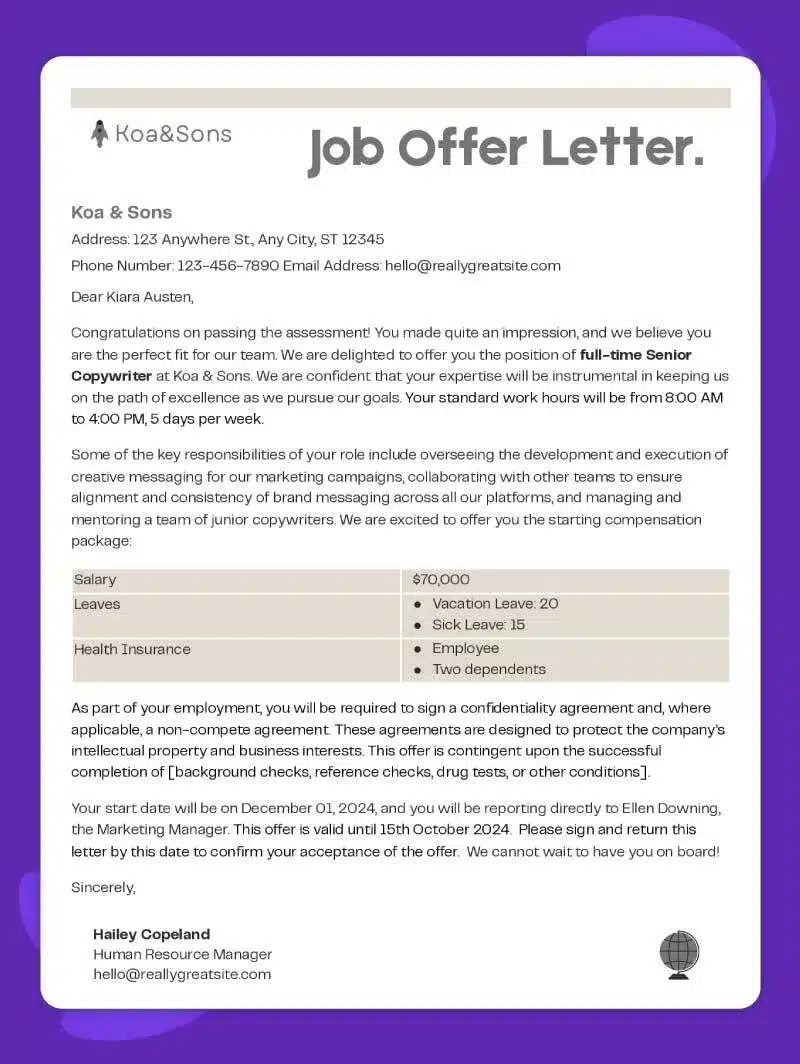
Here are some of the key elements typically found in a job offer letter. This is not an exhaustive list, and there could be additional components over and above this tailored to the needs of different organizations:
Job Title and Description: This section provides the official position title and a brief description of the responsibilities.
Compensation and Benefits: This section outlines the salary, bonus structure (if any), and benefits such as health insurance, retirement plans, and other perks.
Start Date: The start date specifies when the new hire is expected to begin working.
Work Schedule: This section outlines the expected working hours, whether the position is full-time or part-time, and any potential flexibility.
Reporting Structure: This will specify who the new hire will report to, helping the employee understand their immediate supervisor and where they fit into the company hierarchy.
Conditions of Employment: This includes any pre-employment requirements such as background checks, reference checks, or medical exams.
Confidentiality and Non-Compete Agreements: The offer letter should mention whether the company requires the employee to sign confidentiality or non-compete agreements.
Expiry Date for Acceptance: To encourage timely decisions, the offer letter typically includes an expiration date for accepting the offer. This creates a sense of urgency and allows the employer to move forward with other candidates if needed.
Signature Section: The final component is the signature section, where both the employer and the candidate sign to confirm their acceptance of the terms. This formalizes the offer and solidifies the employment agreement.
Now that we’ve looked at the basics, it’s time for the free job offer letter samples we promised.
10 Job Offer Letter Samples (Copy & Paste)
1) General Job Offer Letter
Michael Richardson 56 Greenfield Avenue New York, USA 10007
December 01, 2025
Dear Michael,
We are thrilled to offer you the position of Software Engineer at ABC Tech Solutions. Your skills in Python, cloud computing, and machine learning will be a great asset to our team.
Position Details:
Title: Software Engineer
Department: Engineering
Start Date: January 1, 2026
Compensation: $55,000 annually, paid monthly
Additional Benefits:
Health Insurance: Full coverage
Retirement Plan: 5% company match
Paid Time Off: 25 days annually
Other: Gym membership and transportation stipend
This offer is contingent upon the successful completion of a background check. You will report to James Fielding, Director of Engineering, and will be part of the cloud development team. Please confirm your acceptance by signing and returning this letter by December 15, 2025.
We are excited to have you join the team at ABC Tech Solutions.
Sincerely, Sarah Walters Human Resources Manager ABC Tech Solutions
2) Executive Job Offer Letter
ABC Tech Solutions 123 Innovation Drive New York, USA 10001 info@abc-tech.com
December 01, 2025
Helen Foster 89 Elmwood Street New York, USA 10005
Dear Helen,
It is our pleasure to offer you the position of Chief Marketing Officer (CMO) at ABC Tech Solutions. Your leadership and vision in marketing strategy will help elevate our brand globally.
As our Chief Marketing Officer, you will join the executive management team, reporting directly to the CEO, Daniel Gregory. You will lead the marketing department and drive our global marketing strategy, overseeing brand initiatives and growth campaigns.
The start date for this role will be February 1, 2026. You will receive an annual salary of $150,000, paid monthly, along with eligibility for a 20% annual performance-based bonus. After one year of service, you will also receive 10,000 stock options.
In addition to competitive compensation, you will be entitled to an executive benefits package that includes full health insurance coverage for you and your family, a 10% company match in our retirement plan, 30 days of paid time off annually, and a car allowance of $1,000 per month.
Additionally, you will receive an executive travel and housing allowance of $2,500 per month to support your mobility in this high-profile role.
Please confirm your acceptance of this offer by signing and returning this letter by December 15, 2025. We are eager to see the impact your vision and leadership will have on the future of ABC Tech Solutions.
Sincerely, Sarah Walters Human Resources Manager, ABC Tech Solutions
3) Internship Offer Letter
ABC Tech Solutions 123 Innovation Drive New York, USA 10001 info@abc-tech.com
December 01 2025
Emily Johnson 28 Maplewood Avenue New York, USA 10009
Dear Emily,
We are pleased to offer you an internship opportunity at ABC Tech Solutions as a Marketing Intern. Your academic achievements and passion for digital marketing make you an ideal candidate to join our growing marketing team.
This internship will provide you with hands-on experience, allowing you to work on key projects that drive brand awareness and market growth.
As a Marketing Intern, you will report to Laura Bennett, Senior Marketing Manager. You will assist with campaign planning, social media strategy, content creation, and market research. Your internship will begin on January 15, 2026, and is expected to last 3 months.
You will receive a monthly stipend of $30,000, which will be paid at the end of each month. You will also be given a certificate of internship at the end of your tenure. During your internship, you will have access to mentorship programs and professional development resources, designed to help you expand your skills and network.
This is a fantastic opportunity for you to gain valuable industry experience, and we are excited to have you on board. Please confirm your acceptance of this internship offer by signing and returning this letter by December 25, 2025.
Sincerely, Sarah Walters Human Resources Manager ABC Tech Solutions
4) Part-Time to Full-Time Offer Letter
ABC Tech Solutions 123 Innovation Drive New York, USA 10001 info@abc-tech.com
December 5, 2025
Michael Collins 15 Orchard Lane New York, USA 10007
Dear Michael,
We are thrilled to offer you a full-time position at ABC Tech Solutions as a Software Engineer. Your dedication, innovation, and excellent contributions during your part-time tenure have made you a standout team member. We believe you are ready to take on this full-time role and make an even greater impact on our team.
As a full-time Software Engineer, you will continue to report to James Harper, the Lead Software Engineer. You will be tasked with leading larger projects, collaborating with cross-functional teams, and contributing to product development.
Your new full-time schedule will commence on January 1, 2026, with a base salary of $55,000 per year, paid monthly. You will be eligible for 10% annual performance-based bonuses, and your benefits package will include full health insurance coverage, 25 days of paid time off annually, and participation in our employee pension scheme with a 5% company match.
Your transition from part-time to full-time demonstrates our confidence in your ability to deliver results in this expanded capacity. We look forward to seeing you thrive and continue growing with ABC Tech Solutions. Please confirm your acceptance of this offer by signing and returning this letter by December 15, 2025.
Sincerely, Sarah Walters Human Resources Manager ABC Tech Solutions
5) Conditional Job Offer Letter
ABC Tech Solutions 123 Innovation Drive New York, USA 10001 info@abc-tech.com
December 01, 2025
David Parker 43 Maple Avenue New York, USA 10008
Dear David,
We are excited to offer you the position of Business Analyst at ABC Tech Solutions, contingent upon the successful completion of several conditions outlined below. Your experience and analytical expertise will play a vital role in improving our business operations.
As a Business Analyst, you will join the Business Operations Department, reporting to John Blake, Director of Business Operations. Your start date is set for January 15, 2026 and you will receive an annual salary of $45,000, paid monthly.
You will also receive full health insurance coverage, 25 days of paid time off annually, and a $500 professional development budget to support your ongoing learning and growth.
This offer is conditional upon three factors: a satisfactory background check, verification of your educational qualifications, and the successful completion of a 30-day probationary period. Once these conditions are met, the offer will be confirmed in full, and we will officially welcome you to the ABC Tech Solutions team.
Please confirm your acceptance of this offer by signing and returning this letter by December 25, 2025. We are confident that you will make a significant impact here and look forward to working with you.
Sincerely, Sarah Walters Human Resources Manager ABC Tech Solutions
6) Internal Promotion Offer Letter
ABC Tech Solutions 123 Innovation Drive New York, USA 10001 info@abc-tech.com
December 01, 2025
Samantha Evans 123 Spring Street New York, USA 10009
Dear Samantha,
We are delighted to inform you that you have been promoted to the role of Senior Project Manager at ABC Tech Solutions, effective January 15, 2026 Your exceptional performance and leadership in managing complex projects have earned you this well-deserved promotion.
In your new role, you will report to Jonathan Peters, Head of Project Management, and will take on larger and more complex projects that span across various departments. Your new compensation will be $70,000 annually, paid monthly, and you will be eligible for a 15% annual performance-based bonus.
In addition to your salary increase, you will receive an expanded benefits package, which includes 28 days of paid time off annually, up from your current allowance.
You will also receive an annual professional development budget of $1,000 to support your growth in this leadership role, and you will be enrolled in our leadership training program.
Please confirm your acceptance of this promotion by signing and returning this letter by December 25, 2025. We are excited to see you continue to grow and lead within ABC Tech Solutions.
Sincerely, Sarah Walters Human Resources Manager ABC Tech Solutions
7) Remote Job Offer Letter
ABC Tech Solutions 123 Innovation Drive New York, USA 10001 info@abc-tech.com
December 01, 2025
David Thompson 45 Willow Crescent Manchester, UK 20002
Dear David,
We are excited to offer you the position of Remote Software Developer at ABC Tech Solutions. After reviewing your skills and expertise, we believe you are the ideal candidate to join our team, contributing to our projects from a fully remote setting.
As a Remote Software Developer, you will be part of the Development Team and report to Jane Morris, our Head of Engineering. Your primary responsibilities will involve software development, troubleshooting, and collaborating with other team members via virtual platforms such as Slack and Zoom.
The position will commence on January 15, 2026 and you will receive an annual salary of $60,000, paid monthly. You will also be eligible for performance-based bonuses of up to 10% annually.
As part of our remote work policy, you will receive a $1,000 home office setup allowance to cover equipment and office furniture, along with a monthly internet reimbursement of $50.
You will be provided with access to our digital wellness program and the same benefits package as our in-office staff, including full health insurance coverage, 25 days of paid time off, and professional development opportunities.
We look forward to welcoming you to ABC Tech Solutions and supporting you in a remote capacity. Please confirm your acceptance by signing and returning this letter by December 25,2025.
Sincerely, Sarah Walters Human Resources Manager, ABC Tech Solutions
8) Consultant Job Offer Letter
ABC Tech Solutions 123 Innovation Drive New York, USA 10001 info@abc-tech.com
December 01, 2025
Caroline Evans 77 Lakeshore Drive New York, USA 10002
Dear Caroline,
We are pleased to offer you a Consultant position at ABC Tech Solutions. Your extensive experience in data analytics and business strategy will be invaluable as we embark on several high-priority projects over the next six months.
As a Consultant, you will report to Mark Stevens, our Chief Strategy Officer, and will provide expert guidance on our ongoing data transformation initiatives. Your role will involve working closely with our internal teams and advising on best practices.
This consulting engagement will begin on January 15, 2026 and will last for 6 months, with a possibility of extension depending on project needs.
You will be compensated at a rate of $500 per day, invoiced on a monthly basis. This contract will involve 20 days of work per month, with flexibility in the days worked depending on project demands. You will also receive a $3,000 bonus upon successful project completion.
Please note that as a consultant, you will be responsible for your own tax and health insurance obligations. This offer is contingent upon the execution of a formal consulting agreement.
We are confident that your expertise will help us achieve the goals we’ve set, and look forward to working with you. Please confirm your acceptance by signing and returning this letter by December 25, 2025.
Sincerely, Sarah Walters Human Resources Manager, ABC Tech Solutions
9) Rehire Job Offer etter
ABC Tech Solutions 123 Innovation Drive New York, USA 10001 info@abc-tech.com
December 01, 2025
Rachel Williams 22 Cedar Street New York, USA 10006
Dear Rachel,
We are thrilled to extend an offer to rehire you as a Senior Customer Success Manager at ABC Tech Solutions. Your previous contributions to our company were exceptional, and we are confident that your return will once again bring value to our growing customer success department.
As a Senior Customer Success Manager, you will rejoin the Customer Success Team, reporting to Natalie Blake, our Head of Customer Success. In this role, you will lead key client relationships, ensure successful product adoption, and drive client satisfaction across our enterprise accounts.
The position will begin on January 15, 2026 with an annual salary of $58,000, paid monthly, along with eligibility for a 10% annual performance bonus based on team and individual metrics.
We are happy to offer you the same full benefits package as before, including health insurance coverage, 25 days of paid time off, and access to our professional development programs. In addition, we are offering a $2,000 rehire signing bonus to show our appreciation for your return.
We are delighted to welcome you back and are confident that your knowledge and experience will contribute to the success of ABC Tech Solutions once again. Please confirm your acceptance by signing and returning this letter by December 25, 2025.
Sincerely, Sarah Walters Human Resources Manager, ABC Tech Solutions
10) International Job Offer Letter
ABC Tech Solutions 123 Innovation Drive New York, USA 10001
December 01, 2025
Andrea Ramirez 987 Calle del Sol Madrid, Spain 28013
Dear Andrea,
We are excited to offer you the position of Senior Data Scientist at ABC Tech Solutions, with an opportunity to work at our New York, USA office. Your background in data science and machine learning, combined with your innovative approach, makes you an ideal candidate to join our growing team as we expand our global reach.
As a Senior Data Scientist, you will be responsible for leading our data analytics initiatives, developing predictive models, and working closely with our engineering and product teams. You will report directly to Helen Foster, our Head of Data Science. This full-time position will begin on January 1, 2026, and comes with an annual salary of $80,000, paid monthly.
ABC Tech Solutions is committed to supporting your relocation to the UK. We will provide full visa sponsorship, including handling all necessary paperwork and application fees.
Additionally, you will receive a $5,000 relocation allowance to assist with moving expenses and temporary housing for the first two months.
Our HR team will work with you to ensure a smooth transition, and we are offering assistance with finding permanent housing in London. You will also be entitled to 25 days of paid vacation, full health insurance, and access to our employee wellness programs.
Please confirm your acceptance of this offer by signing and returning this letter by December 15, 2025. If you have any questions regarding this offer or need additional details about the relocation process, please don’t hesitate to reach out.
Sincerely,
Sarah Walters Human Resources Manager, ABC Tech Solutions
Tips for Writing an Effective Job Offer Letter
Here are some best practices to follow the next time you craft an offer letter for your hires:
️ Use a Professional and Positive Tone
When you use a professional yet friendly tone in your letter, you convey respect and excitement. While the content should be formal, incorporating a positive tone makes the candidate feel welcomed and valued.
Strike the right balance between professionalism and warmth. It will definitely build a strong impression and ensure the candidate feels confident in their decision to join your team.
Be Clear and Concise About Job Responsibilities
Avoid overwhelming the candidate with too much information. However, ensure that they have a solid understanding of their key duties and how their role contributes to the company’s goals.
Using bullet points is also an effective way to present the core responsibilities in an easily digestible format.
Be Transparent About Salaries and Benefits
Transparency about compensation is key to building trust with new hires. Provide a detailed breakdown of the salary, any bonuses, and employee benefits such as health insurance, retirement plans, paid time off, and other perks.
Being upfront about these details will avoid any misunderstandings later on and ensure the candidate knows exactly what to expect.
⚙️ Customize the Letter for the Specific Role and Candidate
A one-size-fits-all approach will not work for your offer letters. A generic job offer letter will lack the personal touch needed to make a candidate feel special. Tailor the letter to the specific role and candidate. Highlight why they were chosen and how their skills align with the company’s vision.
Mention personal details, such as unique qualifications or experiences from their interview. This will show that you value them as individuals and not just another hire.
✅ Double-check for Accuracy and Legality
Before sending out the offer letter, ensure that all details are accurate. Double-check the salary figures, job title, start date, and any legal aspects, such as employment terms, conditions, or clauses.
It’s essential that the letter complies with labor laws and company policies. Errors or inconsistencies could create confusion or, worse, lead to legal issues later on.
Encourage Open Communication
Invite the candidate to reach out with any questions they may have regarding the job offer or the onboarding process. Make yourself accessible for clarification. It will help build an open line of communication from the start.
Let the candidate know they can contact you or HR if they have any concerns or uncertainties before their start date.
Include Next Steps
To ensure a smooth onboarding process, outline the next steps in your offer letter. This may include the deadline for the candidate to accept or decline the offer. It could also be the required paperwork or instructions on what they need to do before their first day.
Providing a clear roadmap helps alleviate any uncertainty about the hiring process.
Engage Your New Hires with Peoplebox
The moment a new hire joins your organization, employee engagement becomes a key priority for you. Starting with a well-crafted job offer letter, you set the tone for your new hires, but true engagement goes beyond that first impression. Keeping employees engaged ensures they are motivated and satisfied with their roles.
Peoplebox is the key to driving this engagement. It has been carefully designed to simplify employee management from onboarding through growth, automating a variety of tasks in making your hiring and onboarding processes a success.
It also utilizes advanced algorithms to automate skill gap identification and talent matching, ensuring that new hires are placed in roles that align perfectly with their strengths and experience.
With over 50 seamless integrations, Peoplebox seamlessly integrates with your existing HRIS and ATS systems, streamlining the hiring process and reducing administrative burdens.
Put simply, Peoplebox is a complete solution for engaging, growing, and retaining your employees. Book a demo to learn more about the endless capabilities of Peoplebox.
FAQs
How do you send out a job offer letter?
A job offer letter is typically sent via email or traditional mail once you have spoken over the telephone or communicated over an email regarding the offer.
What to write in a job offer letter?
A job offer letter should typically include:
Job Title and Description: The specific position you’re being offered.
Salary and Benefits: Details about your compensation package.
Start Date: When you’re expected to start working.
Work Schedule: The expected hours and days of work.
Reporting Structure: Who you’ll be reporting to.
Conditions of Employment: Any requirements or agreements, such as background checks or confidentiality agreements.
Acceptance Deadline: A deadline for accepting the offer.
What happens after the candidate receives the offer letter?
After receiving a job offer, the candidate will perform one of the three actions:
Accept the Offer: If they’re happy with the terms, they will accept the offer.
Negotiate: If they’re unsure or want to discuss the terms further, they will negotiate.
Decline the Offer: If they’re not interested, they will decline the offer.
Who signs the offer letter?
The offer letter is typically signed by the hiring manager or a representative from the Human Resources department.
What stood out is the deep understanding of the Peoplebox.ai team and their willingness to listen & enhance the platform to scale with our long-term needs.
Khilan Haria
VP and Head of Payments Product, Razorpay
I'm glad that we partnered with Peoplebox.ai for our company-wide OKR rollout. Thanks to its simplicity, we achieved significant adoption within two quarters
Rohit Arumugam
Business Head, Nova Benefits
Since we started using Peoplebox.ai, we have been able to bring all of our leadership across the organization together and show them how all of our goals align
Jaclyn Hoover
Senior Director HR, Propel School
Driving the entire interface through slack is simply brilliant especially for a tech product company! There was zero time spent on training! It can not get easier than that!
Swapna Nair
VP - HR, Khatabook
I chose Peoplebox.ai because it had integrations with the tools we use for sales and engineering to automate updating of key results and sync projects
How to Roll Out OKRs for First Time: 7 Steps Startegy
How to Roll out OKRs for the first time is a question common among organizations just introducing OKRs.
Imagine a scenario-
You are rolling out OKR for the first time.
One thing goes wrong and… Boom!
Your employees are already hating the process- even before it took a pace.
You certainly wouldn’t want that to happen in your organization. OKRs can surcharge and accelerate your organizational growth. But the key is to get this done right.
That’s why a well-planned rollout is significant for the success of an OKR system.
Introduce the new goal-setting approach strategically but not in a mechanical process. Every organization is unique and can face unique challenges while implementing OKRs.
[elementor-template id=”89725″]
How to roll out OKRs: Here are 7 Best Practices for a successful OKR rollout
1 Communicate the OKR Methodology to all the teams
Get everyone in the organization on board with OKRs. Present the concept clearly and precisely. Educate everyone on the OKR language.
While some people will embrace the changes with open arms, there are also going to be some skeptics into the bargain. You must let them express their concerns and provide answers to their “why, how, and what?” questions.
Explain to them the benefits of implementing the OKR framework. Highlight how it’s going to impact the business and the individual success of the employees.
Organize workshops, training, discussions, introductory presentations, and seminars to help your employees’ design quality OKRs. Transparently explain to them the strategic execution, alignment, expectations, and tools they will be required to use for the purpose.
To help everyone speak the same language, document your company OKR framework
2 Inspire with success stories
List the names of reputed companies like Google, Netflix, Intel, LinkedIn, Twitter, etc. which have successfully implemented OKRs. Narrate their success stories to help them visualize how OKRs can cater to their individual success.
For example, OKRs helped LinkedIn become a 20 Billion Company. Jeff Weiner, CEO of LinkedIn, describes OKRs as, “something you want to accomplish over a specific period of time that leans toward a stretch goal rather than a stated plan.
It’s something where you want to create greater urgency, greater mindshare.”
You can either go for an organization-wide rollout Consider running an OKR Pilot first, depending on what fits you best.
If you have a culture that’s open to change and a flexible structure of functioning, an organization-wide rollout will work best for you. But it’s always best to take small steps. Start from one part and gradually move to others.
[elementor-template id=”89725″]
Crafting and implementing OKRs across the entire organization can seem overwhelming especially if you are a large organization. Instead, choose a particular part of the organization and run a pilot project.
“If you concentrate on small, manageable steps you can cross unimaginable distances.”
It’s also important to decide “how often?” will OKRs be reviewed. Will it be done quarterly or annually?
4 Go for the Top-down approach
A top-down approach to OKRs was the first pattern attempted. The top management has a significant role in setting the overall direction of the company. Starting from the top provides clarity for the rest of the organization.
“People buy into the leader before they buy into the vision.”
For example, you can start with the senior leadership team. Make them an example to roll out OKRs to the departmental heads. From there you can move on to team leaders, and to the rest of your teams.
5 Get aligned
You can’t just sit with a blank sheet in front and magically start crafting the perfect OKRs. You need to understand the context. Make the company mission and vision your starting point and tailor your OKRs accordingly.
Buy-ins are critical for OKR success. The success of OKRs depends on the collective effort of each team member. You can imagine it as a group dance performance where everyone needs to perform their parts well to make it a masterpiece.
Thus you need to align the efforts of the workforce, executive leaders, and company heads both horizontally and vertically. This will help you foster transparency, smooth cross-functional communication, and reduce overlap among departments.
6 Track and monitor progress
Tracking OKRs are important to evaluate and measure the progress and understand which teams are falling short.
You can identify any issues and make course corrections as required by Monitoring progress.
Leverage technology to track OKRs. It will make the process transparent.
Using OKR software will also automate the calculations and save your time as you are no longer required to manually update the progress of each team member.
Bonus tip: Remember to celebrate whenever you Hit the nail on the head through OKR win meetings and shoutouts to keep
7 Do frequent check-ins
To stay on top of OKR progress, you need to do regular check-ins. Employees might feel overwhelmed with concerns and doubts, especially in the initial days.
Regular check-ins will give your employees direction. And provide them the required assistance and guidance. Frequent Check-in meetings will also identify the overlappings, increase accountability and ensure execution.
Define your preferred frequency of Check-in meetings. You can do it weekly or monthly as per your organization’s needs. Although weekly check-ins are most recommended to keep track of the progress and evaluate continuously.
Have OKR Champions
Consider having OKR champion who starts implementing the OKR framework with a strong war cry. Build a team of champions who will work as ambassadors to head the change. And make the OKR framework run smoothing across the organization.
They work as mentors and internal OKR experts. And can help you adopt and execute OKRs at all levels of the organization. These OKR enthusiasts will make sure that every concern is addressed, every ‘whys and wherefores’ are explained.
Too many objectives and key results: Less is more. Don’t set more than 5-7 Objectives and 3-5 key results.
Fill it, Forget it: Don’t set OKRs just to forget in a few days.
Mixing KPIs with OKRs: KPIs aren’t a substitution for OKRs. They have separate roles and outcomes.
Rigidity: Rigid adherence to rules can lead to disengagement. Instead, move forward with a flexible and intuitive OKR approach
Link OKRs with Recognition: Don’t make the mistake of making OKRs a base for your reward and recognition program. It can negatively affect performance. And compromises the business output.
The start is never perfect
You might struggle when you are just starting. But after a few OKR cycles, you are sure to hit your stride.
To end, OKR’s success depends on consistency. So, remember to continuously reflect, learn, and refine the process.
Hope we were able to answer all your queries in our blog How to roll out OKRs for the first time? If you have questions feel free to comment below.
Pooja Pooja
Types of OKRs: Aspirational OKRs vs Committed OKRs
Every organization wants to grow, but how do you set goals that are both achievable and visionary? The answer lies in the types of OKRs: committed and aspirational.
Whether it’s near-term performance or long-term innovation for your business, you’ll know just how to leverage the power of committed and aspirational OKRs effectively to unlock new levels of success for your business.
Committed OKRs are about clear, attainable targets that teams can confidently deliver within a set timeframe. This type of OKR delivers accountability and is important for day-to-day business success.
Aspirational OKRs, on the other hand; push teams to be bigger and challenge themselves. The moonshots: ambitious OKRs are meant to stretch an organization from its comfort zone, kindling innovation and long-term growth.
In the rest of this blog, we will take the difference between these two types of OKR apart and see how to balance them in such a way that they enable performance as well as inspiration.
What are Aspirational OKRs and Other Types of OKRs?
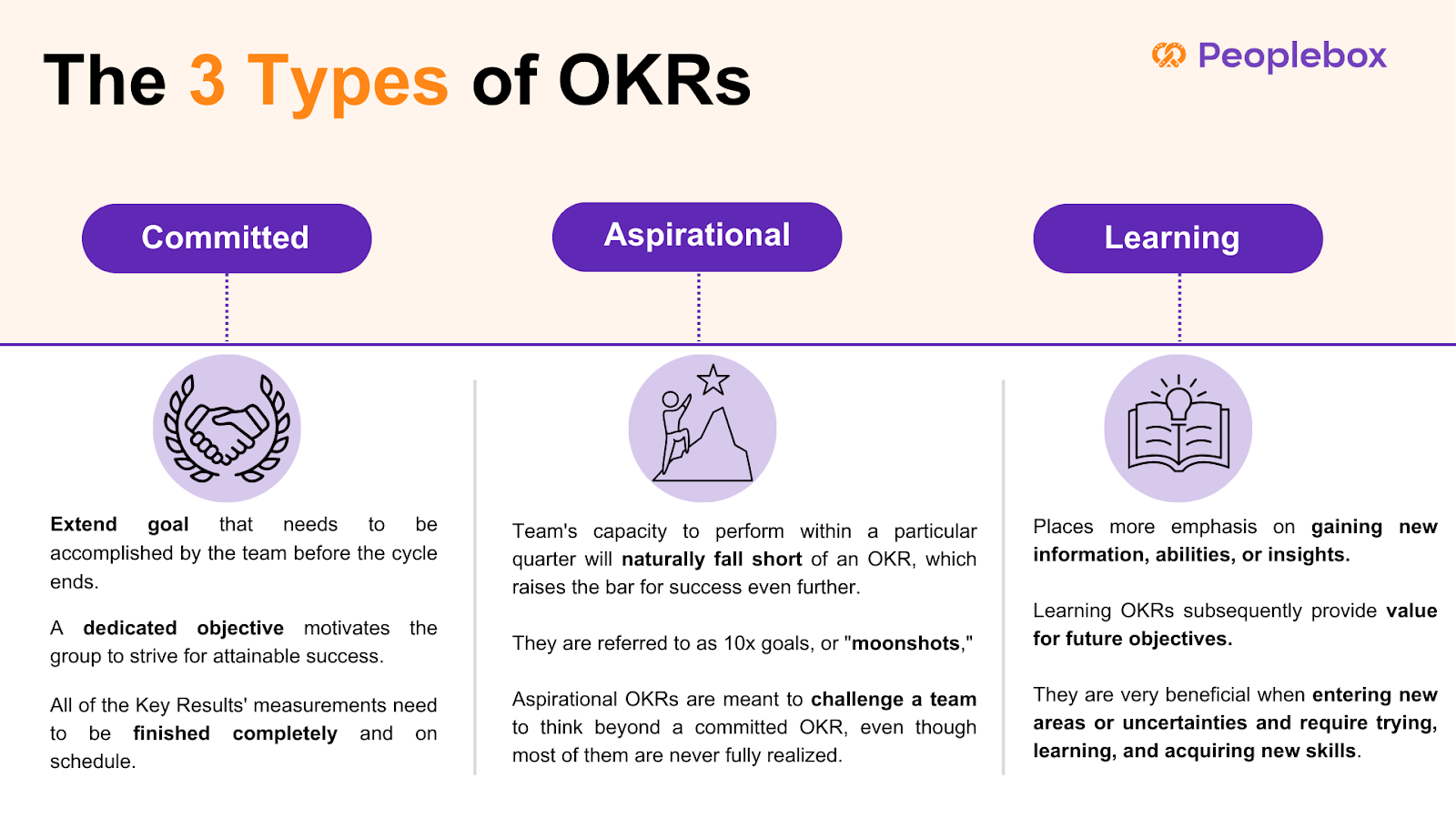
A committed OKR is a stretch goal that the team has to achieve or complete before the cycle is over. A committed goal pushes the team to reach, but still achievable attainment. All metrics of the Key Results must be completed fully and on time. Consider a situation like this:
Daniel’s organization and his teams have agreed to execute certain OKRs and have mapped a precise action plan on how they are going to do so.
These are called Committed OKRs.
An aspirational OKR sets the bar for success further out, and by design will exceed a team’s ability to execute in a given quarter. When they set such a high bar as to be seemingly impossible they are called 10x goals, or “moonshots.” While most aspirational OKRs are never fully achieved, they exist to push a team to think bigger than a committed OKR. Consider the following case:
Martha’s organization is more visionary. They have stretched goals. And her teams are not likely to fully achieve these ambitious goals.
These are called Aspirational OKRs.
Understanding the distinction between aspirational and committed goals is crucial for effective goal-setting and team motivation within the OKR framework. Aspirational goals encourage ambitious thinking and long-term vision, while committed goals focus on immediate, measurable outcomes.
Learning OKR focuses on the acquisition of knowledge, new skills, or insights rather than a direct achievement of business outputs. Extremely helpful when entering new areas or uncertainties and requires experimenting, learning, and developing new skills, Learning OKRs distinguish between usual output measuring of success and measuring acquisition of knowledge, that will later add value for future objectives. For example:
Jerry wants to gain a deep understanding of machine learning to drive full product development. He wants to finish three advanced courses and test his skills by building a model in sandbox.
These are called Learning OKRs.
Aspirational OKRs and Committed OKRs: Key differences
When you aim for the stars, you may come up short, but still reach the moon.
– Larry Page
Read on to find out the key difference between Committed OKRs and Aspirational OKRs.
Objective
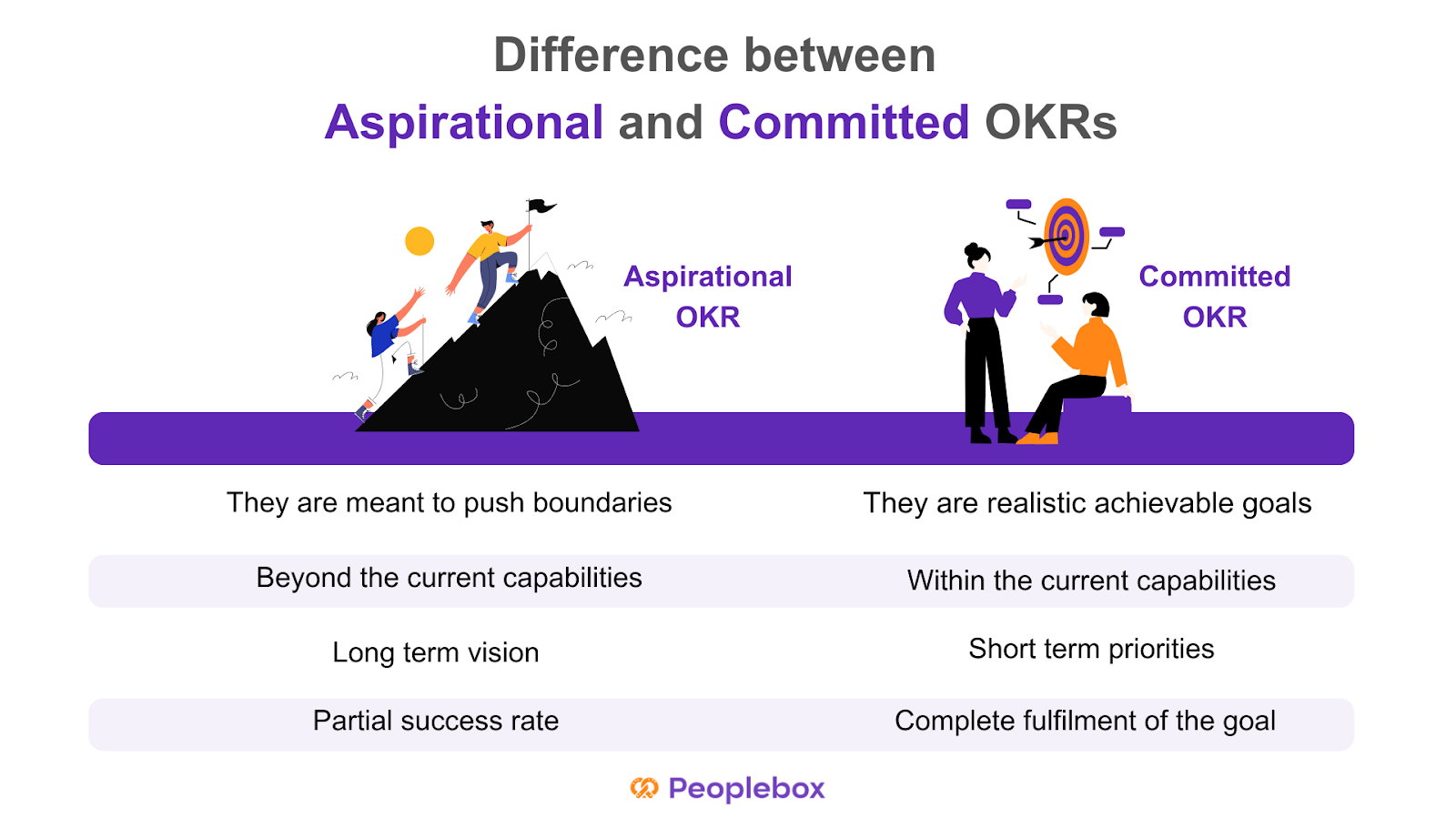
Aspirational OKRs are meant to push the boundaries and encourage employees to achieve visionary objectives. Committed OKRs, on the other hand, focus on committed objectives that offer a more realistic vision of goals with fully achievable results.
Aim
Committed OKRs help companies achieve their goals through individual and team achievements. Aspirational OKRs are often beyond the current capacities of the organization but help in pushing boundaries.
Timeframe
Aspirational OKRs are usually created to focus on long-term strategic vision while Committed OKRs offer short-term operational priorities to guarantee progress in the short term.
Committed OKRs are supposed to have a 100% success rate as each key result comprises fully achievable targets. Aspirational OKRs are usually found to have a success rate of 60-70%.
Committed and Aspirational OKR examples
The difference between committed and aspirational OKRs is subtle. Committed objectives are meant to be fully achievable, requiring teams to concentrate on straightforward priorities without taking unnecessary risks, ultimately serving as motivational tools to foster small wins and consistent progress.
A standard example in the sales team scenario might be like:
Committed OKR
O: Expand to the US market
KR1: Close first 6 start-ups
KR2: Get a meeting-to-close rate of 6%
KR3: Reach average deal size of $200
Aspirational OKR
O: Capture the entire US market in one quarter
KR1: Get onboard 95% of big customers in the US market to grow over competitors
KR2: Get a meeting-to-close rate of 30%
KR3: Reach average deal size of $2000
In the managerial team, these OKRs can manifest like such:
Committed OKR
O: Improve customer satisfaction with the existing solutions
KR1: Increase customer satisfaction score (CSAT) from 85% to 90% by the end of the quarter.
KR2: Reduce average response time from 15 minutes to 10 minutes within the next three months.
KR3: Train 100% of the support team on the new customer service tools within six weeks.
Aspirational OKR
O: Become the market leader in AI-powered customer service solutions.
KR1: Achieve a 30% market share in the AI customer service industry by the end of next year.
KR2: Launch three groundbreaking AI features that no competitor currently offers within 18 months.
KR3: Secure a partnership with at least two top-tier companies by the end of next year.
In a tech context, OKRs like these can come up:
Committed OKR
O: Improve the performance of the app and reliability
KR1: Reduce app crash rate from 2.5% to under 1% within the next quarter.
KR2: Decrease page load times by 30% in six months.
KR3: Fix 100% of the top ten reported bugs within the next two sprints.
Aspirational OKR
O: Revolutionize the user experience of our mobile app.
KR1: Increase daily active users (DAU) by 100% within 12 months.
KR2: Develop and launch a fully AI-driven recommendation system that personalizes the user experience by the end of the year.
KR3: Achieve a 4.8+ rating across app stores by introducing five innovative features within the next 18 months.
How to decide between Committed OKRs and Aspirational OKRs?
Committed OKRs will work best if your organization is newly introduced to the framework or is still in the rolling-out phase.
With each goal achieved, your team’s motivation and engagement will rise higher. In addition, teams easily get into the habit of running Committed OKRs and make it part of their work culture.
But if you have already used the framework in the past, aspirational OKRs can do wonders for you.
Creating a result-driven work culture takes time. It demands discipline, continuous effort, and a mindset shift of employees and management. So you should start simple and focus on learning the methodology first. And set up the necessary processes to make it work.
Setting aspirational OKRs in the very beginning would make your teams feel overwhelmed and over-pressurized. Extremely ambitious Key Results soon become too much to handle. Learning a new methodology takes time. Once your teams are used to the framework and it becomes a part of their work-life, you can consider aspirational OKRs.
With the later process, you can have objectives and a combination of committed and aspirational key results. While some key results will be easier to achieve, others will aim higher. Understanding the distinction between aspirational and committed goals is crucial for better goal-setting and team motivation.
Choosing the Right Type of OKRs
Choosing the right type of OKRs depends on the organization’s goals, culture, and priorities. Committed OKRs are suitable for organizations that need to achieve specific, measurable outcomes within a set timeframe. They are ideal for teams that require a clear direction and a sense of accountability. Aspirational OKRs, on the other hand, are suitable for organizations that want to drive innovation, creativity, and excellence. They are ideal for teams that want to push the boundaries and strive for something bigger.
When choosing between Committed and Aspirational OKRs, consider the following factors:
What are the organization’s goals and priorities?
What type of culture do we want to foster?
What kind of outcomes do we want to achieve?
What level of risk are we willing to take?
By considering these factors, organizations can choose the right type of OKRs that align with their goals, culture, and priorities. Whether you opt for committed or aspirational OKRs, the key is to ensure that they are aligned with your company aims and internal communication processes, fostering a balanced approach to achieving both immediate and long-term objectives.
How to balance Committed and Aspirational OKRs?
There is no one-size-fits-all answer, but where OKRs are aligned with company strategy, teams are well educated, open communication exists, and performance is reviewed regularly, it will help keep the balance between aspirational and committed OKRs intact.
However, the first step in finding equilibrium between the two forms of OKRs is that there has to be a knowledge of the difference. It needs to be apparent from the outset that everyone involved makes it clear the distinction between the two OKRs.
Teams and employees may have suitable insights that will assist in determining what is realistically achievable (committed) and what is a stretch but possible (aspirational). This can help determine what the balance ratio for the OKRs is going to be.
A very critical element to succeed with OKRs is reviewing and tracking the progress. With weekly check-ins, teams can go through their OKRs regularly and update the same performance data. It becomes easy to track how they have progressed on the outcome of the OKR in the OKR review process.
The grading of OKRs is very clear on the distinction between committed and aspirational goals. Committed OKRs are things to be accomplished within the cycle, and grading is binary: pass or fail. That is, an OKR is said to be successful if 100% of it is accomplished; otherwise, it is regarded as a failure. Aspirational OKRs, on the other hand, are graded along a more nuanced scale.
Common mistakes to avoid while setting up Aspirational OKRs
Here are 6 common mistakes organizations commit while setting up aspirational OKRs-
1️⃣Ignoring organizational structure and needs
A common mistake most organizations commit while writing aspirational OKRs is to write something like, “What can be done more if we have extra resources and luck favors us ?” Instead, you can pretend to be a genie and strive to understand “What our customer needs at present moment?”
2️⃣Unrealistic aspirational OKRs
Aspirational OKRs don’t imply setting unrealistic goals. It should be achievable, with the understanding that your teams won’t have any clue about how to achieve these OKRs. Aspirational OKRs demand overuse of resources. They are fluid and flexible. But still helps your teams focus on well-defined goals.
3️⃣Writing a low-value objective (LVO)
Moving forward with a “Who cares?” attitude is a common pitfall among organizations. Low-value objectives go unnoticed even after the successful completion of the key results.
4️⃣OKRs should be framed to gain tangible benefit
OKRs are a tool for organizations to work for big goals in the long run by breaking them into small chunks that can be achieved within a shorter cycle.
5️⃣A committed OKR must deliver a 1.0
It makes the framework stiff and doesn’t leave scope for improvement.
6️⃣Too many OKRs
How many aspirational OKRs you should set for one cycle will depend on your company’s resources. But never aim for too many Objectives and key results. As it can easily divert your focus altogether.
Best Practices for Implementing OKRs
Implementing OKRs requires a structured approach to ensure success. Here are some best practices to consider:
Align OKRs with company goals: Ensure that OKRs align with the organization’s overall goals and priorities.
Make OKRs specific and measurable: Ensure that OKRs are specific, measurable, achievable, relevant, and time-bound (SMART).
Set ambitious yet achievable goals: Set goals that are challenging yet achievable, and provide a clear direction for the team.
Establish clear key results: Establish clear key results that indicate progress towards achieving the objective.
Track progress regularly: Track progress regularly and provide feedback to teams and individuals.
Foster a culture of transparency and accountability: Foster a culture of transparency and accountability, where teams and individuals are held accountable for their progress.
Provide training and support: Provide training and support to teams and individuals to ensure they understand the OKR framework and how to use it effectively.
Review and adjust OKRs regularly: Review and adjust OKRs regularly to ensure they remain relevant and aligned with the organization’s goals.
By following these best practices, organizations can implement OKRs effectively and achieve their goals. Regularly reviewing and adjusting OKRs ensures that they stay aligned with the evolving needs of the organization, helping teams to maintain focus and drive continuous improvement.
Conclusion
Now that you know the difference between committed and aspirational OKRs and how they can impact your organization’s success, it’s the decision time. Choose the one that will best suit your purpose.
And don’t forget it’s a trial and error method. Have regular OKR check-ins and reviews. Collect feedback during and after each cycle. And use your learnings to avoid further mistakes in the next OKR cycle.
Pooja Pooja
Quarterly OKRs: 5 Tips for Successful Wrap-Up
Imagine a scene! the quarter is about to end and it’s time to review and wrap up quarterly OKRs.
The clock’s ticking. Everyone is in a rush. And you are busy evaluating which goals are yet to be achieved. And what has already been done. It’s also time to think about your priorities for the next quarter.
There are so many checklists and questions going in your head.
Have my teams found ways of closing out quarterly OKRs? Will my teams beat the clock and tick all the boxes? Have they reflected on their OKR progress? How will I deal with this end-of-quarter OKRs rush?
Feeling overwhelmed!!
Here is a step by step guide to help you prepare best to wrap up your quarterly OKRs–
Before you start to review and wrap up quarterly OKRs- remember that wrapping up quarterly OKRs is teamwork. And to see the best results every team irrespective of their department have to come together.
Track your team’s OKR progress and gather the key results scores. You can score your OKRs on a scale of 1 to 10 on the basis of how far the objectives have been achieved.
This will help you evaluate your progress in a truly data-driven manner.
If the scores are low this might suggest that your OKRs were unrealistic. On the other hand, if the score is too high it may suggest that your OKRs were not ambitious enough.
Whatever learning you made from this process. It will help you to form the basis for designing your next set of quarterly OKRs.
Make sure everyone is up to date
It is important to ensure that your teams have clarity about their OKR status. At the same time, they have visibility into what other teams have been doing. It can be achieved through regular check-ins with your teams. Check this ebook on OKR handbook.
This step will help you check if your teams are aligned or not. When everyone in your team is on the same page taking decisions based on priorities becomes easy. As you have the data in hand to rely on instead of guessing.
Organize OKR check-ins
The importance of check-ins for OKR success cannot be emphasized enough. OKR check-ins provide you an opportunity to have 1 on 1 discussion in all OKR matters.
With OKR check-ins you can discuss with your leaders and team members about – what went well, what didn’t work for them, what needs to be dealt with immediately, what problems they are facing etc. at an individual as well as team level.
OKR check-ins will help you understand what’s holding teams back. You will further get the chance to push priorities that might have shifted midway.
Dig into opportunities
Organize Quarterly OKRs review meetings to dig into opportunities. During these meetings, go through each key result with your teams. Find out what went well and what needs to be done better.
Let the OKR leaders from each team present their learnings and achievements before everyone. Here teams can give a small presentation highlighting the most important lessons with context.
So that other teams can benefit from their learnings and experiences. And use them in designing their OKRs for the next quarter.
If you are a large-scale company working with multiple departments. The OKR review meetings can be held at the departmental level.
Plan the future
Now that you have gathered the data and matrix you need through OKR check-ins and OKR review meetings. It’s high time to plan for the next quarter.
OKRs have the power to build the future of your organization. But OKR failures can cost you a fortune.
Hence it’s important to find out the core reasons behind your OKR success or failure for the present quarter. And use it as context while designing OKRs for the next quarter.
[elementor-template id=”89725″]
Do you need to plan new OKRs every quarter?
“Should OKRs change every quarter?” is a question often left unanswered.
Even after an OKR is achieved, you can roll it forward for the next quarter if necessary.
For example, if your OKR was to increase customer satisfaction by 20% in the present quarter. This could be relevant even for the next few quarters.
In case, of missed OKRs, you need to take a call. And decide whether you want to carry it forward or set new OKRs based on the data gathered.
When should you review and wrap up Quarterly OKRs
You should preferably wrap up the quarterly OKRs at least a week prior to the beginning of the next quarter.
But the preparation and discussions for the next quarter should be initiated almost a month before the new quarter begins. This is because designing OKRs takes dedication, time, and effort.
Bonus Tips:
Maintain Transparency from day one. Keep data transparent so that everyone knows how it’s going.
Create a culture of critical feedback. Be honest when it comes to feedback. At the same time be open to getting feedback from your teams as well.
Celebrate wins– even the smallest ones. Recognize your teams for their achievements more often.
Over-communicate. Communication is the key when it comes to wrapping up quarterly OKRs.
Take a moment
Wrapping up end-of-quarter OKRs will allow you to pause and take a moment to think. It provides you time to reflect on your wins, failures, and setbacks. It’s a stitch in time to make sure that your OKR framework is a success.
Follow the steps given to close out quarterly OKRs and make the most out of the process.