Performance appraisal software helps organizations replace outdated annual reviews with structured, ongoing feedback and development. It creates fair, transparent, and data-driven evaluations that improve employee engagement, retention, and growth.
This guide reviews the 16 best performance appraisal tools for 2026, comparing their features, pricing, and use cases to help you find the right fit for your team.
Our evaluation is based on:
- Insights from HR and People Ops leaders across 50+ organizations
- Hands-on platform testing for usability, integrations, and automation
- Reviews and ratings from trusted sources like G2 and Capterra
- Research on implementation success and business impact
Use this guide to identify performance appraisal software that not only simplifies reviews but also strengthens employee growth and organizational performance.
What is Performance Appraisal Software?
Performance appraisal software helps organizations manage employee evaluations in a structured and consistent way. It replaces manual, spreadsheet-based reviews with a single system that tracks goals, gathers feedback, conducts reviews, and identifies growth opportunities.
Instead of relying on once-a-year reviews, these platforms make performance management continuous. They support ongoing feedback, real-time goal tracking, and regular check-ins, so employees and managers stay aligned throughout the year.
Goal alignment is another key benefit. Each employee can clearly see how their daily work supports larger company objectives, improving focus, accountability, and motivation.
Organizations that use performance appraisal software report clear improvements in efficiency and engagement. Research shows that companies focusing on performance management practices often see higher growth and lower attrition rates compared with organizations that do not adopt structured reviews.
These tools also reduce administrative time, improve talent development, and strengthen overall workforce performance through clear expectations and consistent feedback.
What Features Your Performance Appraisal Tool Must Have?
The best performance appraisal tools help organizations evaluate, develop, and retain employees effectively. Here are the five key features every platform should include:
-
Customizable Review Templates
A good appraisal tool should allow you to create templates for different review types, such as annual evaluations, quarterly check-ins, project reviews, or probation assessments. You should be able to adjust rating scales, competencies, and review questions to match your company’s culture and goals.
2. 360-Degree Feedback
Comprehensive feedback gives a clearer picture of performance. Choose software that collects input from managers, peers, and direct reports, along with self-assessments. This ensures fairer evaluations and reduces bias by capturing multiple viewpoints.
3. Goal Setting and Tracking
Your tool should connect individual goals with broader company objectives. It should help employees set measurable goals, track progress throughout the year, and show how their work contributes to business outcomes.
4. Automated Workflows and Reminders
Automation saves time and prevents missed deadlines. Look for platforms that schedule review cycles, send automated reminders, and route approvals to the right people. Integration with calendars also helps plan performance discussions easily.
5. Continuous Feedback and Development
Appraisals should not happen only once a year. The right software supports ongoing feedback through check-ins, recognition, and coaching notes. It encourages regular conversations that help employees stay on track and improve continuously.
Comparison: Top Performance Appraisal Tools for 2026
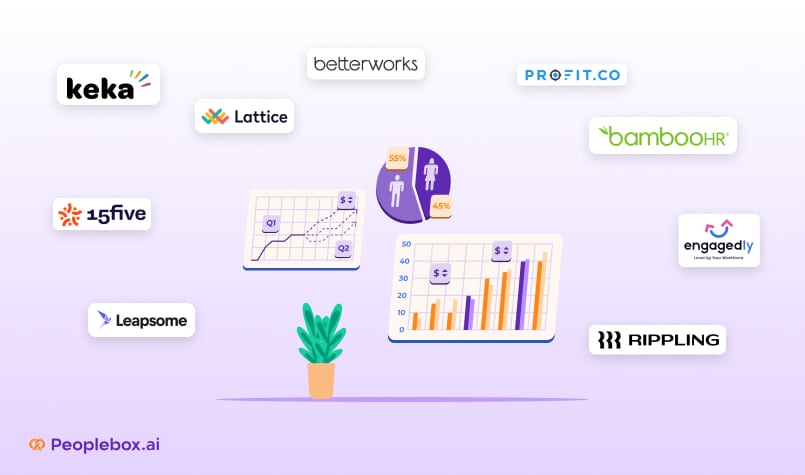
Here’s a quick comparison of the top performance appraisal tools to help you choose the right fit for your organization.
| Tool |
Best For |
Key Features |
Starting Price |
| Peoplebox |
OKR-driven performance and automation |
360-degree feedback, goal alignment, performance tracking |
$7–$12/user/month |
| PeopleGoal |
Boosting Employee Performance & Improving Engagement |
OKRs and SMART goals, 360-degree feedback, no-code app builder, engagement surveys |
FREE 14-day trial. Paid starts at $4 per user per month. |
| Lattice |
Continuous feedback culture |
Modern interface, automated reviews, engagement surveys |
From $11/user/month |
| BambooHR |
Small and mid-sized businesses needing HR + performance |
Integrated HR system, customizable reviews, easy setup |
On request |
| 15Five |
Regular check-ins and coaching |
Structured weekly updates, manager support tools |
From $9/user/month |
| PerformYard |
Custom review processes |
High flexibility, strong customization, dedicated support |
From $5/user/month |
| Keka HR |
SMBs in India and Southeast Asia |
HR + payroll integration, affordable pricing |
From $5/user/month |
| Profit.co |
OKR and KPI management |
Detailed goal tracking, performance analytics |
From $7/user/month |
| Engagedly |
Performance and engagement |
Learning integration, recognition, and rewards |
$5,000/year |
| Zoho People |
Budget-conscious organizations |
Affordable cloud solution, part of the Zoho suite |
From $1.50/user/month |
| Workday |
Large enterprises with HCM needs |
Predictive insights, talent, and succession planning |
On request |
| Culture Amp |
Development and engagement analytics |
Advanced surveys, DEI, and retention insights |
On request |
| AssessTEAM |
Global multilingual teams |
Multilingual support, project-based analytics |
From $5/user/month |
| Leapsome |
Integrated learning and performance |
Goal tracking, personalized development plans |
From $8/user/month |
| Rippling |
Unified HR, IT, and performance |
Automated workflows, integrated HR + IT systems |
From $8/user/month |
| Betterworks |
Goal-focused enterprises |
OKR alignment, continuous feedback system |
From $7/user/month |
16 Best Performance Appraisal Software
Below are the top 16 performance appraisal software options with detailed insights.
1. Peoplebox: Best for OKR-Driven Performance Management with Deep Automation
Peoplebox is a modern performance management platform that helps companies connect employee goals with business outcomes. It brings together performance reviews, goal tracking, feedback, and development planning into one simple, structured system.
Peoplebox focuses on growth and alignment, unlike traditional review tools that only record past results. It ensures every review reflects how employee goals contribute to company success, helping managers make data-driven decisions and meaningful coaching conversations.
Designed for fast-growing teams, Peoplebox streamlines performance cycles with automated workflows, feedback reminders, and review templates. It reduces administrative work and helps organizations maintain fair, timely, and consistent appraisals across all departments.
Key Features
-
Goal Tracking and OKR Management
Aligns individual, team, and company goals with visual dashboards showing progress and contribution to business objectives.
2. 360-Degree Feedback
Collects input from managers, peers, and direct reports for a balanced performance view that minimizes bias.
3. Performance Review Automation
Simplifies the entire review process with customizable templates, automated reminders, and approval workflows.
4. Development Planning
Helps managers create personalized growth plans based on strengths and improvement areas, with tracked progress over time.
5. Seamless Slack & Teams Integration
Enables feedback, recognition, and goal updates directly within everyday communication tools to boost engagement.
Pros:
- Strong goal-performance alignment connects reviews directly to measurable OKRs, ensuring evaluations focus on business impact
- High automation depth significantly reduces HR administrative burden with intelligent workflows and reminders
- Scales seamlessly from small teams to mid-market enterprises without platform changes
- Quick implementation gets teams operational within weeks rather than months-long deployments
- Comprehensive feature set eliminates the need for multiple point solutions
- Strong integration ecosystem connects with major HRIS, communication, and productivity platforms
Cons:
- May feel feature-rich initially for very small teams (under 10 people) seeking extremely simple review-only tools
- Requires some change management for organizations transitioning from traditional annual-only review processes
Ratings:
Peoplebox.ai G2 Rating: 4.5/5 ⭐ (based on 350+ verified user reviews)
Pricing:
Peoplebox.ai offers flexible pricing based on company size and selected modules:
- Talent Management: $7/user/month (billed annually)
- Full Suite Professional: $12/user/month (billed annually)
- Full Suite Premium: $15/user/month (billed annually)
View detailed pricing page
Why Choose Peoplebox.ai Over Competitors?
Peoplebox stands out for its clear goal alignment and automation. Unlike Lattice (feedback-first) or BambooHR (lightweight HR + performance), Peoplebox connects OKRs directly with reviews, making appraisals more strategic and measurable. It’s a complete, scalable system that helps organizations turn performance reviews into a continuous growth process.
Schedule a Demo and see how Peoplebox helps teams align goals, automate reviews, and drive real employee growth.
2. PeopleGoal
PeopleGoal is a fully customizable performance management platform built for organizations that want more control over how goals, feedback, reviews, and development actually work. It helps companies move beyond rigid HR systems by letting them create workflows that match their structure, culture, and performance philosophy.
The platform is especially useful for teams that need flexibility. Whether you run reviews, continuous feedback, OKRs, SMART goals, or multi-manager evaluations, PeopleGoal gives you the tools to build the process your way. Its no-code setup also makes it easier for HR teams to launch and refine workflows without leaning on technical teams.
PeopleGoal also combines performance management, employee engagement, development planning, and custom HR workflows in one system. It is a strong fit for companies that want both structure and adaptability, especially when standard one-size-fits-all tools fall short.
Key Features
- Goal and OKR Tracking
Supports OKRs and SMART goals while connecting individual, team, and company objectives for better alignment and visibility.
- 360-Degree Feedback and Reviews
Enables self, peer, manager, and multi-manager feedback to create more balanced and complete performance reviews.
- No-Code Custom Workflows
Allows HR teams to build and adjust workflows, states, rules, and permissions without coding knowledge.
- App Store and Custom Apps
Provides ready-made templates and customizable apps for onboarding, absence management, asset tracking, and other HR processes.
- Reports and Analytics
Delivers real-time dashboards, custom calculations, and scheduled reports to help leaders track progress and make informed decisions.
Pros
- Highly customizable for different team structures and review styles
- Supports complex organizations with multi-dimensional teams and multi-manager input
- Combines performance, engagement, development, and workflow tools in one platform
- No-code setup makes it easier for HR teams to manage independently
- Template App Store helps teams launch processes faster
Cons
- No downloadable or on-premise version for the users.
- It does not support a dark user interface for users.
Integrations
Major SaaS platforms and HR tools
Pricing
FREE 14-day trial. Paid starts at $4 per user per month.
3. Lattice
Lattice is a modern performance management platform designed for growing companies that want to replace annual reviews with ongoing feedback and development conversations. It helps organizations maintain consistent communication between employees and managers throughout the year.
The platform focuses on growth, engagement, and goal alignment, making performance management more natural and less administrative. Its clean, intuitive interface encourages participation from managers and employees alike, even without dedicated HR teams.
Lattice is trusted by mid-sized companies because it supports continuous feedback, real-time goal tracking, and employee engagement surveys—all in one platform. It helps build a culture of regular check-ins and meaningful discussions that lead to lasting performance improvements.
Key Features
1. Continuous Feedback System
Enables ongoing performance conversations and real-time feedback between employees and managers.
2. Goal and OKR Tracking
Helps teams set clear goals, monitor progress, and stay aligned with company priorities.
3. Employee Engagement Surveys
Captures employee sentiment to identify engagement levels and areas for improvement.
4. Career Development Planning
Supports personalized growth plans and clear career pathways for employees.
5. Analytics and Reporting
Provides workforce insights to guide planning, performance trends, and leadership decisions.
Pros
- Clean and easy-to-use interface requiring little training
- Promotes continuous feedback and real-time recognition
- Integrates well with tools like Slack, Teams, and leading HR systems
Cons
- Pricing can increase quickly for larger teams
- Advanced analytics are available only on higher tiers
- May need onboarding support for teams new to OKR-based frameworks
Integrations
Slack, Microsoft Teams, BambooHR, Workday, ADP, Greenhouse, Lever, JIRA
Pricing
Starts at $11 per user per month (billed annually).
4. BambooHR
BambooHR is an integrated HRIS with performance management capabilities designed for small to mid-market businesses with 10–500 employees. The platform combines employee data management, hiring, onboarding, time tracking, and performance reviews in one user-friendly system.
Organizations choose BambooHR for simplicity and seamless integration between HR administration and performance management.
Employee data flows automatically from onboarding through performance reviews, eliminating duplicate data entry.
Features:
- Customizable performance reviews with flexible templates
- Employee self-assessments empowering reflection
- Goal alignment tools connecting objectives to priorities
- Automated review reminders keep evaluations on schedule
- Seamless HR & payroll integration
Pros:
- User-friendly interface requiring minimal training
- Integrated ecosystem eliminating manual data reconciliation
- Exceptional customer support is consistently praised
Cons:
- Limited performance analytics compared to specialized platforms
- Lightweight goal features are not ideal for advanced OKR frameworks
- Performance feels like an add-on rather than a core strength
Integrations: Slack, Microsoft Teams, Greenhouse, Lever, ADP, Gusto, various HRIS and payroll systems
Price: Available on request
5. 15Five
15Five is a continuous performance management platform designed for organizations with 100–1,000 employees, prioritizing ongoing feedback over annual reviews.
The platform structures performance through weekly check-ins, where employees spend 15 minutes updating progress and managers spend 5 minutes reviewing.
Organizations choose 15Five for simplicity in building continuous feedback cultures, excellent manager enablement through coaching frameworks, and peer recognition features, making appreciation visible.
Features:
- Weekly performance check-ins with structured prompts
- Peer and manager feedback for well-rounded evaluations
- Customizable review templates adapting to company criteria
- AI-driven coaching insights with data-backed recommendations
- Mobile-friendly performance tracking for remote teams
Pros:
- An extremely user-friendly interface is driving high adoption
- Reduces administrative overhead with ongoing check-ins
- Excellent manager enablement with coaching frameworks
Cons:
- Limited analytics compared to enterprise platforms
- Lightweight feature sets may not suit complex organizations
- Simpler OKR functionality than dedicated platforms
Integrations: Slack, Microsoft Teams, BambooHR, Namely, ADP, Workday, JIRA, Asana
Price: Starts at $9/user/month (billed annually)
6. Perform Yard
PerformYard is a highly customizable performance management platform designed for organizations with 50–2,000 employees that have unique review processes or complex organizational structures. The platform provides extreme flexibility in review forms, workflows, and approval chains.
Organizations choose PerformYard when they need performance software adapting to their specific processes rather than forcing them into rigid platform constraints.
Features:
- Custom review cycles allowing tailored appraisal processes
- Goal tracking & analytics for monitoring performance
- KPI-based performance monitoring tracking productivity
- Seamless HRIS integrations ensure data synchronization
- Employee performance dashboards with visual metrics
Pros:
- Unmatched flexibility allows organizations to build exact processes
- Unlimited support included without per-incident fees
- Strong compliance features with audit trails
Cons:
- The complexity of customization can feel overwhelming initially
- Focuses primarily on reviews without broader talent features
- Implementation requires significant upfront configuration
Integrations: BambooHR, Workday, ADP, SAP SuccessFactors, Namely, Paycor, UltiPro
Price: Starts at $5/user/month (billed annually)
7. Keka HR
Keka HR is an integrated HR and performance management platform designed for small to mid-sized businesses with 10–500 employees in India and Southeast Asia.
The platform combines payroll, attendance, leave management, and performance appraisals in one system.
Organizations choose Keka for affordability, ease of use, and region-specific compliance features handling complex payroll regulations in Indian and Southeast Asian markets.
Features:
- Customizable performance appraisals with tailored cycles
- Self & peer reviews encouraging 360-degree feedback
- AI-powered HR insights identifying trends
- Automated review cycles with workflows and reminders
- Employee development & training with personalized recommendations
Pros:
- Affordable pricing for budget-conscious SMBs
- Integrated payroll and attendance eliminates multiple systems
- Region-specific compliance handles complex regulations
Cons:
- Limited global scalability focused on India/Southeast Asia
- Basic analytics compared to specialized platforms
- The performance module feels secondary to core HR
Integrations: Slack, Microsoft Teams, Zoom, Google Workspace, various Indian payroll providers
Price: Starts at $5/user/month (billed annually)
Profit.co is an OKR-centric performance management platform designed for organizations with 50–5,000 employees that want goal alignment at the core of appraisals.
The platform helps businesses track, measure, and optimize both objectives (OKRs) and performance through integrated reviews.
Organizations choose Profit.co when they want performance appraisals tightly connected to strategic goal achievement.
Features:
- OKR & KPI tracking with measurable key results
- 360-degree feedback collects multi-source input
- Performance reviews & check-ins with structured evaluations
- AI-powered insights providing real-time analytics
- Seamless integrations with Slack, Teams, and HRIS
Pros:
- Strong OKR focus, ensuring connection to strategic goals
- Comprehensive analytics providing visibility
- Flexible review cycles supporting various cadences
Cons:
- OKR learning curve requires methodology adoption
- Limited standalone HR features
- Customization complexity may require setup time
Integrations: Slack, Microsoft Teams, JIRA, Asana, Monday.com, BambooHR, Workday
Price: Starts at $7/user/month (billed annually)
9. Engagedly
Engagedly is a performance and engagement platform designed for organizations with 100–10,000 employees that want to connect performance management with employee engagement initiatives.
The platform bridges appraisals, goal setting, learning, and recognition.
Organizations choose Engagedly when they want performance management to drive engagement rather than treating them as separate initiatives.
Features:
- 360-degree feedback with comprehensive performance views
- Recognition and rewards foster an appreciation culture
- AI-driven performance insights with personalized recommendations
- Learning management system integration
- Employee goal-setting tools aligned with objectives
Pros:
- Strong engagement focus supporting broader employee experience
- Integrated learning connecting gaps to development
- Flexible recognition makes appreciation visible
Cons:
- Higher price point potentially expensive for smaller organizations
- Feature complexity may overwhelm teams wanting simplicity
- Implementation time requires significant setup
Integrations: Slack, Microsoft Teams, Zoom, SAP SuccessFactors, Workday, various LMS platforms
Price: Starts at $5,000/year (minimum contract)
10. Zoho People
Zoho People is a scalable, cloud-based HR and performance appraisal platform designed for businesses of all sizes seeking affordable, comprehensive solutions.
The platform provides customizable appraisals, self and peer reviews, and AI-powered insights at significantly lower price points.
Organizations choose Zoho People for budget-friendly pricing without sacrificing essential capabilities.
Features:
- Customizable performance appraisals, tailoring reviews
- Self and peer reviews encourage 360-degree feedback
- AI-powered HR insights leveraging analytics
- Automated performance review cycles reduce workload
- Workforce analytics and reporting generate insights
Pros:
- Extremely affordable pricing for startups and SMBs
- Comprehensive feature set despite low cost
- Zoho ecosystem integration for unified management
Cons:
- Interface feels dated compared to modern competitors
- Limited advanced features compared to premium platforms
- Customer support varies, with reported slower response times
Integrations: Zoho Analytics, Zoho CRM, Zoho Projects, Zoho Books, Slack, Microsoft Teams
Price: Starts at $1.50/user/month (billed annually)
11. Workday
Workday is an enterprise-level human capital management platform designed for large organizations with 5,000+ employees operating existing Workday HCM infrastructure.
The performance module integrates seamlessly with broader talent management functions.
Organizations choose Workday when they need performance management deeply integrated with enterprise HCM systems.
Features:
- AI-driven performance tracking, analyzing trends
- Employee development & succession planning
- Continuous feedback & goal alignment
- Custom workflows for industries with tailored templates
- Compliance & reporting features maintain regulations
Pros:
- Enterprise-grade scalability supporting complex global organizations
- Unified data visibility, eliminating silos
- Strong compliance support with comprehensive audit trails
Cons:
- Extremely complex implementation typically requiring 8–18 months
- High cost of entry with annual fees $50K–$500K+
- Steep learning curve requiring extensive training
Integrations: Native Workday ecosystem, major HRIS and payroll systems, Slack, Microsoft Teams
Price: Custom enterprise pricing based on size and modules
12. Culture Amp
Culture Amp is a data-driven employee development platform designed for enterprises with 250+ employees, prioritizing engagement measurement and performance tracking.
The platform transforms employee feedback into organizational intelligence through comprehensive surveys.
Organizations choose Culture Amp for unmatched survey sophistication with industry benchmarking and strong DEI analytics.
Features:
- Real-time feedback & performance tracking
- Employee development planning supporting career growth
- AI-powered engagement insights analyzing sentiment
- Goal alignment features help track objectives
- Seamless HR system integration
Pros:
- Best-in-class survey design with research-backed templates
- Exceptional analytics with intuitive visualizations
- Strong DEI capabilities, identifying representation gaps
Cons:
- High cost of entry with a typical $9–$14/user monthly
- Performance management less robust than dedicated platforms
- Requires analytical sophistication to maximize ROI
Integrations: Workday, SAP SuccessFactors, BambooHR, ADP, Slack, Microsoft Teams
Price: Custom quotes estimated $9–$14/user monthly
13. AssessTEAM
AssessTEAM is a cloud-based, multilingual performance management platform designed for global organizations with 100–5,000 employees operating across multiple countries and languages.
The platform enables competency evaluation with localization support.
Organizations choose AssessTEAM when they need performance management supporting multiple languages natively.
Features:
- Real-time performance tracking and monitoring contributions
- Project profitability analysis linking metrics to outcomes
- Customizable evaluation templates for tailored reviews
- AI-powered workforce insights with predictive analytics
- Multilingual interface supporting global teams
Pros:
- Strong multilingual support for global operations
- Project-focused analytics connecting performance to profitability
- Affordable pricing for mid-market organizations
Cons:
- Limited brand recognition compared to established platforms
- Basic integration capabilities with fewer native connections
- A smaller user community means fewer resources available
Integrations: Major HRIS platforms, Microsoft Teams, Slack, various project management tools
Price: Starts at $5/user/month (billed annually)
14. Leapsome
Leapsome is an AI-powered people platform built for fast-growing mid-market companies with 100–5,000 employees operating across multiple countries.
The platform unifies performance management, learning and development, and engagement surveys.
Organizations choose Leapsome for integrated learning pathways connecting performance reviews directly to personalized development plans.
Features:
- 360-degree feedback collects comprehensive input
- Goal & OKR management aligning objectives
- Customizable performance reviews with structured templates
- Employee development plans identifying skill gaps
- Seamless integrations with HR and communication tools
Pros:
- Highly customizable with granular controls
- AI features add genuine value with survey analysis
- Comprehensive integration connecting learning and performance
Cons:
- Steep initial setup requiring upfront configuration
- Core HRIS features lag behind dedicated platforms
- Full implementation costs can reach $8–$12/user monthly
Integrations: Slack, Microsoft Teams, BambooHR, Personio, various HRIS, and learning platforms
Price: Starts at $8/user/month (billed annually)
15. Rippling
Rippling is a comprehensive workforce management platform designed for organizations with 50–5,000 employees that want to unify HR, IT, and performance management in one system.
The platform automates performance reviews while handling payroll, benefits, and device management.
Organizations choose Rippling when they want performance appraisals integrated with broader workforce management.
Features:
- Automated performance reviews streamlining the process
- Real-time feedback & surveys facilitating ongoing feedback
- Goal setting & progress tracking, aligning objectives
- Comprehensive HR integration with payroll and benefits
- AI-driven workforce insights analyzing performance trends
Pros:
- Unified platform eliminating separate systems
- Strong automation capabilities across functions
- Modern interface with a clean design
Cons:
- Complex pricing varies significantly by modules
- Performance features secondary to core HR and IT
- May be overkill for organizations wanting only performance management
Integrations: Native integrations across HR, IT, payroll, benefits, and productivity platforms
Price: Starts at $8/user/month (varies by modules)
16. Betterworks
Betterworks is a continuous performance management platform designed for organizations with 200–10,000 employees that want goal-focused approaches to employee development.
The platform emphasizes OKR alignment, continuous feedback, and data-driven coaching.
Organizations choose Betterworks when they want performance management centered on strategic goal achievement.
Features:
- OKR & goal management aligning objectives
- Continuous feedback system enabling real-time coaching
- 360-degree performance reviews with multi-source input
- AI-powered analytics delivering engagement insights
- Seamless integrations with HRIS and communication tools
Pros:
- Strong OKR focus connecting to strategic goals
- Continuous feedback emphasis with modern philosophy
- Good integration ecosystem with workplace tools
Cons:
- Enterprise pricing may be expensive for smaller organizations
- Requires OKR adoption, necessitating training
- Implementation time requires significant setup
Integrations: Slack, Microsoft Teams, Workday, SAP SuccessFactors, ADP, various HRIS platforms
Price: Starts at $7/user/month (billed annually)
How to choose the best performance appraisal software for your team?
Selecting the right performance appraisal software requires evaluating your specific needs against key criteria:
1. Start with Your Core Need
Clarify your goal before exploring platforms. Do you want better goal alignment (Peoplebox, Profit.co), ongoing feedback (Lattice, 15Five), or simpler workflows (BambooHR, Keka)? Knowing this prevents overbuying features you won’t use.
2. Check Analytics and Insights
Strong reporting separates good software from great. Look for dashboards that show performance trends, goal progress, and engagement signals. Advanced tools like Peoplebox or Culture Amp even highlight early warning signs of disengagement.
3. Review Integration and Ease of Use
Your appraisal tool should fit naturally with HR systems, payroll, and communication platforms like Slack or Teams. A smooth user experience encourages adoption and cuts down on training time.
4. Match the Tool to Team Size and Budget
Startups need simple, affordable options; mid-sized companies should focus on scalable platforms; large enterprises need robust analytics and compliance support. Always factor in true costs, setup, training, and support beyond monthly pricing.
5. Focus on Features That Matter Most
Prioritize essentials: customizable templates, goal tracking, 360° feedback, and automated workflows. Add-ons like AI insights or learning integrations are valuable, but only if they support your core performance process.
Conclusion
The right performance appraisal software turns annual reviews into continuous growth conversations that drive measurable results.
Modern tools do more than track ratings; they connect goals, enable feedback, reduce bias, and help employees grow with clarity and purpose.
For goal-driven teams, Peoplebox leads with OKR alignment, 360° feedback, and deep automation.
For feedback-focused cultures, Lattice delivers an intuitive, engagement-friendly experience. And for SMBs, BambooHR offers simple, integrated performance management within its HR suite.
No matter your size or goals, data-backed performance management is now essential for building stronger, more motivated, and high-performing teams.
Ready to simplify and strengthen your performance reviews?
Schedule a Demo with Peoplebox!
Frequently Asked Questions
1. Does Peoplebox help visualize performance trends from appraisals?
Yes, Peoplebox provides detailed dashboards that show performance trends for individuals, teams, and departments. You can track ratings, goal progress, feedback patterns, and development activities over time, helping managers make data-driven decisions and spot improvement areas early.
2. Which tool combines appraisal data with development plans?
Peoplebox, Leapsome, and Engagedly are great options for connecting performance reviews with employee development. These tools identify skill gaps during reviews and automatically suggest personalized learning paths, ensuring every development plan is backed by real performance data.
3. What’s the best platform for running digital employee appraisals?
Peoplebox is ideal for teams looking for OKR-linked appraisals and automated workflows. Lattice works best for continuous feedback and engagement tracking, while BambooHR suits small businesses wanting a simple, built-in performance review system.
4. What’s the best platform for managing evaluations and re-authorizations?
PerformYard offers advanced customization and is perfect for industries with strict compliance needs. Workday is great for large enterprises managing regulated evaluations, while Trakstar supports certification-based review cycles and detailed reporting.
5. What features help automate feedback requests and reminders?
Modern tools automatically send feedback requests and reminders based on review schedules or project milestones. Platforms like Peoplebox, Lattice, and 15Five also integrate with Slack or Teams to collect quick, in-context feedback and keep performance conversations consistent throughout the year.