

















Logo of Peoplebox.ai - blue font

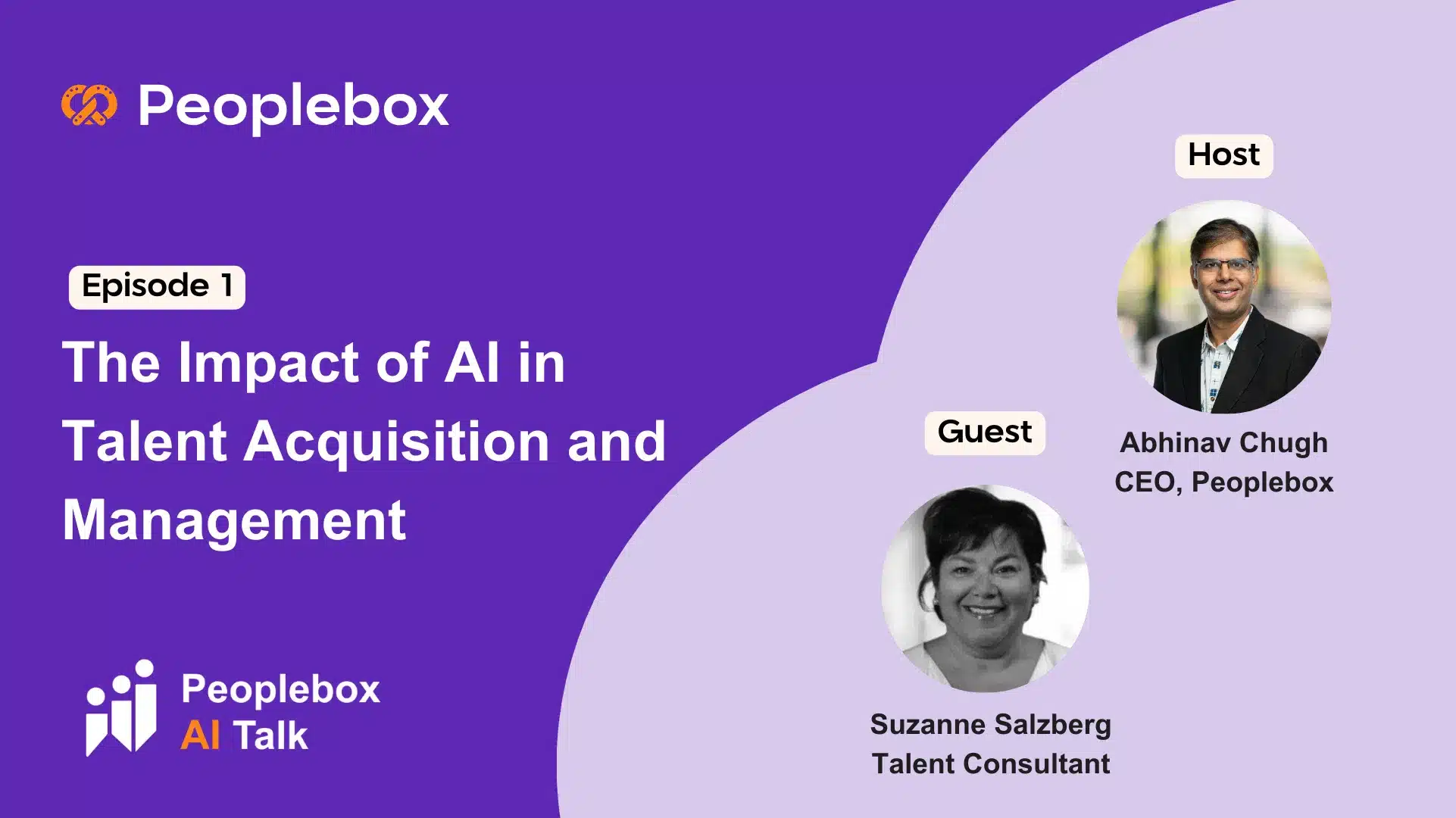
Episode 1 – Impact of AI in Talent Acquisition and Management

Rohitha Rohitha
September 3, 2024
https://podcasters.spotify.com/pod/show/peoplebox/episodes/Episode-1–The-Impact-of-AI-in-Talent-Acquisition-and-Management-e2n9lg8/a-abgqak1

Summary

Recruitment today is broken. Businesses are grappling with challenges like misalignment between hiring and business goals, overburdened recruiters, and poor candidate communication.

These inefficiencies are costly. According to HBR, the wrong hire can cost a company 5-7 times the employee’s annual salary when considering hiring, training, and lost productivity. Additionally, a study by Glassdoor found that a single job opening costs companies $4,129 on average, with costs increasing the longer a position remains unfilled.

In the first episode of The Peoplebox AI Talk, Abhinav Chugh, CEO and Co-founder at Peoplebox, sits down with Suzanne Salzberg, a veteran talent leader with over three decades of experience at leading tech companies like Highspot and TextNow.

Suzanne discusses how AI can streamline processes, from creating unbiased job descriptions to improving candidate communication and making data-driven hiring decisions.

Full Transcript

Abhinav (00:00)
If there’s one thing everyone is speaking about today, it’s AI. It’s going to disrupt every aspect of our professional lives. And some may say it has already started. So what will be its impact on the future of work, especially how we hire, develop, and retain our most valuable asset, People

and which part of the employee life cycle from hiring to retirement is going to see a biggest change What does it mean for the companies and HR? Hi everyone. I’m Abhinav, and welcome to the new season of our podcast, Peoplebox AI Talk, where we invite incredible leaders to go deep into the fascinating intersection of talent and AI. Today, I’m delighted to have Suzanne Salzberg on the show

Suzanne comes with over three decades of experience in the talent space. She has been the head of talent for big tech companies like Highspot and TextNow, and she’s now also a visiting lecturer at the University of

Welcome to the show, Suzanne.

Suzanne Salzberg (01:00)
Thank you, I’m happy to be here.

Abhinav (01:02)
Suzanne, you have been a talent leader for some of the most high tech companies. Let’s start with speaking about the disruption of AI in the talent space. Where do you see its biggest impact in the employee life cycle?

Suzanne Salzberg (01:16)
Well, I can, I can focus on the candidate’s life cycle in the talent acquisition you know context. I really think the, the biggest impact is going to become, honestly from the minute they read the job description because I think I see AI really helping to create complete, unbiased, easy to understand job descriptions. and it’ll also help hiring managers because one of the biggest pain points for talent teams is waiting for that job description.

The next big impact would be how fast a candidate hears back in the process, whether it means they applied and they get a response or if they’re in first, second, third, fourth interviews getting a response because I talk to a lot of candidates every day. And one of the biggest grievances from candidates is that they’re being ghosted.

And then I think the other major impact will be is how recruiting softwares are actually using AI on their backend and taking some of that load off of talent teams.

Abhinav (02:20)
That’s actually so well said. You’ve been in this industry for over three decades. Where do you believe that recruitment is most broken today and craving for AI to fix?

Suzanne Salzberg (02:24)
Right. Well, I feel like it’s changed, but I feel like right now where it is most broken is because recruiting teams have become so much leaner. The hiring is slowed. So full teams got laid off or there’s one recruiter left. And so those small teams have so, you know time management is a huge problem because now they’re doing four jobs. They’re the recruiting coordinator. They’re the travel coordinator. They’re looking at resumes. They’re doing the interviews. And so it’s almost impossible for them to go through a thousand resumes that they’re getting in a day because they’re also doing, I was talking to a previous recruiter that I worked with and she said that she was, you know, a CMO was coming in, took her eight hours to schedule their onsite, you know, with everybody’s schedules and I’m , and so that’s eight hours that she can’t be recruiting.

And so because AI can help with a lot of those administrative tasks, it’s great at doing travel planning, scheduling, you know, screening those initial resumes, like we said before it can really help with JDs. And so I think that that is a huge place where AI can help. I think the other place that it’s broken, is when you’re hiring for technical roles and engineers and they have to take a coding test, right? And that coding test is only as good as the person writing it. And so many times from a talent perspectiveyou know, someone will get a question wrong and it’s not even something that they’re measuring for that this person is going to do. And so I think if AI can write some amazing coding tests or tests that engineers or QA employees can do, like that will be a huge piece that is a big pain point for recruiting.

Abhinav (04:19)
Do you think that recruiters will be replaced because of AI?

Suzanne Salzberg (04:22)
Well, I think if you talk to anybody in talent acquisition, they’ll laugh thinking like, good luck. There’s no, because I mean, honestly, so many times recruitment and talent acquisition is siloed over here. And we just live in our own world and nobody really knows what we do, right? And so like they don’t, and it’s probably bad on us for saying all the work that we do and what we do, but I just don’t ever see, and anybody that does it, knows that they should not be replaced, right? But there is a fear because the people that don’t know really what we do say, oh we can replace the talent team with AI, right? So, you know, it’s that.

Abhinav (05:03)
So you really have had thousands of resumes in a day?

Suzanne Salzberg (05:07)
Oh, 100%. If you just go on LinkedIn and look at some jobs, it literally will say, a thousand people have applied to this job, for one job, right? So if you think that every job pretty much gets 500 to a thousand resumes, so it’s, and if you know, you have 20 recs open, 20 job openings, yeah, you’re getting a thousand a day for sure.

Abhinav (05:16)
Oh my God, and how do, how do you manage that? I don’t think it’s humanly possible to go through them one by one. And you know, it’s destined to have a

Suzanne Salzberg (05:38)
What I do is I help people navigate the job market and the hiring system. And, and so, and when the first thing I help them with is their resume. And so I teach them that a recruiter probably is going to spend… 10 to 20 seconds on your resume. And that is no lie. So that first half of your resume better be good. because we, there’s you know, fortunately The applicant tracking systems have this thing, it’s called quick review. And you can go into quick review and you’re literally just tapping. And, and that’s why people you know are frustrated that the recruiters aren’t getting back to them. But I said, if you knew what a recruiter was doing right now, all of these things, like that’s, like don’t blame the recruiter. Like it’s the situation that’s happening.

Suzanne Salzberg (06:26)
That’s, it’s real. It is a real thing.

Abhinav (06:29)
I had a very interesting talk, I was at, I was at a conference where there are a lot of job boards and they’re talking about what are the things that they are doing to attract candidates. And they say, we are giving them the ability to not only create their you know resume based on AI, we are giving them the capability to actually apply for say 35 different jobs with 35 different resume, all altered on the basis of the job description.

And we were just laughing that it’s not that AI is going to fight humans or, you know candidates are going to fight AI. It’s AI fighting AI. You know AI from the recruiter side is actually fighting AI on the candidate. And good luck to the Boolean searches and the keyword searches because now everyone’s resume will be built based on the job description. How do you see that world? What are the skills that both the recruiters as well as the candidate will now need to do a better matching.

Suzanne Salzberg (07:34)
I always teach candidates that the job description is the final before the exam.

So I will look at their resume and then I’ll say, look at this job description. And when a applicant tracking systems or LinkedIn or any of those companies are matching you to the Boolean searches, right? they’re literally taking keywords from that job description that recruiter put in. And if that’s not on your resume, guess what? You’re not gonna be one of the top 30 people that show. And so

You can do it without AI. I mean, it’s harder, but like I encourage people to have a couple of different resumes. I mean, sure, if you want to make them, you can tell an AI resume. It’s still at the point where it’s a little bit of a turnoff because like, is it real? Have you searched like what this company is looking for? So there’s a trust factor. There’s a trust factor because AI can make this beautiful resume that literally matches the job description. Then you have to question, do I trust this person? Are these, is this data real?

We’re at the point now where we can tell. We can tell if it’s an AI resume. And I’ve been to, when I’ve been to conferences and you have people that, you know AI still misspells things. You can always tell there’s certain little things. It’s like when you get like a scam email, there’s certain little things you can tell that make it a scam. And so I would encourage people still to do it the old fashioned way, but use that job description as your final, like, and you know, focus on what you’ve done to match the job description.

Abhinav (09:07)
And, you know, when I’m speaking with a lot of, you know, talent heads or, you know, experts in the talent acquisition space, one of the big fear that I hear is about the AI bias.

What do you think both the companies as well as the you know AI tools can do to mitigate this bias in the AI -driven, you know world.

Suzanne Salzberg (09:28)
Yeah, I totally agree that bias can cause AI to make decisions that are, you know, systematically unfair to particular groups of people. it can discriminate based on race, biological sex, national, you know everything.

And so because humans are choosing the data that the algorithms use, and even if like these humans are making a conscious effort to eliminate bias, it can still be baked into the data that they select, right? And so you can do extensive testing and diverse teams can act as effective, you know, safeguards. But even with these measures in place, I mean, you’ve heard the old saying garbage in, garbage out, right?

Suzanne Salzberg (10:11)
And so bias can still enter that machine learning process and AI systems can then automate and perpetuate bias models going forward and then you’re in big trouble, right? And so one of the ways that you can help to mitigate the problem, and I think this is where companies really need to focus on, is that businesses should look to engage their data science teams, all the other functions, like very early on in their organization as early as possible. And so then they can assure that the models accurately reflecting the decision -making process and that you know, the data is just weighed accurately. But engaging those people after the fact is not a smart decision. So just getting everybody in early and preventing that bias early is what’s gonna help because if we don’t then it’s just gonna keep perpetuating that bad bias going forward

Abhinav (11:04)
Yeah, and just about those checks, you know, there are a lot of laws coming up about using AI in recruitment. There are recent law in Europe. New York recently passed a law to build more checks when it comes to recruitment. What are your thoughts? Do you think these laws and compliances, will they help the technology or will they become a blocker in the technological advancement?

Suzanne Salzberg (11:28)
It’s probably a mix of both. I mean, it’s going to be a learning process. think it’s good that there, there are laws. I think there definitely needs to be regulation in AI. And it’s, it’s going to be a lot of trial and error, honestly. I mean, things are going to happen. Things are going to break. And I hope they just fail fast and fix them fast. But I definitely think there should be some regulations. just like when GDPR became a huge thing.

Other countries besides ours were like, you know you have to delete our data within three months and you have to put on there, like, do you want us to delete your data? So yes, it was a blocker, but it was also a good thing, right? And so, anytime something new is, that’s what happens.

Abhinav (12:11)
Absolutely. And I want to talk also about the data. You know data has been one of the most important things when it comes to you know making recruitment more effective, making it better. You know the more the enrichment you can do of the candidate profile, the more you know diverse data you can do that. You know in this world of AI, How, What role do you play that data will take in making better talent decisions? And how can AI further put a fuel to that.

Suzanne Salzberg (12:39)
Data plays a huge role in making, you know, better talent decisions. I mean, I talked to you about, you know, when CEOs want data, right? So where does this data come from? It used to be like, just my information, right? And so data can play a huge role in making better hiring decisions. We talked about the analytics in the process, huge, right? So just to give you an example, if you build a great dashboard, you can tell in every part of the process how long it’s taking how many diverse underrepresented groups are in the pipeline.

It’s a lot of pipeline analytics that are really important because if you want to do great diversity hiring, then it has to be intentional. And it starts at the beginning of the pipeline. It doesn’t just happen at the end, right? And so let’s say you have a hiring manager that you notice underrepresented groups are just never getting through.

Like, you know, then that’s when you talk with HR and you say, hey, this hiring manager’s never letting through a person from an underrepresented group, right? And so those, it helps you to make better decisions. It also really helps with, one of the biggest mistakes I think people are making is they’re thinking, oh, we need 30 QA engineers.

But AI can help you build these models based on your revenue goals and all these things. And then you can reverse engineer based on these models, how many people should we actually be hiring? And, and what skills should they actually be? Here’s our problem of company X. What skills should the people we hire actually possess.

Suzanne Salzberg (14:22)
The other piece that’s huge is keeping up with compensation. So companies like Radford, I don’t know if you’re familiar with Radford, but companies like Radford that most people use to like look at what we should be paying people, you know, they have 35 ,000 companies that feed input into their, their software.

They do it once every six months, right? And so like say in 2022, what was happening was because salaries were going so high, so fast in the US companies started going outside of the US to hire, right? Canada, South America, that was happening a lot. And the salaries were half, which isn’t great, but, but companies were like, let’s go to Canada cuz you know, but so what was happening, the salaries in Canada and other countries were going up so fast

Because every company got this great idea. And I would come back and say, hey, the senior engineer is now making this much. And they’re like, what? Like there’s no way, right? There’s people just didn’t believe you. And so if AI could, could, you know, take that data and analyze it and quickly and give me like actual data that I can say, no, look here, that would be amazing. And then because you wouldn’t lose candidates, you know, based on the fan companies were just offering 50 grand more per person just to get them, you know? So the smaller companies were like, what do we do? like you know, so, and then the employees that had brought on, before that from those countries were now like making way less. It was, it was crazy. I’ve never seen anything like it in all my years. So, so I think the data on compensation can really help create better models.

Abhinav (16:06)
I think it’s so interesting, they said that how AI or data can actually help align companies business objectives to their hiring goals. And this is one of the big problem that we see that when majority of the companies, this whole talent acquisition and talent managements are staying silos and completely disconnected. You know, I would love to hear your thoughts on how can companies better align both the talent acquisition and talent management to just build a more cohesive ecosystem.

Suzanne Salzberg (16:35)
This is a big problem that’s happening right now in the talent ecosystem, and it’s looming very large right now. And because of the crazy market that’s been, right now employees and candidates are feeling that, you know, going back three to five years, that was, we’re people first. We care about people. We’re people before profit

Like you heard all these things of like people are a number one goal and which is great but now it’s like it’s a bottom line and all we care about and which is you know as a CEO it’s important right? It’s important that you consider the bottom line, but now so what’s happening is Employees are not feeling like companies are loyal to them so guess what we’re not gonna be loyal to you so when Suzanne reaches out as a recruiter I’m getting people way easier to jump ship from a company because they think well we could have a layoff next month because we’ve already had three so I’m just gonna leave right.

The other thing that’s happening is candidates are seeing this or they’re just been burned because they’ve been laid off three times in the last two years so they’re interviewing, they’re getting job offers and then they’re continuing to interview.

And so I’ve had in the past probably six months where candidates literally called the day before and said, oh, I decided to take another job because they gave me 20 ,000 more dollars. so nobody’s loyal. So everybody’s pretty much just like, sorry, not sorry. You know like you haven’t been, you know, helping me at all.

Companies need to be, especially HR, needs to do a better job in hiring better leaders that are understanding hiring the right people and budget forecasting. So we’re trying to mitigate all of this and we just really need to have better succession planning and it’s just instead of everything always being on fire and oh the first, the first solution is to do a layoff, right? And so companies have to really get back to valuing the people, not just staying there, but actually valuing the people. I feel like that’s, that’s really bad right now.

Abhinav (18:43)
We have spoken about hiring Suzzane, but what about post -hiring? You know do you think that AI will make a difference in providing overall employee experience as well, especially say from the day one right from their onboarding

Suzanne Salzberg (18:58)
Yeah, yes, for sure. think it will. I also think that it really helps people. I mean I talk to people that companies every day that’s like, Oh I had to make this PowerPoint presentation and AI helped me make these beautiful slides like that used to take someone a long time to do. Right. So it helps again now that companies are leaner. It’s helping take a lot of those administrative tasks, even off of onboarding and all of those things.

As in recruiting, I don’t think AI should replace onboarding. I think you should have real people doing people’s onboarding because again, it’s the first impression from these companies. I think, this is a really interesting aspect that I think can help a ton, is

If you ask any employee at a tech company, especially right now, is they’re always having to fill out these engagement surveys? How are we doing? What can we do better? Like on and people are very honest because a lot of times they’re anonymous, right? So what happens is the company fills it out, HR is saying, oh make sure you get your engagement survey filled out. And then they have an all hands meeting and they report the findings and people can do you know anonymous questions.

And the biggest pet peeve of employees is they take the time fill these out, they give you the feedback, and then they never hear anything about what’s going to be done to fix what we just told you was wrong. And so I feel like, because it takes HR teams a long time to compile this data, look at where the problems are, and I think AI can do that really fast, and then also maybe recommend some solutions to helping, right? And so then HR is going to be the one that executes them, but they can get that stuff done faster because HR so many things on their plate, again, it just takes that administrative stuff off. So I think it helps everybody, everybody’s employee experience.

Abhinav (20:53)
Absolutely, being an employee engagement platform. I can 100 % you know relate to what you’re saying. It’s not about the effort to take a survey. It is not even about an effort to go and collect the feedback. It’s about what to do with that. And like they say that you know a feedback taken and not done anything is actually worse than no feedback taken, 100%

Because HR has so many different things to do and so many fire to douse, if you just tell them that this is what your number one thing to increase your ENPS or your retention, they would absolutely grab that. And I think that’s a great opportunity for AI. And my last question, you know, we’re speaking about it today, but I want, you know, I would love to hear your thoughts on that one thing, that biggest impact that you believe that AI will make in the talent life cycle in the next 10 years from now

Suzanne Salzberg (21:27)
For sure. You’re gonna see a lot of trial and error which I said well I think you’re gonna see a lot of trial and error which works, but I think the analytics and seeing where the process is working or not working. I think it’s really gonna help make data driven decisions as well as taking the time off the recruiting team on parsing those resumes that we get so many resumes I would say a lot of it depends on the industry for an example

I have a friend who’s a radiologist, and he literally said to me, there will not be radiologists. AI is going to completely take over, just the radiologists that are reading the scans, not the ones that are doing you know surgery. He said they can do it faster, they don’t make mistakes, and, and people can get that information way faster, right? So like you’re sitting there, you just got a scan, and you have to wait for the results. Painful, right? You can literally get it in 10 seconds.

Suzanne Salzberg (22:44)
And so he said, he literally told me, goes, my job is not going to exist. So a lot of it depends on the industry, right? So that is one job that yes, AI can replace that job.

Abhinav (22:44)
Wow.

Suzanne Salzberg (22:56)
Right? And so, yeah. And I think that what’s happening right now is we’re between generations. Right? And so even Gen Z, like they’ve had human interaction and AI right now, but like say a Gen A, like after Gen Z, they’re fine with no human interaction. Right? They’re like, I don’t want to talk to people because they can’t have a conversation. Right? I don’t want to talk to people. I’m fine if an avatar does my interview. So I’m not saying 10 years from now what’s gonna happen

Abhinav (22:56)
my god.

Suzanne Salzberg (23:27)
But I think right now there’s too many people that were in this flux between the generations where that’s why it’s not gonna happen but hey, I am not naive enough to say that like if you have future generations that have no problem never talking to a human it might not, you know replace it. That’s my biggest fear I would be very sad if that happened, but you know, some of it’s probably inevitable

Abhinav (23:49)
I want to say one thing to your radiologist friend that I am talking to, everybody. Like, I’m hearing this from a programmer. I’m hearing from an SDR. I’m hearing from a copywriter, from a marketer that our job will be replaced by AI. And to be honest with you, I honestly, I don’t think so. I think we humans have an incredible capability to adapt and learn and build new skills that an AI can’t do. So I’m

I’m sure there’s both of us to see that what the next 10 years we do, but I’m very optimistic that it’s going to be something good and not very negative. Well Suzanne, thank you so much for taking the time to speak with me. I just loved our conversation and this industry is moving with such a high speed. And I’m sure when we speak again, we’ll have a different you know AI landscape and new challenges.

Suzanne Salzberg (24:24)
Exactly.

Abhinav (24:42)
I’m sure we both and you know all our audience will be fully prepared for that. Have a wonderful day and thank you so much for your time.

Suzanne Salzberg (24:49)
Thank you. I enjoyed it. Have a great day. Bye.

Abhinav (24:52)
Thank you.

RELEVANT TALKS
Episode 2: Using People Insights to Drive Business Impact at Panasonic

Summary

Lydia Wu, an expert in people analytics and AI, discusses the importance of people analytics at Panasonic and how it shaped the company’s HR strategy. She shares examples of using data and people insights to achieve strategic business objectives, such as connecting production line data to people data and understanding informal feedback discrepancies by gender. Lydia also addresses the challenges of data quality and accessibility and provides advice on building a business case and where to start with people analytics. Lydia Wu discusses the importance of financial survival in business and the need to tie people dollars to business dollars. She shares her experience of starting with basic tools and data, such as Microsoft Office Suite, and the value of curiosity in starting conversations. Lydia also discusses the rent vs buy debate in HR technology and the need for HR leaders to try out tools before committing to them. She highlights the power of people analytics in providing real-time insights to line leaders and driving conversations around high performance culture and employee well-being. Finally, she explores the future of HR technology and the shift towards targeting individual practitioners before licensing to enterprises.

Key Takeaways

  • People analytics is crucial for understanding the impact of the human element on business outcomes.
  • Connecting production line data to people data can provide valuable insights into improving productivity and reducing defects.
  • Analyzing informal feedback can uncover gender disparities and inform initiatives to promote equality and inclusion.
  • Addressing data quality and accessibility challenges requires a combination of manual cleanup, data architecture design, and building trust with employees.

Full Transcript

Abhinav (00:00)
you ever wondered how Fortune 100 companies with tens of thousands of employees do people analytics? Have you ever struggled with connecting people data to its business impact? Have you ever thought how AI is going to change the world of people insights? Are you just intrigued by what is the future of people analytics?

and how important role will it play in helping companies beat its competitors.

Hi Everyone I’m Abhinav and welcome to the Peoplebox Analytics Talk, where we invite incredible leaders to go deep into the fascinating intersection of data, AI and people.

And today, I’m delighted to welcome Lydia Wu. Lydia started her journey at Accenture and Deloitte, providing people analytics and HR transformation consulting.

to large enterprises. Later, she joined Panasonic to head their talent analytics. She’s an advisor to many startups and large companies in this space. And her knowledge and passion for people analytics and AI is second to none. Welcome to the show, Lydia.

Lydia Wu (01:04)
Thank you for having me. Happy to be here.

Abhinav (01:07)
Thank you. Lydia, let’s start with Panasonic. How important is people analytics to Panasonic and what role did it play in shaping companies overall HR strategy?

Lydia Wu (01:19)
Of course. So for Panasonic, I think like many other organizations who are growing, transforming and reshaping their strategy in the current macroeconomic environment, analytics is incredibly important. When we started on the journey back in 2018, we didn’t quite know exactly what we were getting ourselves into. It was more so the fact that understanding we had a lot of data in the cloud and we had to get all the data out of the cloud and make something of it.

But as we went on this journey, as we morphed and as we grew, what we realized was that analytics was really the key to unlock the value HR held in the company. Especially when you think about the manufacturing environment, which I’m working right now, 24 seven, 365 around the clock. It is incredibly important not to only understand what your production line outputs and inputs are, but also to understand how the human element really impacts the production lines.

Because For any leader out there who thinks that as long as you perfect a process, the people don’t quite matter as much, I will for sure tell you that the engagement of your line managers, the engagement of your QA person on that line is actually gonna impact the defect rates as well as the good throughputs that is gonna happen on the line. That is something that we’ve been able to statistically prove and I think that has really helped us have the conversation around how to better support our people because,

It’s not just a good people decision, but at the end of the day, it’s also a good business decision.

Abhinav (02:48)
What was the trigger for the company to build the best practices for people analytics and say, we need data. So we need Lydia.

Lydia Wu (02:48)
Yes.

Absolutely. Well, we need Lydia came through the interview process. Let’s be honest for a moment. We need data was really coming from the complexity of this organization because I think when you think about Panasonic or when you think about any larger brand names that are out there, not everyone necessarily thinks about the complexity of the legal holding structure, the subsidiary structure. And because of the organic nature of those organizational setups,

What ends up happening is that you also have disparate data sources because if your company grew through M &A or if it grew through acquisition of any sort, the data sources that you acquire, the historical data transfers that you acquire, all of that gets stored somewhere, but no one was really looking at it. And we were at that point in 2018 sitting on about 10 years at least worth of historical data.

that we thought we should make something out of. And if you think about the environment back in 2018, the war on talent was really starting to heat up back then. And what we realized was that across buy, build and rent, we don’t exactly have the top dollars in the industry for the engineers, for the top sales folks. And what we really had to do was get smart about what it meant to be a part of Panasonic and really what it meant to…

the talent that we needed and to grow and develop them internally and come up with the quote unquote business case. I have my sentiments about that word, but really the financial metrics behind why it makes sense to invest in your people and not just let it burn and churn and hire additional from the market.

Abhinav (04:34)
It’s so amazing you use the word be smart and that’s so right because not everybody has the money and the brand that many of these large companies like Google, Facebook, Amazon hold, And I think the only mantra for them, like you said, very rightly is be smart and be data driven. Now going even before the Panasonic, you started your career as a consultant with Accenture and Deloitte and I’m sure you must have worked with.

loads of large enterprises. And later you led the same role at Panasonic. So how different was it to be on the execution side than from the consulting one?

Lydia Wu (05:09)
Very. So I actually went to Panasonic because when I was in consulting, first of all, I got the bug to look into people analytics. But I also realized the challenge with working in consulting, especially when you’re a talent strategy, HR strategy consultant, is that your bill rates can only afford 20 % of the work on any transformation or implementation project. And usually for me, what that used to look like was,

You come up with a business case, maybe you’ll do a work breakdown analysis, maybe you’ll map some processes, maybe you’ll come up with a taxonomy. But when the rubber hits the road or really the 80 % of the work where it really, really matters to an organization executing on a transformation, nobody can afford you at that point anymore because they thought that the strategy consultants were supposed to deliver a deck and somehow magic will just happen and the implementation will happen on its own. So having seen that through one too many times and having.

deliver those strategy deck, which in a way is kind of like my brain children if I think about it. What I decided to do was like, you know what, I’m gonna see one through to fruition and let’s see what it’s actually like. Let’s see what people are actually stuck with. What they’re actually challenged with. What’s keeping the business partners up at night? What’s keeping talent management, talent acquisition up at night?

Abhinav (06:26)
And I agree if you don’t understand what’s the problem that they are facing in a day to day, it’s very hard to even understand the value of that data. And a lot of our audience are HR and business leaders and they always try to understand the impact. So Lydia, could you provide some examples of…

how you are able to use these data and people insights to achieve some strategic business objectives.

Lydia Wu (06:53)
Absolutely. So I think the tails are many because it’s been six years and on average, the way I looked at it was that we would deliver about three to four banner projects or like top high level hitting projects on an annual basis to one balance the business need, but also to balance the internal team need to do the research, get the data clean and really get the homework done.

I think one of the most fascinating projects I’ve undertaken in manufacturing was for the first time ever connecting production line data to people data.

For the first time ever, we were able to look at production leaders in the eye and say, hey, you know that line that you thought you need 55 people on? You only need 48 because by person number 49 in the last 12 months,

your defect rate has gone up. Regardless of why, regardless of how, instead of asking for bodies, let’s start looking at why is 48 the magic number for you. Line two, hey, let’s start looking at why 46 is a magic number for you, because every single line was so different. And that was actually how we were able to backtrack to the fact that engagement did matter, frontline manager effectiveness did matter. And it’s not just because satisfaction or employee sentiments.

It’s actually the outputs. And right now I’m in a battery manufacturing world. So for anyone out there who understand what battery manufacturing is like, you would know that when you scrap a battery at the end of the line, it’s really hard to recycle that raw material back into the process again. So scraps for us aren’t like, oh, just grind it into paper pulp and try it over again and you’re fine. It is actually dollars wasted natural resources that the earth has limited amounts of.

So for us, that was incredibly important. And for us, that was genuinely one of the biggest business objectives that we were able to convey that essentially also led us to be able to implement different HR systems, different ERPs, so we can really be smart about how we do the work at a manufacturing plant. So that’s sort of the manufacturing and throughput side of the house. I think the other part of the work that we did that was really fascinating for me was actually during the pandemic era.

This was back when I was with the regional head offices. And at that time, everyone was always talking about personas, personas in your employee base, design your journey according to personas. But it was like a very happy and fluffy concept and arguably to some organizations it still is today. So I went on this journey saying, okay, does personas actually matter? Should we really pay attention to them?

And what we ended up doing was that we ran a series of longitudinal engagement surveys. It was incredibly insightful because in the pandemic era, what it allowed us to understand was that.

hey, the traditional way we’ve been doing benefits with 401k, healthcare, eye care, dental, so on and so forth, it doesn’t actually work for everyone because if you’re a millennial or Gen Z coming into the workforce back then, having vision and dental didn’t really matter to you. Having somebody being able to tell you how to do taxes and financial plan for you and teach you about a 401k was actually what mattered. It sounds again, really, really intuitive, but.

in the face of limited investment dollars. It was also something that a lot of times when we were in boardrooms where the conversation went something to the effect of like, yeah, it’s nice to have, but we have all these other things, so why bother? So first of all, that piece of research led to us establishing a wellbeing credit across the organization to say, hey, in addition to everything that we think you need, here’s a bucket of money that we’re gonna give you for you to figure out what you need. And here’s a category of things that you can spend it on.

So that’s part one. Part two, as a subsidiary part of that research, we also looked into talent management because again, personas, what the heck does that even mean for talent management? It sounds very happy fluffy. Why can’t you just do bare bones talent management, get an annual performance review done and call it a day? Why are we spending money on this? It was all of these great questions that were coming up. And I think it’s questions a lot of HR departments are still facing today.

And what we did was that we connected the longitudinal satisfaction data to talent management to performance feedback data, hooked it all up to demographics, because the beauty of analytics is you’re allowed to wire data sets together that didn’t historically go together.

And it actually floored us to find that from a formal feedback perspective, so your annual performance reviews, everyone was about the same in terms of satisfaction. Nobody really loved it, but they understood it. And they were like, yeah, things are going well. We get it. Let’s move on. But what was amazing with us realizing the informal feedback, so the casual check -ins and the hey, how am I doings, those had such a discrepancy between gender.

in terms of satisfaction rates, that we were actually paused in the midst of a conversation and meeting to say, hang on, what’s going on here? And when we do these analysis, we actually run regressions against all demographics. So not just gender, but like ethnicity, generation, whatever region, so on and so forth, managerial population. And gender was the only one that stood out enough with a significant score that we’re like, wait, what’s going on? Ran a focus group. And that was actually when we uncovered that,

As women in the organization are going through the day to day experiences, they were actually finding it a lot harder to have these water cooler conversations with their most often are male. And what ended up happening is that because of that level of discomfort in terms of how we’re socialized and just how things work in general, they weren’t getting as much feedback. They weren’t getting as much insights as their male colleagues were in terms of like, hey, how was your weekend? Like the water cooler chats that eventually go into work.

Again, as I’m telling you this, it sounds so intuitive, but as HR, you always wonder, is this anecdotal or is this legit? And we actually statistically proved out the fact that it was legit and it is a genuine statistical problem in the organization. So coming straight out of that, what we did was that we actually instituted a formal mentorship program, even in playing fields across genders, across different parts of the population.

all because we had to wear without to say we’re gonna gather the data and we’re gonna let the data guide our investment and guide our decisions.

Abhinav (13:17)
This is fascinating, Lydia, because actually both the examples, the assembly line and the watercolors, are so insightful. And I’m wondering, it’s not just for the HR, but even for the leaders and the managers, just getting the data could help them so much with achieving their strategic objective, retaining their team, improving the whole employee experience.

In both of the examples, you talk about real large set of data. And whenever I’m talking to the HR leaders about, you know, starting people analytics or just using the whole aspect of people insights, one of the major challenges that they spoke about is the data quality and accessibility, For a large organization like Panasonic, I can imagine, or I can’t even imagine the magnitude of this problem.

How did you overcome that?

Lydia Wu (14:09)
Yes. So first of all, for whoever’s listening to this, we’re all going to virtually hold hands for a moment and just acknowledge the fact that unless you turn off your HCM system, you are never going to have a hundred percent clean data. It’s a pipe dream. And I think most of us who work in analytics have given up at this point. So a couple of different things in terms of how we dealt with this. When I first started in 2018, it was a one woman army, one person shot.

Abhinav (14:16)
Hahaha!

Lydia Wu (14:37)
and on a shoestring budget as well. So it was a lot of cleaning after the fact. It was a lot of dumping everything out into Excel, recognizing that different companies were using different data fields differently, because under the region column, I would have somebody use it to identify full -time, part -time employees. I would have someone identifying the home region. I would have somebody else identifying the office region. And it was a little crazy to see what all the values were within the broader ecosystem.

And on top of that, the way we had gender was like F, capital F for female, and then, or lowercase f female, or like FEM, and just all the variations. So it was a lot of manual cleanup to start, but I actually really appreciated that exercise because what that then allowed me to do was truly understand the power of data architecture and really the power of designing your data input processes and your data storage mechanisms. So, fast forward.

What do we do today? Step one, I do not skip the step of data architecturing when it comes to system implementation, when it comes to release management, when it comes to plugging in a new system. Sometimes when we go through system implementation, it sounds very easy to say, oh yeah, it’s a six week thing. Just plug it in, run a flat file, SFTP integration, and boom, there you go. But the problem is,

Unless you know the ROI that you’re trying to get out of that system and the broader picture of what you’re trying to achieve, plugging in a CRM on top of your ATS is easy. Getting that CRM to measure the funnel, measure the effectiveness of your programmatic advertising, measure if Indeed or JobCase or whatever the posting size that Procutor works better for you, that is a challenge. And unless you design that data in, unless you design that measurement step in a friend,

It’s really hard to build it in later in terms of retrofitting processes and kind of ripping a bandaid off people who just want to enjoy the fruits of their labor. So for me right now, step one is always understanding what am I trying to get to? What is my five to 10 year strategy? What do I need to convince the business to help me with my five to 10 year strategy? And therefore taking a step back, what do I need to capture and measure?

to deliver that message to the business accordingly. So that is the philosophy of the data architecture. The second part of it is then getting technology to really help control the data input. I think HR as an industry love opinions. We love to give people that open life space to say, open comments, other, tell us more. And I think it’s a phenomenal idea and it’s phenomenal value for the information we get. However, when you’re designing a system,

it becomes a little crazy when you let everyone freehand everything that you need to collect in the system. So what we then do is we basically gather all of the, what I call the 90%, the values that we expect 90 % of the time, turn them into multiple choice. So at least we know what our data catalog looks like. And then from there, the 10%, we give the other option. If needed, we’ll have somebody follow up on the other option. But most of the time, the 90 % catches everything.

Abhinav (17:46)
Lydia, when I talk with a lot of HR leaders, right, who are fascinated about data, who really want to be, not that they’re HR team, but the business leaders to be more data driven, they mainly speak about these two challenges. Okay, one is how do we go about building a business case to the leadership to invest more in people, data and insights? And second, and very like…

Quite obvious is where to start, what should be our first step, because even if the CEOs or the CXO approve, they say, okay, what’s going to be our first step? And a lot of times they don’t have clear idea. So a lot of these leaders must be in our audience. What would you advise them? One on building, how to build a business case, and second is where to start.

Lydia Wu (18:31)
Delete the fact that you’re an HR leader. Delete the fact that you’re looking at a people data. Let’s look at it from a home mortgage or a home loan perspective. When you go to a bank and say, I need money, give me money, what’s the first thing they ask you? Okay, well, what are you going to show for it?

And most of the time, it’s the evaluation of your house, the fact that your house is worth more than what they’re giving you. So push comes to shove, they can still make about 20 % in liquidating your home. And let’s hope nothing ever comes down to that. But it’s a very cut and dry mathematical equation. That equation doesn’t change in the corporate world. It doesn’t change just because we’re talking about people data. For some reason, a lot of leaders and a lot of practitioners I talk to, they think that people function and people data is different.

But at the end of the day, when you’re running a business, what is incredibly critical is the financial survival of that business. So you can pay everyone and make sure before you make sure that they’re happy working for you. Because if you can’t pay them, well, engagement isn’t necessarily top priority at that moment in time. So working from that logic backwards then, when you’re creating a business case, it’s not just about like, oh, we’re going to have a cost avoidance. We’re going to…

be able to make people happier, more satisfied, more engaged, all important, all incredibly valid. But at the end of the day, your CFO is gonna look you in the eye and say, what the heck am I getting out of it? Where is that extra penny for every dollar I put into this? And how are you gonna guarantee and prove to me that you’re gonna squeeze that extra penny out of that dollar? And it sounds incredibly crude to some. I’m sure some of our audiences are listening to me say this and going, oh my God, you cannot possibly.

But at the end of the day, when you’re trying to get money, when you’re trying to grow, that is the equation. And that is unfortunately the game rules that have been written and the game rules that as HR we have to play by. So how do I look at it? First of all, I never approached a question of how do we create a business case for people data? People data like technology. It’s a tool. It’s a mechanism. It’s not a be all end all. It’s not the end. So take a step back and figure out what is the business strategy and what are you trying to do with the HR function and people in general?

because then you have a case of, okay, let me tie people dollars to the business dollars. Once you figure that out, take another step back to say, okay, of that people dollar, let’s say I want half a million, but finance can only afford quarter million or 200 ,000. Then how do I efficiently squeeze out that $300 ,000? Because the answer honestly, 95 % of the time lies in technology, automation, data, intelligence, research, so on and so forth.

That is where that business case of HR analytics and data comes in. It’s not like, hey, leader, I need money for more data to build an HR specific data lake because most CEOs will look at you like you were a second head and tell you to go bugger off and go to IT and figure it out with what’s available today. It’s the angle of which you attack that conversation that I think builds the most successful business cases. And the angle should never be data necessity led. It should always wire itself back to the people problem and ultimately back to the business problem.

that the whole organization is trying to solve. I think related to that, one of the most critical questions any HR practitioner can ask their business first day on your job, if not during the interview process, is how do we make money? Because until you understand how your organization makes money, you always are going to feel like you’re running into a wall every time you’re trying to ask for funding and every time you’re trying to ask for money. And that’s really the balance of the equation. So that’s part one. Part two, where do you start?

I just had to get the conversation started. And in doing the incredibly painful dashboards and getting the conversation started, what I was able to do was generate a sense of curiosity in the organization. Because when somebody sees their turnover number, when somebody sees their demographic breakdown, the immediate next question was always like, OK, but how did it happen? How do you know? What do I do now?

The moment you get that hook, you can keep the conversation going. And once you keep the, once you grow from a one person team to HR having that whole conversation holistically together, and that was about a year and a half’s worth of journey, it’s a lot easier to then go to the business and say, hey, you know that data that you’ve been asking us for the last five years on? I actually have it. Let me show you what I’ve got. This is a month by month, incredibly painful process.

So can I get like $100 ,000 from you if you think that’s interesting so I can invest in something to make this a little less painful?

Abhinav (23:01)
Moving now to both of our favorite topic, which is AI. How did Panasonic leverage AI, and especially you there, leverage AI and machine learning to its people analytics and all the insights initiative?

Lydia Wu (23:18)
Yeah, absolutely. So right now I think we are still in the discovery and build phase of AI. So here’s how I look at the HR technology world. If you look at the last three to five years, I think the development of technology phases trends, especially in the world of HR has happened at a quicker pace than we’ve ever seen before in the industry. You start, initially it was like UX UI and then it was like, oh, HCM cloud. And then it was like, oh, employee experience. Those were slow. It was like,

two, three years apart, but in the last year alone, it was more so skill set than it was AI. And then it was sort of, how do you apply all of that to everything that you’re working on? Here’s a problem. I don’t think most of us out here are working on a solid technological foundation to be able to adapt to a quicker pace of technology evolution in our ecosystem.

We’ve been able to duct tape it. We’ve been able to sort of like wire together, hold it together with bubblegum. But my thinking has always been until you have a really solid technical foundation, you are always going to feel like you’re getting hit sideways with all of the innovation, with all of the technology. And your employees are never going to feel that you’re on top of it because you will always tell them, here’s why we cannot do something and not here is why we’re embracing something.

So I am actually in the midst of a HR system implementation right now because I have decided that we’re going to rip out and re -foundation and re -architecture and re -layer the sort of basement and foundation level of how we run HR from an infrastructure perspective. So we’re not really duct taping and trick and wiring everything. So we’re actually having the proper support beams and the concrete pours and things along those lines. So we’re not standing on stilts. And in doing that,

It’s really done with the future in mind. So how we architected the data, how we designed roles and responsibility, how we even designed a field of employee ID, which I’m happy to get to in a bit, was really the thinking of how are we going to now use all of this to propel us into the world of AI, into the future of HR technology, regardless of AI, regardless of the skill sets, regardless if it’s something else that’s going to hit us sideways in three months time at the current development cycle.

Abhinav (25:33)
which now brings us to this, I think, ever going debate of build versus buy. I’m curious to know, and I’m sure most of our audience would be curious to know, what side are you on?

Lydia Wu (25:48)
I am on the rent side of things, to be honest. So here’s my fundamental problem with build versus buy, and I’ll be very candid about it. Until somebody experiences the pain or joy of build, they’re never going to truly understand what build actually means. Because very similar to how solution consultants demo the most perfect version of a tech product,

Abhinav (25:51)
You

Lydia Wu (26:15)
When you are exploring the build phase internally, it’s always layered with assumptions of like, oh yeah, it’ll be easy because it’s easy because I’m assuming you only have five data fields. It’s easy because I’m assuming you only have so many historical data. It’s easy because I’m assuming there’s only one single organization. You’ve cleaned the data, you validated before you fed the data over to the data lake. So yeah, absolutely. We can build it for you because we are assuming humans are like widgets and things never change. That’s never the case in our world. Now, I also understand a

organizations with incredibly robust IT organizations and possibly HR leaders who just don’t want to touch data. That’s totally fine. It’s not for everyone who want to take that build approach. And I think definitely go for it. Try it out, but isolate yourself so that you’re not fully all in on it and have to peel back. Always build in sort of what I call the gate check periods in your build journey for you to say like, is this working? What are the indicators of it’s working? And if it’s not working, let’s just peel back and pivot another way.

So that’s my opinion on build. In terms of my opinion on buy, my God, they are expensive. I feel like I just share the sentiment of most HR buyers out there, right? Because if you look at a solution, it’s a beautiful solution, and somebody tells you like, oh, it’s $50 per employee per year, you pause. Because depending on the size of your organization, depending on the belief of your leaders that HR analytics is actually going to work, you pause because that’s a

hefty chunk of cash you’re about to shell out.

So here’s the reason why Lydia advocates for rent. Because in rent is what I call the pilot projects. It’s the easily accessible tool sets that you don’t need a lot of technological sophistication to be able to do.

It’s not a solution where you’re either all in or all out. It’s the dip your toe in the water, see how you feel. If you like it, let’s keep going. If you don’t like it, that’s fine. Let’s back out of it. Not enough people in the environment are doing this and not enough HR folks in the ecosystem are asking to say, hey, can I try it out before I buy it?

Abhinav (28:15)
Lydia, you have built so amazing systems, you have rented it, you have bought some of the systems at Panasonic as well. I’m personally very curious about what’s the most bad-ass thing that you have been…

able to see people analytics doing for you.

Lydia Wu (28:29)
It is genuinely being able to tell our line leaders in near real time how the people they have assigned to different parts of their production line are impacting the outputs of their production line. Because if you think about the sort of the office environment, it’s almost like everyday managerial training. I’m like, yeah, pay attention to your people. But if you think about the production line environment, especially when you’re running a giant facility that’s 24 seven around the clock,

Most line leaders think about output. They don’t think about the people and how that impacts output. Everything impacts output, but most importantly, you think about the output. And that’s fine, because that’s what we hired them to do. We need them to obsess themselves over the output so we can maximize our overall productivity. But the ability to tell them, hey, by the way, here’s how your people actually impacts your output. It’s not just your machine operating uptime, downtime, and maintenance time.

it’s the bodies that you’re assigning to those pieces of work as well. It sort of gave them the aha moment to say, oh, let me check in on how that person is doing. Let me be a little more human that if somebody needs to step out for 15 minutes and take a call or whatever, let’s do that.

Abhinav (29:42)
That’s so true. And Lydia, at the end of the day, when it comes to people analytics, the owner and the implementer is always going to be HR. You have been in this industry for 12 years now. Do you see that HR is becoming more and more data -driven with time

Lydia Wu (29:59)
It’s interesting. So I think the owners and implementers will always be HR, but I almost want to tell everyone, don’t ignore your IT department. It’s not HR or IT. It has to be HR with IT because whether you like it or not, your HR system, your data system, and everything else ultimately has to plug into the broader ecosystem. So find your best friend in IT, take them along for the ride because it’s going to serve you in the long run. That would be one part of it.

I think in terms of it has HR become more data driven. Yes, absolutely. HR has become more data driven. Is data literacy and data maturity still a challenge? Yes, absolutely. And this is where I will look at all of the educational institutions for future HR resources and ask them, what are you doing to teach people about data literacy, to teach the future generation of HR practitioners about data and the utilization of data?

Abhinav (30:50)
And the reason I asked this, and very rightly, you also said this is always this debate about balancing data -driven approaches to the human element of HR. I mean, you’ve obviously been to both sides. How do you advise HR to not just rely on one thing, but like use the power of both and balance it correctly?

Lydia Wu (31:09)
Yeah, absolutely. I think Data is actually what makes the human side things of HR more human. And the reason for that is a lot of times we talk about human side of things, we talk about the anecdotes, we talk about the qualitative things. But the problem with the anecdotes and the qualitative things is that you don’t always get the full picture. It’s the saying the squeakiest wheel always gets the oil essentially. And what data allows you to do is being able to look at the

qualitative side of HR, aka the human side of HR, with a lot more objectivity, with a much broader coverage, to be able to definitively and logically say, is this a problem in our organization? Do we need to act on it? How big of a priority is it for us? Because you’d be surprised at the number of organizations I talked to when I asked the question, like, so what did you implement last quarter? It’s like, well, what that one guy who put up his hand during our last quarterly said, that’s what we did.

Okay, well, is that representative of the whole few hundred that you have in the organization? Or is that just one person who was courageous enough to speak up and is actually the minority whom now you have forced to become the majority? So a lot of times I think in being people, people and being more people focused, HR is actually doing the organization and their employees a disservice without looking at the data side and without looking at the broader picture of what it is that they’re trying to do.

Abhinav (32:34)
That is so powerful, Lydia. I am certainly taking that note. And that brings us to the end of this talk. Lydia, thank you so much. So, so much for talking with me. I really enjoyed our conversation. And the work that you have done is inspiring for so many HR and business leaders. We definitely need more people like you in every company. I’ll just say keep up the great work, keep inspiring, and have a great day. Thank you so much again.

Lydia Wu (33:00)
Awesome. Thank you for having me.

Episode 4: People Analytics Maturity in India: Paving the Path for Success

Summary

HR was traditionally considered a soft area with little quantitative data. However, with the advent of people analytics, HR has gained a stronger foothold at the decision-making table by providing data-driven insights.

Consultants like Japneet Sachdeva are critical in empowering HR with people analytics and developing new possibilities, such as generative AI.

In the People Analytics Talk episode, Japneet and Abhinav discuss the about:

– Why People Analytics is important in Consulting?

– How Consultants Use People Analytics?

– People Analytics Maturity in India

Key Takeaways

  • People analytics is a core part of consulting work and has become a product in itself.
  • Data is essential for people analytics, and organizations can start with imperfect data and iterate over time.
  • People analytics provides quantification and ROI for HR functions, helps consultants stay ahead of the curve, and allows them to pioneer new practices.
  • The maturity of people analytics involves a complete ecosystem, including data culture, structured insights, and automated actions. Data-driven decision-making is crucial in HR and can be achieved through people analytics.
  • Attrition prediction models can help identify systemic issues and individual-level insights to improve talent retention.
  • AI is transforming people analytics by providing actionable and hyper-personalized insights.
  • Data democratization and conversational interfaces can bring people analytics to every employee and manager.

Full Transcript

Abhinav (00:00)
When large enterprises face critical business and people challenges, they reach out to big consulting companies like Deloitte, Accenture, and McKinsey. But did you ever wonder how do these consultants, who have very little idea about the company, get up to speed and end up consulting about what the company should do? The answer is they rely on data. And often in many business problems and all human capital problems, they rely on people data, in short, people analytics.

People Analytics is a core part of almost every consulting company, be it McKinsey, Bain, or Deloitte, and lately it has moved from becoming an enabler to a product in itself. Hi, everyone. I’m Abhinav and welcome to the Peoplebox Analytics Talk, where we invite incredible leaders to go deep into the fascinating intersection of data, AI, and people. Today, I’m delighted to have Japneet Sachdeva on the show. Japneet, a partner at Deloitte, is one of the most experienced people in People Analytics in Asia.

She’s also the co-author of People Analytics Maturity in India Report, which we spoke about in our very first episode. In her previous role, she led a large people analytics practice for global clients at Accenture. Welcome to the show, Japneet.

Japneet Sachdeva (01:13)
Thank you so much, Abhinav. Glad to be here.

Abhinav (01:15)
Japneet, talk to us about your journey in the consulting world and how you get into people analytics.

Japneet Sachdeva (01:21)
Okay, so I’m an MBA from IIM Kozhikode, and then Accenture was, you know, I was a campus hire for

them. They were also looking to build their HR consulting practice. So I joined what they used to call Talent and Organization Consulting, joined fresh from Campus and somewhere along the line

Accenture wanted to invest in this whole talent and organization analytics capability. And we set up a team. We started from basic surveys that were very in, you know, like 10, 15 years down the line. But from there, we evolved into, you know, more of analytics around, you know, machine learning, using more of algorithms, Python and statistics and stuff.

And then I think India got me to Deloitte closer to home, closer to my heart. So the last two years, almost two years now, I worked on setting up the people analytics practice in India.

And that’s how the journey has been Abhinav.

Abhinav (02:14)
That’s fascinating, Japneet. A lot of our audience here are founders, are CEOs.

HR heads and people analysts understand that for a company it’s a very critical piece.

So Japneet helps us understand why people analytics is such a critical piece in consulting work.

Japneet Sachdeva (02:34)
So I’ll tell you, I’m going to have two, three things, you know, why it makes a lot of sense. Okay. Number one, A lot of other functions, if you see a finance, a supply chain, a consumer, for example, they were pretty solid on analytics as a part of their business, right? HR, I mean, fortunately, or unfortunately, we were always the softer, you know, practice.

So for me what analytics brought in was that opportunity to say we mean business as well. Right. So whenever I have discussions with CHROs, it was my biggest, you know, sort of pitch to them is that, see, this is what gives you the seat on the table because you can go back and say that, you know, there is a concrete investment that the quantification that HR function lack. I think that’s to me, the number one, you know, what I see enabling all organizations to do as a consultant for me, that’s the biggest shift I can bring to my CHRO. Right. At the end of the day, you know, what a consultant should be able to do is

as an HR consultant, I should be able to help a CHRO and a CEO to make a better case for their people. Okay, so that’s number one, right? To me, it gives you the power of quantification. It gives you the power of sitting on the table and saying, this is the ROI I’m going to get to you for any kind of investment in people. Okay. Number two,

As a consultant, just staying ahead of the curve. That’s what everybody else expects from us. If we don’t do that, we’re pretty much not sustainable as a business. If I can’t stay three steps ahead of everybody else, that’s the core part of being a consultant. We are ahead of the curve. To me, that’s another opportunity analytics is giving. Gradually we saw, that while we started with basic analysis and analytics and service stuff, we have moved to using Generative AI for a lot of stuff in the HR space.

We’ve recently done something on individual performance paths, and learning development paths using generative AI. But I think a little bit of it’s also me as an Indian feels good about it, Abhinav. So while, I mean, as India, we are pushing boundaries, right? We are really going ahead and doing stuff that nobody believed we could do.

So to me, that’s also like a close-to-heart right part of it being as an in-depth consulting practice to say I am pioneering stuff that you know nobody else has done. So maybe those are the top three Abhinav that as a consultant I feel very proud of.

Abhinav (04:51)
That is so fantastic. I love the phrase that you said that everybody expects us to be ahead of the curve. And just going back to the thing that I spoke about initially when you go into a company, you know, there are experts there. They are, you know, people who have so much experience. How do you get yourself up to speed, understand the nuances as an outsider and are able to bring some, you know, out-of-work insights to help them achieve the objective?

Japneet Sachdeva (05:07)
Thanks for watching!

As a consultant, I feel we succeed only when we have a strong partnership, right? So nobody knows the organization better than the organization themselves, right? So I think

how this whole partnership works right between the client and the consultant is one.

we are able to provide a little bit of outside perspective to say that sometimes it’s okay to just take a step back and say that I know my stuff very well, but what is it that I can learn from the outside world? I think that is what sort of a consultant helps in whether we like it or not, but we would have seen similar stuff happening across organizations. So that’s number one. Number two, I think…

as consultants, we also spend a lot of effort and time to understand the organization, right? How it works so that it’s both ways, right? I mean, they open up to say, okay, let’s see what outside can bring to us. But we also open up to say, let us learn on how your business is structured, right? What you are doing so we can also best tell you what will work versus what will not work for you. So stronger that partnership is right, stronger that to say that we are working on this together rather than a consultant has come in to help us do something or whatever.

The stronger the partnership is more successful the outcome is going to be.

Abhinav (06:35)
Fantastic.

So, 16 years you have been in the consulting world, almost a decade in people analytics. A decade ago, people analytics would most likely be an enabler for other human or business consulting projects. Today, it’s becoming a product in itself. Today, companies are asking you to solve their people analytics problems. How did this transition happen? And who do you contribute towards it?

Japneet Sachdeva (07:01)
So I think…

two- three things that have changed, which has contributed to generally the growth of analytics and AI. One is the whole tech transformation, the whole digital transformation that has given us so much data to talk about. And in the people space, I mean, you see the biggest business that’s happening in human capital right now is the HR tech stuff, all the HR tech implementation, whatever the HR MS may be. That’s the big one. Now, what it’s doing is it’s giving you a lot of data, which we didn’t capture before.

I think second, is the whole treatment of data itself, right? Moving away from simple, you know, just having a survey and asking people questions. There’s a lot of possibility now to use unstructured data, right? What I generally call proxy metrics, right? I mean, I’ll tell you culture is an example, right? So typically, how would you assess the culture of an organization? Go float a survey, okay? How are you feeling? You know, is it good? Is it not good? I’ll tell you the past two years, I have done 20 culture assessments, and one survey.

Only one survey. 19 of them have been non-survey based. You use proxy metrics. You use more unstructured data. So if you want to see a safety culture in a mining organization, don’t go ask people, do you feel safe? Look at the safety incidents. So look at just the treatment opportunities we have. How much we can do with unstructured data these days? Today, I can look at a worker working in a factory and see if his helmet drops. There’s an issue.

safety issues. So, I mean, there’s just a lot of possibilities right now on what I can do with data. So I think one, just the data that you start capturing, two, the possibilities and I think third, just the general business data progress that’s happening, right, has helped people data as well. Now, if you’re investing in a data lake, right, I’ve seen, while we did this people analytics maturity that you mentioned, two things we saw. We saw that

the organizations either were heavy in consumer analytics, or actually picked up people analytics sooner because they already have a data lake set up. They already have capability to do predictive modelling, which they’re doing for consumers. Easy to replicate to people. Secondly, so all of these big tech companies, right? Very good at it because the capability is there. The appreciation of using data and analytics is there. So I think the overall progress of data and analytics in the business also helped people analytics.

Abhinav (09:08)
Good. Yeah.

Japneet Sachdeva (09:29)
So to me, I think, these are some of the things that have helped us progress as well.

Abhinav (09:33)
I think this is so interesting that you talk about data and, you know, especially the use case of not using the surveys And I mean, being an employee engagement platform ourselves, we see that there are so many of these non-employee driven data that you have, whether in their one-on-one notes, whether in their goals, it’s hidden in their, you know, reviews where you can go and identify whether the

you know, employees engaged or whether he or she is more likely to leave. But coming back now to the use cases Japneet, you know,

Having said that almost every people analytics expert that I’ve spoken with has mentioned that, you know, your output, uh, and, and then, the objective that you want to achieve out of the people analytics exercise, all depend on the quality of data at the end of the day. You know, it’s the garbage in garbage out. So when you reach out to these large companies,

Japneet Sachdeva (10:06)
doubt.

Abhinav (10:28)
I mean, it’s hard for me to imagine that they have everything in place, all data, all historical data, all in one place. And just ready for you to just crunch numbers and get inside.

Japneet Sachdeva (10:39)
Spot on Abhinav and I have yet to come across an organization that has all the data in place. So it’s, I don’t think so it’s happening in this world and that’s the reality of it. Right. I mean, data can fall apart anywhere. Data can fall apart when you enter into data, data can fall apart when somebody is updating the data. I mean,

Even today, we find those simple errors. What is a date format? Is it MM-DD- YY, or is it? So generally, my recommendation for Abhinav to most clients is that now there are two ways to do it. One is you actually invest a lot of time in getting that data right, having a data governance structure in place. And to be honest, some organizations are doing that. I mean, the Data Strategy Project that I was talking about, we’re doing a six-month just Data Strategy Project, just getting their data right.

It is not even getting to the analytics part, just getting the data right. So that’s one way to do it, right? That you actually, you know, I mean, the criticality of data is so important to you that you spend time and money and effort to get it right. Okay. But…

a lot of organizations, I mean, you’re also going towards that whole, you know, agile mode and I want to see something in six weeks. So if I tell somebody, you know, I’m going to take, and it takes time, right? Getting data right does take time. Okay. So if I tell somebody, you know, I’m going to take five months and tell you, just get your data right okay, you know, what are you even doing? So

Abhinav (11:49)
Easy.

Yeah.

Japneet Sachdeva (12:04)
Then there are types of organizations where we’re not willing to invest and not, I mean, it’s not judgment, right? We want to be quick, right? I don’t want to wait for eight months to see a result, right? So there generally I’m saying is give it a first pass, right? Even if you’re 70% on your data, what the analysis will at least help you do and see is that, okay, you know, unless I see a dashboard in front of me, I’m not even going

Abhinav (12:19)
Yeah.

Japneet Sachdeva (12:30)
to be able to tell you also whether this data is right or data is wrong. Right. So you need to start somewhere is what I say. So, you know, a lot of, a lot of my recommendation is let’s go parallel. Let’s, let’s do something. I mean, 70% accuracy is better than 0%. Right. So don’t compare 70% to a hundred percent compare 70% to 0%. So start somewhere and then it’s an iterative process. Right. You will get to 70, you will get to 80. And I’ll be honest, I’m working with my own CHRO, right? Deepti Sagar Chief People and Experience Officer.

Abhinav (12:42)
Yeah.

Japneet Sachdeva (13:00)
We’re doing a people analytics project with ourselves as well. Okay. And exactly the same approach, right? Let’s get the MVP rolling out. So we’ve just rolled out our first dashboard to our business leads. Let’s get the MVP rollout, right? Let them also come back, and say this is not right. This is not right. And we saw some major glitches in data, right? Our iteration has significantly gone down from last year. So, but

Abhinav (13:13)
Yeah.

Japneet Sachdeva (13:23)
At least start somewhere, right? You will not get to the moon and the star the first time, but at least start, you know, so that’s that sort of my recommendation on data. Data is not going to be perfect, but that’s our life, right? Nothing is perfect. So let’s start somewhere.

Abhinav (13:37)
That is so fascinating. You can see the smile on my face because listening to these startup analogies of MVP that we use and practice in everyday lives to bring the, you know, V1 or V0.1 in the hands of the user as soon as possible, even though it’s breaking. And hearing that, you know, large, these gigantic consulting firms also follow the same. It’s so nice. It’s so incredible.

Japneet Sachdeva (14:02)
That’s the way to go, right? We are in an agile world, right? Let’s try fail, go quickly and you know get on to the next step.

Abhinav (14:05)
Absolutely.

100% I couldn’t agree more on that and on the maturity bit, you know, Japneet you author this Fantastic report. I think everybody in my company every one of our clients that are shared with this absolutely loves that So fascinating work there, you know along with Nitin The report, you know, you spoke about you know, maturity of people analytics in India Could you explain what you meant by it? and you know, what are the different stages of maturity that organisations

typically go through like very sort of powerful insights that you got out of that.

Japneet Sachdeva (14:44)
So I think first and foremost thing Abhinav that I touched a little bit while I was talking about it is just in the thinking of it, just in the approach and framework of it, we try to go away from just the analytics maturity of it. So analytics maturity is your typical descriptive and then exploratory analysis, then neuroprotective and neuroprescriptive. So one thing we focused on is just one part of your people analytics maturity.

the ecosystem around it that will define maturity. We discuss a lot about data. So that’s an important part of maturity. Some of the softer elements that we generally don’t discuss when we discuss an analytics maturity, are equally critical, right? What I said earlier, is user engagement, and business alignment. I can create hundreds of fancy Chat GPTs and dashboards and everything. But if my user doesn’t like it, if my business feels this is not useful, so.

Abhinav (15:33)
Thank you.

Japneet Sachdeva (15:42)
I mean, one of the dimensions we also looked at while we were discussing with maturity is how business and the HR analytics or whoever is managing HR analytics are actually working together. And I keep giving the Google example, right? Google at the time of Laszlo Bock they were so successful because the business and the team, the team of his managing HR analytics was so closely entrenched, it was almost like a, you know, this is my problem, solve it for me using data, right? So to me, that was

Abhinav (15:57)
Yeah.

Yeah.

Japneet Sachdeva (16:11)
One big thing about the maturity, right? We moved away from saying that, you know, any analytics maturity is not just about analytics, right? It’s about a complete ecosystem culture we spoke about, right? Do we have the data culture in the organization? So that’s one part of the maturity. Second, in what you asked how are we seeing India, right? So, I mean, if I broadly look at it, we define four levels of maturity, right?

Abhinav (16:30)
Yeah.

Japneet Sachdeva (16:35)
pretty much where you’re all over the place, you don’t know where data is. Two is at least where you’ve done some sort of sorting, right, there’s some basic dashboards that come through, whether it’s your HRMS who’s pulling it out, or at least you’ve done something, you know, hands-on. Three is where you’re more structured and focused in terms of saying, I know what my business problems are, I have some sort of data lake where the data is getting pulled up from, and I’m deriving insights that I find useful.

Abhinav (16:45)
Hmm

Power BI.

Japneet Sachdeva (17:05)
And four is where we say that the whole loop sort of closes. So there is almost like an automated machinery, where I say, let me take the example of attrition where I say.

so and so is going to leave because his skill group is getting paid higher in the market. That red flag comes in either it action-orients to the manager to go have a conversation or it automatically goes to the compensation team to say you need to give the person a hike in the next year. And it’s almost like a self-running machine of sorts. Whatever the underlying, I mean, in certain use cases, even analytics is enough, basic statistics is enough as well.

Abhinav (17:44)
Yeah.

Japneet Sachdeva (17:47)
in certain cases, you might need AI and machine learning and complete the whole loop together. So irrespective of analytics, to me, the final state of maturity is to say that

preemptive issues have been identified, action has been determined, the system or person who is supposed to take the action has been generated and the loop goes back to say we took the action this was the ROI. So to me, that’s sort of the state for I mean we’ve seen I mean we were also a little liberal in our rating because otherwise nobody would have leaned in it so we have given people who at least achieved the complete loop in one or two of their use cases.

Abhinav (18:10)
Hmm.

Bye.

Japneet Sachdeva (18:25)
was most critical for them. At least they were there.

Abhinav (18:29)
Fantastic. I truly hope that with experts like you and companies like Deloitte, who’s actually investing so much in this, we see more and more companies moving into the fourth category.

One of the most critical parts of business metrics, like you also mentioned is about, you know, retaining your talent. It’s about the turnover or the attrition. Our audience would be super curious to know what happens, what does Japneet do? What does Deloitte do when a large company invites them and partner with them to just solve one problem, which is talent retention? What are the, what are the steps you take? What all do you

go into? Would love to hear that.

Japneet Sachdeva (19:08)
So two, three things, okay, Abhinav. So typically, one is a little bit of the education process also, right? One is the analytics part of it, right? Okay, so we typically build an attrition prediction model for them. We’ll use some of their internal data to see, what are we seeing in terms of trends of people left in the past. Why have they typically left? We’ll add it with some external data. So for example, I’ll give an example of external data. So skill group level compensation. A lot of compensation benchmark sometimes happens only at a level, for example.

And let’s say if I give my own example as a consulting firm, right, we would look at an analyst versus an analyst, how is an analyst paid in Big Four or other consulting firms? But within an analyst, you might have somebody who’s doing org design versus somebody who’s doing generative AI. OK, now they are not being paid the same in the market, right? So for us, both of them are analysts. And hence, we are putting them in an analyst company. So some of that external data, we try to sort of marry with the internal data

Abhinav (19:37)
Mm-hmm.

Hmm.

Japneet Sachdeva (20:07)
two, or three things, right? One, we’ll tell them what are the systemic issues we are seeing in the organization. So systemic issues could be one I just mentioned, right? There’s compensation for a particular skill group. Systemic issues could be certain managers or departments as well, right? You will see, and we see both kinds of things, right? We see attrition because staying with the same manager for a long time, attrition because the managers move too frequently, right? So either of them could come up as a cause, but that’s another.

Abhinav (20:30)
Thank you.

Japneet Sachdeva (20:33)
kind of systemic issue, right? To say that, you know, either people are not getting enough stability or people are feeling too stuck with the manager. So some examples, that’s one kind of insight we’ll give them. The other we also most often go into an individual level detail to say, based on the model, what the model is saying, what is the likelihood of an Abhinav or Japneet leaving tomorrow? Right? I mean, and again, you know, you look at all the factors you look at, you look at the performance, you look at the demographics, you look at

Abhinav (20:55)
Yeah.

.

Japneet Sachdeva (21:04)
If somebody has a skill that’s going to get a 50% hike in the market, then all your party culture and experience is not going to hold the person back. So there are multiple things that you will look at, rules, and flexibility.

And this is that we’ll tell them at an individual level, what it looks like. So that’s the analytics part of it, right? Which says systemic issues in the organization, individual level. Then there is, now what do we do? How do we action it around? So that’s one part. We also educate clients as, okay, so how do you intervene? Certain interventions are easy, right? Maybe you are feeling like the onboarding training is very simple, right? You just go and bandage it and you’ll see the impact. Certain are more complicated, right? So every time, I mean,

Abhinav (21:43)
Yeah.

Japneet Sachdeva (21:49)
clients to say that just because somebody is coming at an 85% likelihood of leaving, just don’t pick up the phone and call the person, you know, are you going to leave? So there’s a little bit of education, right? What you want to do. Another thing I felt is that I’ve actually lost a couple of attrition prediction projects up enough because of that because the expectation is that if we get the model, the attrition will reduce. That’s not what’s going to happen, right? So you will have to do something, right? There’s an investment that’s going to go. I mean, what’s going to happen?

Abhinav (21:57)
Yeah.

Yes.

something.

Japneet Sachdeva (22:18)
model is going to help you is to say that what needs to be done, right? What do you need to do? So don’t just, you know, randomly just that’s, that’s one.

Abhinav (22:22)
Yeah.

Japneet Sachdeva (22:29)
we’ve seen is also start measuring the cost of attrition as well. Now there are people who are going to leave, which is okay, right? I mean,

Abhinav (22:34)
Oh god.

Japneet Sachdeva (22:38)
But like, what is it, what is the cost of, let’s say, replacing in Abhinav versus replacing in Japneet, right? If Japneet is an easy skill in the market, it’s okay, right? I mean, we’ll find another, find 10 other people to whatever does this work that she’s doing, then my energy doesn’t need to be focused on that. So there’s a little bit of cost and the criticality of skill as well, right? If there is nobody else who can do people analytics, then you know, you want to keep, I mean, one, the skill itself, second, the demand of the skill you are seeing as well, right? If it’s a growing business, right?

I’m growing at a 50% rate and I will struggle if somebody in the team leaves. So the criticality of the scale also is sort of a parameter. It’s not just about, you know, personally leaving or not leaving. So these are typically the things Abhinav that we sort of do in an attrition prediction project.

Abhinav (23:24)
Amazing. That’s this space is so close to our hearts and I’ll talk to you about that as well But just want to follow that when you go into a company to take an attrition project A lot part of your diagnostic must depend on data So do you only rely on the data that is available to them and of course the external factors? Or do you also create data through either surveys focus groups or doing things that you know give you some external insights as well

Japneet Sachdeva (23:52)
So generally flexible client by client. So certain organizations do a very, I would say very uncomfortable doing surveys and focus group discussions. And we’ve also, I mean, there is a mix. We’ve also moved to some digital platforms. So we’ve tried new things.

As far as possible, I mean, the objective is, as unbiased and honest feedback as we can get, right? The whole point of data is also that, right? That it’s telling me something that people are not saying, you know, if I may put it that way, is right.

There are organizations who still want to do a survey, but I’m seeing more and more hesitation towards, let’s not do a survey. And even if we are using, I mean, we still use survey data in attrition prediction, but typically what we do is we use whatever standard survey they had done, right? Something they would have definitely done, some engagement survey they would have done. So we try to use that, then again, specifically doing another round of, some, and again, case to case basis.

Abhinav (24:38)
Mm-hmm. Yeah.

Japneet Sachdeva (24:51)
help right I mean sometimes I feel they’re all over the place right people start cribbing about the food in the cafeteria and you know I mean so that’s not the kind of insight you’re looking right the food is I mean yeah maybe we can change the food vendor but I mean food doesn’t keep you in the organization or makes you leave the organization

How many sources of data input do we use by client? It’s also sometimes the availability of data itself, right? If there is a lot of unstructured data or a lot of non-intrusive data, let me put it that way, is available, then I’ll not do a survey. But at times there’s nothing like that. I mean, there is nothing. And what do you do, right? Then you just go and ask people. So.

Abhinav (25:12)
Yeah.

This whole word of turnover prediction is really, really amazing. And I have two follow-up questions. One is, how long does typically this whole engagement take, especially the prediction one? And I know there is a lot of things to be done after you give a diagnostic report. And second is, what has been the most accurate prediction that you have seen in all of these projects?

Japneet Sachdeva (26:00)
So I think it’s a one, it’s an iterative process, right? I mean, the first ML model, predictive model, yeah, you will get in seven, eight weeks, right? That’s not too much of an effort, you can do it faster depending on how many functions you are considering and so on and so forth. So you will get to something in six to eight weeks, right? As I said, right, it’s an iterative process. Maybe the first time around, you’ll only get to a 60% accuracy of the model, right?

The more you keep feeding in the data, the more you keep using, okay, this person left, this person did not leave or etc. The more data you keep in mind, I have seen it go up to 92% in one case, which I think is alright. Yeah, I mean, I’m not even expecting more than that. So I think it, it.

happens with time, but we just have to be patient with it to say that. And again, as I said, we’re doing it for ourselves, right? And the way we’ve thought about this, it’s 60% versus zero, right? Today, I absolutely have no clue who’s going to leave, right? I mean, of course, there is some, there’s something from the engagement survey you will get, but there’s something from what managers are feeling about it. But there is no systemic way to say that, you know when I look at my, you know, CHRO and when I look at my CEO,

Abhinav (26:57)
Go.

Japneet Sachdeva (27:15)
from their perspective, there is no systemic way to go and tell X business leader versus Y business leader, watch out, you know, watch out for these people. For them, 60% is also a great start. So I mean, you can start with a 7 to 8 week, you know, is a 6 to 8 week, you know, you will get a good model running like a 67%. But yeah, the more you invest in it, the better it will keep getting.

Abhinav (27:38)
it’s hard for me to imagine how incredible a return on investment would be for a company that is absolutely at zero like they have no idea who is about to leave till of course the letter comes to even achieving a 60% or 92% I mean it’s if they would save so much of money they would have so much of control they can have contingency they can have backup plans now they can take actions which is, of course, all business dollars.

Now coming to the most interesting topic, which it was so hard for me to control myself to come to, which is technology and AI. We are a Gen AI company. We are heavily investing in this. You talked about AI in the previous answers. I’m very curious about how do you see the whole advent of Gen AI into the people analytics world and some of the trends that you’ve already seen.

Japneet Sachdeva (28:35)
Great question Abhinav. And the reason I say, you know, the people analytics was the best place to, you know, kind of capture the AI and GenAI use cases. They quickly came to, you know, because ultimately people analytics was anyways doing a lot of AI work, right? Now I see, I mean, I see so many use cases out there, Abhinav, and the discussion that I’m having or the ones that I’m running.

Because the inherent part of it is again the same, right? It’s data and it’s data’s, I mean, just the form of data has changed, the ability that we have to process the data. LLM has given us, you know, a new sort of life, I would say, for data analysts to, you know, the kind of processing of data that we do. So I see it impacting almost everywhere, right? Culture assessments, for example, right? All this recruitment, CV screening, I mean, recruitment end-to-end, right? I was talking about candidate matching, CV screening. Earlier, I have…

I mean, we can still use the LLM and customize a little bit basis, my organization, my stuff, et cetera. But just the potential it gives me like, I mean, it’s almost reducing a lot of my effort. You know, from starting from a zero code, I’m starting from probably an eight and a half or a nine in terms of code if I were to reach 10. So to me, I’ve seen I mean, it almost has given people analytics and accelerator, right? I mean, a lot of stuff that I was doing manually, I’m quickly, you know, using GenAI to do it. I mean, a lot of skills work.

We used to, I mean, we’re still doing a lot of work because it’s very custom and stuff. But at least that validation, you know, Gen AI quickly helps you, right? Even role skill matching, for example, used to be a big exercise for organizations, right? Can I get the skill ontology for whatever 100 roles that I had? Now you just go to Gen AI, I ask you to get a basic list. So to me, I see it as a big source of data, a big source of processing the data. It’s opening up a lot of opportunities to actually do more than, you know, what

Abhinav (30:04)
Peace out.

Japneet Sachdeva (30:27)
I was able to do. So to me, actually, this opened up a lot of more opportunities to do things faster to penetrate into more use cases as well. Right. Because you need speed, right? You need speed at scale to impact multiple areas. That’s what I think Gen AI is giving me.

Abhinav (30:42)
It sounds so sweet music to my ears. One of the very interesting things that we are doing is to solve this problem of data democratization using a Gen AI with a very strong access control. We are bringing the conversational interface into the hands of every employee, every manager, every HR VP so that they can also ask any people analytics questions about engagement, about who is working on which projects, what are the different projects being run. I’m curious to know that.

How do you see the impact of AI on the, you know, bringing people analytics in the hands of rank and file and how do you see this will impact the businesses?

Japneet Sachdeva (31:22)
So I’ll give you a…

this first use case that you know, just people that we worked on. We called it a fact or insight generator. That’s what we called it. It was simple, right? You upload your Excel sheet of data. And that was the first one, you know, we worked in as you upload the Excel sheet with whatever data fields you have. And you ask them, okay, what was the attrition in the past X rate? Even the descriptive analysis. And I know, I mean, as we keep sort of customizing the LLMs and using more and more of them, we’ll go to predictive as well. But even basic descriptive.

analytics that is not in the hands of a lot of CXOs today, Gen AI provides that. I’ll give you another example. A lot of times the question we hear from CHROs is that

See, I’m not going to go look into a dashboard and do the cuts and slices and see what data is happening. Okay. And primarily for two, or three reasons, right? One is how the dashboard is designed. So I mean, as people, analytics professionals also, and that’s why, I mean, people keep asking me this question, right? Why do you sit in human capital and you sit in analytics? And the reason I sit in human capital is because I want to design a dashboard that the CHRO understands So, okay. So a lot of part was the user interface, but a lot of parts is also that who is

designed for right? A recruitment dashboard will be looked at by the recruitment lead. Okay. He wants to go into the cuts and slices. Maybe the CHRO does not want to. So to me, the Gen AI is also giving that one layer in between to say on top of the dashboard or whatever, on top of that data.

you can still have the dashboard because it helps. It helps with certain things. But for somebody who wants to look at 50,000 feet, or for somebody who has a very specific question on something, can I just ask that question and not go into the whole dashboard and cut slices lightly? Sometimes if I want to see.

you know, what was my manager attrition from this particular department last year, I might have to go to three different drop downs on a power BI on a Tableau to get to that. So those simple questions and even more complex questions that you know, you want insights into. I feel it’s kind of providing that user experience.

ease of me getting insights, hyper-personalized insights. That’s another thing. I feel it’s very powerful with Gen-AI It’s not standard. Before this, personalization was happening only at the level of personas. Now we are saying it’s you. It’s up to your level that we can personalize. So I see a lot of power. I’m just from the insights generation perspective. I think there’s a lot it can do.

Abhinav (33:45)
Yeah.

We have them.

Yeah.

You put it so rightly, Japneet, it’s not just data, it’s insights, it’s actionable insights, and it’s hyper-personal insights. I think that’s the thing AI can do really, really well. I’m really hoping that there are more companies who are bringing all that into the hands of the users and employees. Probably my last question for today, Japneet, coming out of this people analytics world and just sitting in the shoes of a CHRO who has so many other things to do.

There’s one thing that you believe that AI is going to make the biggest impact, you know, for a CHRO. What do you think it would be?

Japneet Sachdeva (34:45)
I think I’ll go back to what I said up Abhinav Their ability to be more efficient, more effective, which gives them a leadership seat at the table, which to me, you know, sort of has been an aspiration that all CHROs should have, right? Why don’t a lot of CHROs become CEOs? You keep asking that question, right? To me, this is the game changer that it’s gonna be, right? We’ve never had that.

where they actually can talk the business language with ROI, with concrete results. So to me, this sort of is the biggest change that CHROs can expect out of AI.

What we’ve seen Abhinav is it depends a lot on the organization’s priority. For somebody who’s hiring thousand people a month, let’s say, and we have organizations, they are going to look at how it’s making their recruitment more efficient and effective. For somebody who is, let’s say, more into innovation, that’s sort of their theme, they are going to look at it, how does this provide more research, more content in the hands of my people.

Abhinav (35:28)
Mm-hmm.

Japneet Sachdeva (35:50)
30% sooner. For somebody who’s into coding, are my engineers going to be able to generate a code, I don’t know, 30% time faster than normal? So again, business context, and organization context, but there is an ROI around efficiency or effectiveness associated with each one of them.

Abhinav (35:52)
Hmm.

Again, that’s so true. You said like, you know, one of the very important aspects of Gen AI is hyper-personalization And that’s so true that the impact of AI would also be, it depends on the maturity and, you know, the business of each organization. And I’m very hopeful that, you know, the speed by which we are seeing the change in the whole people analytics in Gen AI world, it will be a very different conversation, you know, if you have it in a few months.

But, Japneet, I really want to thank you for first taking the time to speak with me and give some incredible insights to the audience. But also I want to mention, thank you so much for changing this career path from being insight provided to the global companies to bringing your focus to India.

Indian organizations because this is so important. You know, as India grows so fast, as we bring Indian organizations to the world map, Indian leaders, both business and HR need to be more data-driven, they need to make more people decisions, which are, you know, came out of analytics and insight, and you are at the forefront of providing. And I hope as a technology and Gen AI company, we are able to provide that through the new technologies and all that. Fascinating to have you, Japneet Thank you so much for your time.

Japneet Sachdeva (37:26)
Thank you so much, Abhinav. Thank you so much for having me. As you know, this topic is very close to my heart, right? I mean, I believe in the potential of people analytics. So, and as you said, right, being able to do it for Indian organizations is sort of at the heart of it, right? So thank you so much Abhinav for having me.

Abhinav (37:42)
You’re most welcome.

How strategy leaders can achieve their moonshot goals

Summary

Welcome to the inaugural episode of The Peoplebox Show, where we uncover the secrets behind the OKR success of top businesses around the world. In this episode, we have Austin Strong, the Director of Corporate Strategy at Weave, an all-in-one communication platform.

Weave made history by being the first Utah-based company to go through the prestigious startup funding boot camp, Y Combinator, in 2014. Since then, Weave has continued to make remarkable strides in the tech industry. It became a Unicorn in 2019 and went public in 2021, demonstrating its impressive growth and stability.

With a background ranging from managing Deloitte Consulting’s Strategy & Operations practice to leading product compliance testing and lean manufacturing operations, Austin is a seasoned leader and brings a wealth of knowledge and expertise to the table.

Tune in to this insight-packed session to hear Austin talk about:

  • The strategies for crafting and accomplishing moonshot goals during uncertain times
  • How to achieve optimal alignment within teams and between different departments in large organizations
  • Strong’s personal experience with OKRs and key takeaways for others to learn from
  • Proven tips, tricks, and best practices to set and effectively manage OKRs

Below are some excerpts from the session hosted by our CEO & Co-Founder, Abhinav Chugh. You can also watch the full podcast below.

Complete Transcript

Abhinav Chugh: Despite the current economic downturn, most leaders still want to achieve moonshot goals— but now have fewer resources. Does it mean companies need to calibrate their strategy and tone down their goals?

Austin Strong: I don’t believe in reducing moonshot goals during economic turbulence. The challenge is not in the goal itself but in the approach or path to reaching it. For example, consider a company with a target of 30% yearly revenue growth. Rather than relying on conventional sales and marketing methods, the company could launch a product-led growth strategy with self-sign-up and self-onboarding that is more cost-effective and requires lesser resources. This shift in approach doesn’t alter the ultimate goal but rather the path toward it.

However, in some cases, revising the annual operating plan and financial model may be necessary, resulting in the tapering down of goals. But you should only do this after exploring all other viable alternatives.

Abhinav Chugh: Your organization went public last year. Has that changed your approach to strategy execution in any way?

Austin Strong: Definitely! Going public brings a higher level of scrutiny to a company’s operations. Instead of being accountable to just the board, and employees, the company now faces examination from analysts, investors, and public shareholders who want to know how resources and time are being managed.

So really, what it did for our strategy was that it forced us to sharpen our pencils. And it has necessitated a more mature and sophisticated approach to managing our OKRs, long-term plans, and metrics, as we are now accountable for these during every quarter’s investor call and the board calls leading up to it.

Abhinav Chugh: As a large organization, how do you foster alignment among teams and individuals to enable quick execution akin to that of a small startup?

Austin Strong: When it comes to effective strategy execution in a large company, there are a few key things to keep in mind. First and foremost, having a dedicated team or person in charge of the strategy and metrics is essential. You need to designate a single person to be in charge of the strategy and the metrics associated with it to avoid ending up in a situation where no one owns it.

Next, it’s crucial to have a written plan that everyone at the company can refer to. This allows everyone to be on the same page and understand the company’s goals and objectives. Additionally, having a written plan encourages debate and discussion, which can lead to a more robust and well-thought-out strategy. It helps in democratizing strategy, implementation, and execution. You’ll be amazed at how many companies don’t actually have a strategy plan written down.

If you think of a company like a military unit, the CEO is like the general who has a big plan for the company. Still, the success of that plan depends on each department (like the regiments or divisions in the military) understanding and working towards the overall strategy. This way, each department can act independently, making decisions and coming up with creative solutions that align with the company’s goals. This leads to faster execution, improved decision-making, and increased creativity while ensuring no department goes off track and does something that goes against the company’s strategy.

Another important aspect of strategy execution is having a centralized tool to track all the information. With a strategy plan involving multiple initiatives, metrics, and KPIs, it’s easy to get overwhelmed. Having a tool like Peoplebox helps to manage this information in a digestible way.

Finally, constant communication is crucial for effective strategy execution. This means having regular meetings, newsletter updates, and other forms of communication to ensure that everyone is up-to-date and aligned on the strategy.

Abhinav Chugh: That brings us to the main question— When did you start implementing OKRs, and how has your journey been?

Austin Strong: We started using OKRs last August while developing our plan for 2023. It’s important to understand that setting up the right OKRs takes a lot of thought and effort, and it’s not something you can just throw up on the wall.

I’ve been with the company for 18 months, and at that time, the OKRs were in a primitive form. But now that we’re public, we need to clearly define what a successful 2023 looks like for us. So we went through a thorough process of defining our objectives, the key performance indicators that support those goals, and the key initiatives that will help us achieve them.

One of the challenges with OKRs is that you need someone to own them; in our case, that responsibility was given to my team and me. Another common mistake is starting too big. People often don’t want to make trade-offs and want to do everything at once, but that’s just not possible.

If you don’t prioritize your OKRs and say no to some ideas or objectives, your OKRs will become too sprawling and complex, leading to exhaustion and abandonment. However, if you focus on just two or three key objectives, you’ll have a better chance of success. 

Refusing to make trade-offs and having too many OKRs can quickly lead to burnout and the feeling that OKRs don’t work when it’s just a failure to embrace the reality of trade-offs.

Abhinav Chugh: How closely do you associate company strategy with individual performance and engagement, and what is your opinion on how it should be linked?

Austin Strong: Yeah, this is something that we’re trying to get better here at Weave— having a solid written strategy plan is key. When everyone agrees on the plan, and it’s clear how your team fits into one of the focus areas, each department and team within that department can create a plan for how they’ll contribute to the company’s goals. You can even break this down to the individual level. If you do it right, it should be a significant factor in their year-end performance review. We’ll be looking at what they did to contribute to the company, which will play a big role in determining things like promotions, coaching, and more.

Abhinav Chugh: How do you strive to build cross-functional visibility and transparency throughout the process? Is access to the company’s OKRs open to all employees, including interns and early hires, or is it only available to specific teams?

Austin Strong: At Weave, we have a strategy plan that includes sensitive information we don’t want to be publicized. We don’t want our competitors to know our exact goals or how we plan to achieve them. That’s why we’ve created a balance between having a detailed strategy plan that only a few key people can access and a simplified version called “strategy on a page” that we give to every employee. 

The simplified version still points everyone in the right direction but reveals less sensitive information. This way, everyone understands what we’re trying to do, but the leadership team has the full details. That’s how we balance keeping sensitive information secure and ensuring everyone is on the same page.

Abhinav Chugh: In your experience, who is the most suitable person or team to manage OKRs in a medium to a large company?

Austin Strong: That’s a great question you’ve got there. When it comes to OKRs, it really depends on the size of the company. For smaller companies, the CEO and the chief of staff often take charge. But as the company grows, they’ll need to delegate the responsibility to others.

In a medium to a large company, I’d recommend that the chief operating officer and their business ops or corporate strategy team own the OKRs. The COO and their team are broad across the entire organization and have a holistic view of the company, which makes them the ideal group to manage the OKRs. However, the ultimate accountability for the objectives and key results must fall on the CEO or the COO. When you delegate the responsibility to other functions, it tends to become too departmentalized.

Abhinav Chugh: How do you increase team productivity when resources are limited, like having less budget and fewer people available? As an experienced consultant and executive, what strategies have been successful for you in this situation?

Austin Strong: I’ve found that two things really work: simplification and communication. First, simplifying goals and focusing on one or two things at a time can help with execution. Secondly, communication is critical, especially in larger organizations. We have regular vital signs meetings to discuss strategy and progress toward our objectives. This helps keep everyone on the same page and ensures that strategy is not just a yearly or quarterly conversation but a weekly and monthly one as well.

Abhinav Chugh: How do you make sure that you stay focused on OKRs? Are OKRs talked about in every meeting or just some of them?

Austin Strong: The OKRs are the main focus of these meetings. For example, the Vital Signs meeting is all about tracking the key metrics, the project meetings are about the progress on the initiatives tied to the OKRs, and the monthly progress meeting is specifically to check in on how the OKRs are coming along.

And during our Quarterly Business Reviews, it’s like a check-in on our OKRs’ progress for the quarter. So the OKRs are not an afterthought or something pushed to the side, they are the center of attention in these meetings. And any other discussions or updates are taken care of outside of the meeting.

Abhinav Chugh: Have you also experienced a shift in accountability as companies grow, where people become more responsible for initiatives and tasks rather than metrics and outcomes?

Austin Strong: In small companies, it’s easy to hold everyone accountable to a single number, but as a company grows, it becomes more challenging.

At our company, with about 800 employees, we’ve found that it’s not always possible to hold everyone accountable to a single number. Instead, we focus on measuring the overall output of a team and then trust the team leaders to determine how to measure the accountability of their individual team members. It’s like empowering the division leaders to rate the soldiers instead of the general. If the departments know what they need to achieve, they can manage at a tactical level and measure the performance of their individual components.

Abhinav Chugh: What is your number one piece of advice that you want to give to other strategy leaders to ensure a very tight strategy execution in 2023?

Austin Strong: So, my advice for ensuring the successful implementation of your strategy is what I call “pre-wiring.” Essentially, it’s about ensuring that all the key players in your company are on board before you present your plan to the CEO. If you just go to the CEO with a plan and haven’t gotten buy-in from everyone else, it won’t be executed, even if it’s a great plan.

So, take the time to meet with all the stakeholders, get their input, and make them feel like they’re a part of the process. This way, when you present the plan to the CEO, you’ve got everyone else in the room nodding their heads because they helped create it. And they’re ready to defend it and make it a reality. It may take longer, but it’s 100% worth it. So instead of trying to dictate from the top down, build up momentum from the bottom up.


That’s a wrap for today!

OUR CUSTOMERS LOVE US

Nova has quickly become a natural part of how we hire. The insights are strong, the experience is easy, and the value shows up immediately."

Hillary Reynolds,
VP People & Enterprise Services

Nova has quickly become a natural part of how we hire. The insights are strong, the experience is easy, and the value shows up immediately."

Hillary Reynolds,
VP People & Enterprise Services

Nova has quickly become a natural part of how we hire. The insights are strong, the experience is easy, and the value shows up immediately."

Hillary Reynolds,
VP People & Enterprise Services

Nova has quickly become a natural part of how we hire. The insights are strong, the experience is easy, and the value shows up immediately."

Hillary Reynolds,
VP People & Enterprise Services

Nova has quickly become a natural part of how we hire. The insights are strong, the experience is easy, and the value shows up immediately."

Hillary Reynolds,
VP People & Enterprise Services

Nova has quickly become a natural part of how we hire. The insights are strong, the experience is easy, and the value shows up immediately."

Hillary Reynolds,
VP People & Enterprise Services